
 A SCHOLARLY BOOK REPOSITORY
11 start with M start with M
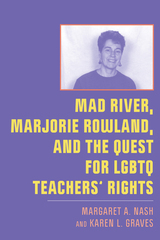
In the first in-depth treatment of this foundational legal case, authors Margaret A. Nash and Karen L. Graves tell the story of that case and of Marjorie Rowland, the pioneer who fought for employment rights for LGBTQ educators and who paid a heavy price for that fight. It brings the story of LGBTQ educators’ rights to the present, including commentary on Bostock v Clayton County, the 2020 Supreme Court case that struck down employment discrimination against LGBT workers.
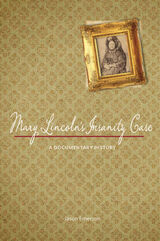
In 1875 Mary Lincoln, the widow of a revered president, was committed to an insane asylum by her son, Robert. The trial that preceded her internment was a subject of keen national interest. The focus of public attention since Abraham Lincoln's election in 1860, Mary Lincoln had attracted plentiful criticism and visible scorn from much of the public, who perceived her as spoiled, a spendthrift, and even too much of a Southern sympathizer. Widespread scrutiny only increased following her husband's assassination in 1865 and her son Tad's death six years later, after which her overwhelming grief led to the increasingly erratic behavior that led to her being committed to a sanitarium. A second trial a year later resulted in her release, but the stigma of insanity stuck. In the years since, questions emerged with new force, as the populace and historians debated whether she had been truly insane and subsequently cured, or if she was the victim of family maneuvering.
In this volume, noted Lincoln scholar Jason Emerson provides a documentary history of Mary Lincoln's mental illness and insanity case, evenhandedly presenting every possible primary source on the subject to enable a clearer view of the facts. Beginning with documents from the immediate aftermath of her husband's assassination and ending with reminiscences by friends and family in the mid-twentieth century, Mary Lincoln's Insanity Case: A Documentary History compiles more than one hundred letters, dozens of newspaper articles, editorials, and legal documents, and the daily patient progress reports from Bellevue Place Sanitarium during Mary Lincoln's incarceration. Including many materials that have never been previously published, Emerson also collects multiple reminiscences, interviews, and diaries of people who knew Mary Lincoln or were involved in the case, including the first-hand recollection of one of the jurors in the 1875 insanity trial.
Suggesting neither accusation nor exoneration of the embattled First Lady, Mary Lincoln's Insanity Case: A Documentary History gives scholars and history enthusiasts incomparable access to the documents and information crucial to understanding this vexing chapter in American history.
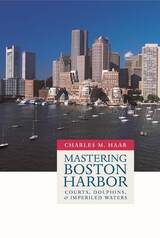
Mastering Boston Harbor chronicles how America's most glorious and historically significant harbor was rescued from decades of pollution and neglect by a community of caring citizens who were linked to an environmentally committed judge and his special harbor master. This dynamic public-private team shaped novel legal and political procedures for governing and restoring the harbor.
Charles Haar provides a fascinating study of the convergence of judicial supervision with political, environmental, financial, and technological interests. He challenges those who will instantly decry an "activist" judiciary and pulls back the curtain on the serious problems a court faces when it must grapple with an intractable problem affecting public interest. Haar demonstrates that at times only a resolute judiciary can energize and coordinate the branches of government to achieve essential contemporary social goals--goals that are endorsed and supported by a majority whose voice is often ignored in legislative and executive back rooms.
Because of his experience as special master in the dispute, Haar provides the reader with an insider's view of a modern brand of judicial decision-making that is not anti-majoritarian, and could be applied to similar crises in which the legislative and executive branches of government are impotent. Citizens concerned about the conflict between unbridled economic liberty and environmental protection will gain important insight from this eyewitness account of how the "harbor of shame" became a vibrant focal point for the renewal of Boston as a world-class city.
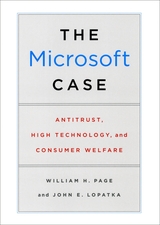
In 1998, the United States Department of Justice and state antitrust agencies charged that Microsoft was monopolizing the market for personal computer operating systems. More than ten years later, the case is still the defining antitrust litigation of our era. William H. Page and John E. Lopatka’s The Microsoft Case contributes to the debate over the future of antitrust policy by examining the implications of the litigation from the perspective of consumer welfare.
The authors trace the development of the case from its conceptual origins through the trial and the key decisions on both liability and remedies. They argue that, at critical points, the legal system failed consumers by overrating government’s ability to influence outcomes in a dynamic market. This ambitious book is essential reading for business, law, and economics scholars as well as anyone else interested in the ways that technology, economics, and antitrust law have interacted in the digital age.
“This book will become the gold standard for analysis of the monopolization cases against Microsoft. . . . No serious student of law or economic policy should go without reading it.”—Thomas C. Arthur, Emory University
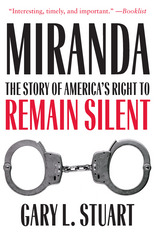
Ernesto Miranda was an uneducated Hispanic man arrested in 1963 in connection with a series of sexual assaults, to which he confessed within hours. He was convicted not on the strength of eyewitness testimony or physical evidence but almost entirely because he had incriminated himself without knowing it—and without knowing that he didn’t have to. Miranda’s lawyers, John P. Frank and John F. Flynn, were among the most prominent in the state, and their work soon focused the entire country on the issue of their client’s rights. A 1966 Supreme Court decision held that Miranda’s rights had been violated and resulted in the now-famous "Miranda warnings."
Stuart personally knows many of the figures involved in Miranda, and here he unravels its complex history, revealing how the defense attorneys created the argument brought before the Court and analyzing the competing societal interests involved in the case. He considers Miranda's aftermath—not only the test cases and ongoing political and legal debate but also what happened to Ernesto Miranda. He then updates the story to the Supreme Court’s 2000 Dickerson decision upholding Miranda and considers its implications for cases in the wake of 9/11 and the rights of suspected terrorists. Interviews with 24 individuals directly concerned with the decision—lawyers, judges, and police officers, as well as suspects, scholars, and ordinary citizens—offer observations on the case’s impact on law enforcement and on the rights of the accused.
Ten years after the decision in the case that bears his name, Ernesto Miranda was murdered in a knife fight at a Phoenix bar, and his suspected killer was "Mirandized" before confessing to the crime. Miranda: The Story of America’s Right to Remain Silent considers the legacy of that case and its fate in the twenty-first century as we face new challenges in the criminal justice system.
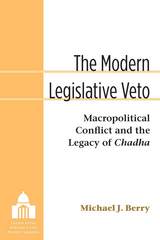
Berry argues that, since the U.S. Supreme Court declared the legislative veto unconstitutional in Immigration and Naturalization Service (INS) v. Chadha (1983), Congress has strategically modified its use of the veto to give more power to appropriations committees. Using an original dataset of legislative veto enactments, Berry finds that Congress has actually increased its use of this oversight mechanism since Chadha, especially over defense and foreign policy issues. Democratic and Republican presidents alike have fought back by vetoing legislation containing legislative vetoes and by using signing statements with greater frequency to challenge the legislative veto’s constitutionality. A complementary analysis of state-level use of the legislative veto finds variation in oversight powers granted to state legislatures, but similar struggles between the legislature and the executive.
This ongoing battle over the legislative veto points to broader efforts by legislative and executive actors to control policy, efforts that continually negotiate how the democratic republic established by the Constitution actually operates in practice.
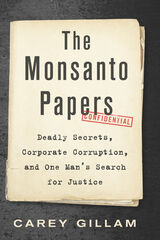
The Monsanto Papers is the inside story of Lee Johnson’s landmark lawsuit against Monsanto. For Lee, the case was a race against the clock, with doctors predicting he wouldn’t survive long enough to take the witness stand. For the eclectic band of young, ambitious lawyers representing him, it was a matter of professional pride and personal risk, with millions of dollars and hard-earned reputations on the line. For the public at large, the lawsuit presented a question of corporate accountability. With enough money and influence, could a company endanger its customers, hide evidence, manipulate regulators, and get away with it all—for decades?
Readers will be astounded by the depth of corruption uncovered, captivated by the shocking twists, and moved by Lee’s quiet determination to see justice served. With gripping narrative force that reads like fiction, The Monsanto Papers takes readers behind the scenes of a grueling legal battle, pulling back the curtain on the frailties of the American court system and the lengths to which lawyers will go to fight corporate wrongdoing.
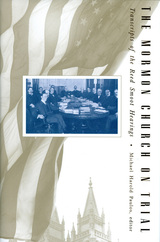
However, Senators did want to know about the LDS Church’s controversial practice of polygamy, especially since 1890 when the practice was formally abandoned. Surprisingly, Church President Joseph F. Smith admitted that he had fathered eleven children by five wives since 1890. Asked about his role in receiving revelations for the church, Smith replied that he had received none thus far. Other questions probed the church’s involvement in politics, including action taken by the church against Apostle Moses Thatcher for saying that “Satan was the author of the Republican Party.”
To a large extent, the Mormon Church, not Senator Smoot, was the real target of the Senate’s scrutiny. Some felt uncomfortable about this emphasis. Senator Bailey (D-Tx) “objected to going into the religious opinions of these people. I do not think Congress has anything to do with that unless their religion connects itself in some way with their civil or political affairs.” But Smoot’s critics proceeded to show a convoluted tangle of Utah business, political, and religious affairs and what they considered to be un-American religious supremacy in all areas. They argued that a Senator “legislates for 80 million people who hold as their most cherished possession … a respect for law because it is law, as Reed Smoot, unhappily for him, has never felt nor understood from the moment of his first conscious thought down to the present hour. ”
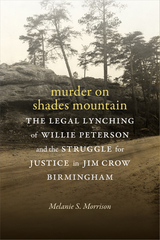
In Murder on Shades Mountain Melanie S. Morrison tells the gripping and tragic story of the attack and its aftermath—events that shook Birmingham to its core. Having first heard the story from her father—who dated Nell's youngest sister when he was a teenager—Morrison scoured the historical archives and documented the black-led campaigns that sought to overturn Peterson's unjust conviction, spearheaded by the NAACP and the Communist Party. The travesty of justice suffered by Peterson reveals how the judicial system could function as a lynch mob in the Jim Crow South. Murder on Shades Mountain also sheds new light on the struggle for justice in Depression-era Birmingham. This riveting narrative is a testament to the courageous predecessors of present-day movements that demand an end to racial profiling, police brutality, and the criminalization of black men.
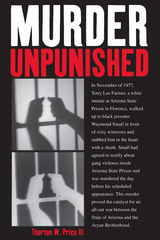
Thornton Price, one of the defense attorneys, now tells how Farmer and Small became cannon fodder in this war to reclaim Arizona’s prisons from rival gangs. These gangs—the Aryan Brotherhood, the Mau Maus, and the Mexican Mafia—were suspected of committing more than a dozen murders over the previous two years, motivating politicians to crack down after the violence could no longer be ignored or contained. To reconstruct the case, Price reviewed 16,000 pages of court records and conducted interviews with key participants to piece together an insider’s account of the crime and the politics behind its investigation. Prison murders should be easy to solve, but investigators quickly learned that the convicts’ code of silence makes these cases often impossible to win in court.
Price focuses on the special problems posed by prison crime by getting inside the skins of men like murderer Terry "Crazy" Farmer and William "Red Dog" Howard, one of the Florence Eleven and a founder of the Aryan Brotherhood. He also presents the perspectives of state investigators and reveals how they calculated to pit black witnesses against white killers until one black would break the code of silence and provoke feuding within the Brotherhood.
Murder Unpunished tells how society’s most outrageous criminals ran the prison through gang violence as outside the walls Arizona struggled to outgrow its Wild West past. Like few other books, it reveals how prisons incubate predatory criminals and gangs, and it exposes the unique difficulties of prosecuting prison crimes. It is a gripping account that cuts to the heart of our penal system and a cautionary tale for citizens who prefer to keep prisons out of sight, out of mind.
READERS
Browse our collection.
PUBLISHERS
See BiblioVault's publisher services.
STUDENT SERVICES
Files for college accessibility offices.
RECENTLY PUBLISHED


UChicago Accessibility Resources
home | accessibility | search | about | contact us
BiblioVault ® 2001 - 2024
The University of Chicago Press