
 A SCHOLARLY BOOK REPOSITORY

By bringing instances of Afro-Asian traffic in the realms of politics, economics, and culture to the foreground, this collection maps an alternative global circuit. The issue examines the non-Eurocentric form of cosmopolitanism that emerged from creative encounters of racialized people in Jazz Age Paris, the Harlem Renaissance, and colonial Shanghai. It reconceptualizes the Indian Ocean as a crucial site for Afro-Asian cross-pollination and investigates the cinematic culture of kung fu as a global discourse of Afro-Asian anti-imperialism.
Contributors. Brent Edwards, Andrew F. Jones, Yukiko Koshiro, Bill Mullen, Vijay Prashad, William Schaefer, Nikhil Pal Singh, Françoise Vergès, Daniel Widener
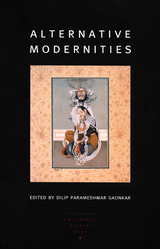
The idea of “alternative modernities” holds that modernity always unfolds within specific cultures or civilizations and that different starting points of the transition to modernity lead to different outcomes. Without abandoning the Western discourse on the subject, the contributors to this volume write from the standpoint that modernity is in truth a richly mulitiplicitous concept. Believing that the language and lessons of Western modernity must be submitted to comparative study of its global receptions, they focus on such sites as China, Russia, India, Trinidad, and Mexico. Other essays treat more theoretical aspects of modernity, such as its self-understanding and the potential reconcilability of cosmopolitanism and diversity.
Contributors. Homi Bhabha, William Cunningham Bissell, Dipesh Chakrabarty, Dilip Parameshwar Gaonkar, Michael Hanchard, Beatriz Jaguaribe, Leo Ou-fan Lee, Claudio Lomnitz, Thomas McCarthy, Tejaswini Niranjana, Elizabeth A. Povinelli, Shahzia Sikander, Charles Taylor, Andrew Wachtel

By focusing on clothing and body practices in East Asia, this collection delves into the dynamic interplay between global trade, images, products, and standards as mediated through and on individual bodies. It investigates what fashion means in the Asian context, past and present, and enters into the debate on fashion as a modern phenomenon predicated upon capitalism and consumerism. One contributor critically assesses ideas about the proper proportions and display of breasts—including implants and other nonsurgical practices for enhancement—in Japan and how such norms may be affected and altered by the spread of a global Euro-American beauty ideology. Another essay debates the influence of globalization and cultural localization on the emergence and popularity of exposed short stockings in China. Fabrications also features a translation of Eileen Chang’s classic article "Chronicle of Changing Clothes," which has defined thinking on Chinese fashion since the 1920s.
Contributors. Peter Carroll, Tina Mai Chen, Matthew Chew, Antonia Finnane, Henrietta Harrison, Andrew Jones, Laura Miller, Henrietta Harrison, Paola Zamperini
Volume 11 addresses the development of marine resources, along with recent transportation, communication, marine science, and technology developments. Twenty-four articles focus on such topics as sea-based nuclear issues, regional cooperation, transport of liquefied natural gas, along with an analysis of the UN conference on Straddling and Highly Migratory Fish Stocks.
Included are "Gender, Culture, and Astrophysical Fieldwork: Elizabeth Campbell and the Lick Observatory-Crocker Eclipse Expeditions," by Alex Soo-jung-Kim Pang; "Wallace in Other Lands," by Jane Camerini; "The Heroic Science of Glacier Motion," by Bruce Hevly; "Objectivity or Heroism: Invisibility of Women in Science," by Naomi Oreskes; "When Nature is the Zoo: Vision and Power in the Art and Science of Natural History," by Gregg Mitman; "Manly Men in Scientific Balloons: Meteorology and the Victorian Scientist as Romantic Hero," by Jennifer Tucker; "Paul du Chaillu and Construction of Authority," by Stuart McCook; "Of Sangfroid and Sphinx Moths: Cruelty, Public Relations, and Entomology, 1800-1840," by Anne Larsen Hollerbach; "The Ship as a Scientific Instrument in the 18th Century," by Richard Sorrenson; and "'A Tent with a View:' Colonial Officers, Anthropologists, and the Making of the Field in Northern Rhodesia, 1937-1960," by Lynette Schumaker.

Playwrights for Tomorrow was first published in 1973. Minnesota Archive Editions uses digital technology to make long-unavailable books once again accessible, and are published unaltered from the original University of Minnesota Press editions.
This volume presents four plays by writers who have worked under the program of the Office for Advanced Drama Research (O.A.D.R.) at the University of Minnesota, an experimental project which provides promising playwrights with the opportunity of working with cooperating theatres in the production of their plays. Arthur H. Ballet, the editor, is director of the
O.A.D.R.
The plays in this volume and the theatres which cooperated in their production are Boxes by Susan Yankowitz, Magic Theatre, Berkeley, California; Canvas by David Roszkowski, Scorpio Rising Theatre, Los Angeles; Bierce Takes on the Railroad! by Philip A. Bosakowski, Theatre III, College of Marin, Kentfield, California; and Chamber Piece by John O'Keefe, Magic Theatre, Berkeley, California.
In an introduction Professor Ballet discussed the program and accomplishments of the O. A.D.R., which was established with the aid of a Rockefeller Foundation grant. He writes: "It seemed obvious that no artist worked in more lonely isolation and needed more direct contact with the theatre than the playwright. Despite loud pronouncements . . . that theatres outside of New York were searching for new plays and writers, the evidence indicates that very few theatres really wanted to work with unknown but living playwrights. The O.A.D.R., in its small way, has tried to open a highway . . . between new, often untried writers and willing, even brave theatres.
As Speech and Drama (England) pointed out in a review of earlier volumes of the Playwrights for Tomorrow series: "Schemes like this one at Minnesota deserve the highest praise. On the evidence of these volumes, the executive committee which operates this venture is not attempting to impose any single imprint on its authors—a further example of the generosity of the patronage."

READERS
Browse our collection.
PUBLISHERS
See BiblioVault's publisher services.
STUDENT SERVICES
Files for college accessibility offices.
RECENTLY PUBLISHED



UChicago Accessibility Resources
home | accessibility | search | about | contact us
BiblioVault ® 2001 - 2024
The University of Chicago Press