
 A SCHOLARLY BOOK REPOSITORY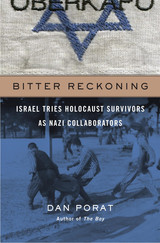
Beginning in 1950, the state of Israel prosecuted and jailed dozens of Holocaust survivors who had served as camp kapos or ghetto police under the Nazis. At last comes the first full account of the kapo trials, based on records newly declassified after forty years.
In December 1945, a Polish-born commuter on a Tel Aviv bus recognized a fellow rider as the former head of a town council the Nazis had established to manage the Jews. When he denounced the man as a collaborator, the rider leapt off the bus, pursued by passengers intent on beating him to death. Five years later, to address ongoing tensions within Holocaust survivor communities, the State of Israel instituted the criminal prosecution of Jews who had served as ghetto administrators or kapos in concentration camps.
Dan Porat brings to light more than three dozen little-known trials, held over the following two decades, of survivors charged with Nazi collaboration. Scouring police investigation files and trial records, he found accounts of Jewish policemen and camp functionaries who harassed, beat, robbed, and even murdered their brethren. But as the trials exposed the tragic experiences of the kapos, over time the courts and the public shifted from seeing them as evil collaborators to victims themselves, and the fervor to prosecute them abated.
Porat shows how these trials changed Israel’s understanding of the Holocaust and explores how the suppression of the trial records—long classified by the state—affected history and memory. Sensitive to the devastating options confronting those who chose to collaborate, yet rigorous in its analysis, Bitter Reckoning invites us to rethink our ideas of complicity and justice and to consider what it means to be a victim in extraordinary circumstances.
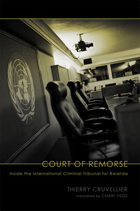
Fascinated by the Tribunal’s rich complexities, journalist Thierry Cruvellier came back day after day to watch the proceedings, spending more time there than any other outside observer. Gradually he gained the confidence of the victims, defendants, lawyers, and judges. Drawing on interviews with these protagonists and his close observations of their interactions, Cruvellier takes readers inside the courtroom to witness the motivations, mechanisms, and manipulations of justice as it unfolded on the stage of high-stakes, global politics. It is this ground-level view that makes his account so valuable—and so absorbing. A must-read for those who want to understand the dynamics of international criminal tribunals, Court of Remorse reveals both the possibilities and the challenges of prosecuting human rights violations.
Best Books for General Audiences, selected by the American Association for School Libraries and the Public Library Association
Best Books for High Schools, selected by the American Association for School Libraries
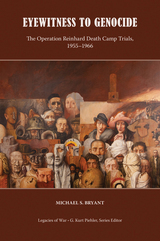
produced three major death camps—Belzec, Treblinka, and Sobibor—which claimed the
lives of 1.8 million Jews. In the 1960s, a small measure of justice came for those victims
when a score of defendants who had been officers and guards at the camps were convicted
of war crimes in West German courts. The conviction rates varied, however. While all but
one of fourteen Treblinka defendants were convicted, half of the twelve Sobibor defendants
escaped punishment, and only one of eight Belzec defendants was convicted. Also,
despite the enormity of the crimes, the sentences were light in many cases, amounting to
only a few years in prison.
In this meticulous history of the Operation Reinhard trials, Michael S. Bryant examines
a disturbing question: Did compromised jurists engineer acquittals or lenient punishments
for proven killers? Drawing on rarely studied archival sources, Bryant concludes
that the trial judges acted in good faith within the bounds of West German law. The key
to successful prosecutions was eyewitness testimony. At Belzec, the near-total efficiency
of the Nazi death machine meant that only one survivor could be found to testify. At Treblinka
and Sobibor, however, prisoner revolts had resulted in a number of survivors who
could give firsthand accounts of specific atrocities and identify participants. The courts,
Bryant finds, treated these witnesses with respect and even made allowances for conflicting
testimony. And when handing down sentences, the judges acted in accordance with
strict legal definitions of perpetration, complicity, and action under duress.
Yet, despite these findings, Bryant also shows that West German legal culture was
hardly blameless during the postwar era. Though ready to convict the mostly workingclass
personnel of the death camps, the Federal Republic followed policies that insulated
the judicial elite from accountability for its own role in the Final Solution. While trial
records show that the “bias” of West German jurists was neither direct nor personal, the
structure of the system ensured that lawyers and judges themselves avoided judgment.

Human Rights after Hitler reveals thousands of forgotten US and Allied war crimes prosecutions against Hitler and other Axis war criminals based on a popular movement for justice that stretched from Poland to the Pacific. These cases provide a great foundation for twenty-first-century human rights and accompany the achievements of the Nuremberg trials and postwar conventions. They include indictments of perpetrators of the Holocaust made while the death camps were still operating, which confounds the conventional wisdom that there was no official Allied response to the Holocaust at the time. This history also brings long overdue credit to the United Nations War Crimes Commission (UNWCC), which operated during and after World War II.
From the 1940s until a recent lobbying effort by Plesch and colleagues, the UNWCC’s files were kept out of public view in the UN archives under pressure from the US government. The book answers why the commission and its files were closed and reveals that the lost precedents set by these cases have enormous practical utility for prosecuting war crimes today. They cover US and Allied prosecutions of torture, including “water treatment,” wartime sexual assault, and crimes by foot soldiers who were “just following orders.” Plesch’s book will fascinate anyone with an interest in the history of the Second World War as well as provide ground-breaking revelations for historians and human rights practitioners alike.
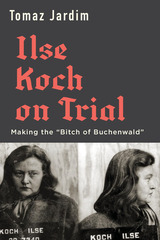
An authoritative reassessment of one of the Third Reich’s most notorious war criminals, whose alleged sexual barbarism made her a convenient scapegoat and obscured the true nature of Nazi terror.
On September 1, 1967, one of the Third Reich’s most infamous figures hanged herself in her cell after nearly twenty-four years in prison. Known as the “Bitch of Buchenwald,” Ilse Koch was singularly notorious, having been accused of owning lampshades fabricated from skins of murdered camp inmates and engaging in “bestial” sexual behavior. These allegations fueled a public fascination that turned Koch into a household name and the foremost symbol of Nazi savagery. Her subsequent prosecution resulted in a scandal that prompted US Senate hearings and even the intervention of President Truman.
Yet the most sensational atrocities attributed to Koch were apocryphal or unproven. In this authoritative reappraisal, Tomaz Jardim shows that, while Koch was guilty of heinous crimes, she also became a scapegoat for postwar Germans eager to distance themselves from the Nazi past. The popular condemnation of Koch—and the particularly perverse crimes attributed to her by prosecutors, the media, and the public at large—diverted attention from the far more consequential but less sensational complicity of millions of ordinary Germans in the Third Reich’s crimes.
Ilse Koch on Trial reveals how gendered perceptions of violence and culpability drove Koch’s zealous prosecution at a time when male Nazi perpetrators responsible for greater crimes often escaped punishment or received lighter sentences. Both in the international press and during her three criminal trials, Koch was condemned for her violation of accepted gender norms and “good womanly behavior.” Koch’s “sexual barbarism,” though treated as an emblem of the Third Reich’s depravity, ultimately obscured the bureaucratized terror of the Nazi state and hampered understanding of the Holocaust.
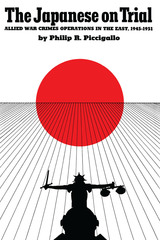
This comprehensive treatment of post–World War II Allied war crimes trials in the Far East is a significant contribution to a neglected subject. While the Nuremberg and, to a lesser degree, Tokyo tribunals have received considerable attention, this is the first full-length assessment of the entire Far East operation, which involved some 5,700 accused and 2,200 trials.
After discussing the Tokyo trial, Piccigallo systematically examines the operations of each Allied nation, documenting procedure and machinery as well as the details of actual trials (including hitherto unpublished photographs) and ending with a statistical summary of cases.
This study allows a completely new assessment of the Far East proceedings: with a few exceptions, the trials were carefully and fairly conducted, the efforts of defense counsel and the elaborate review procedures being especially noteworthy. Piccigallo’s approach to this emotion-filled subject is straightforward and evenhanded throughout. He concludes with a discussion of the broader implications of such war crimes trials, a matter of interest to the general reader as well as to specialists in history, law, and international affairs.
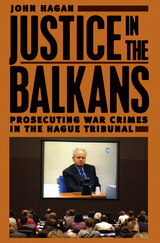
Creating an institution that transcends national borders is a challenge fraught with political and organizational difficulties, yet, as Hagan describes here, the Hague tribunal has increasingly met these difficulties head-on and overcome them. The chief reason for its success, he argues, is the people who have shaped it, particularly its charismatic chief prosecutor, Louise Arbour. With drama and immediacy, Justice in the Balkans re-creates how Arbour worked with others to turn the tribunal's fortunes around, reversing its initial failure to arrest and convict significant figures and advancing the tribunal's agenda to the point at which Arbour and her colleagues, including her successor, Carla Del Ponte (nicknamed the Bulldog), were able to indict Milosevic himself. Leading readers through the investigations and criminal proceedings of the tribunal, Hagan offers the most original account of the foundation and maturity of the institution.
Justice in the Balkans brilliantly shows how an international social movement for human rights in the Balkans was transformed into a pathbreaking legal institution and a new transnational legal field. The Hague tribunal becomes, in Hagan's work, a stellar example of how individuals working with collective purpose can make a profound difference.
"The Hague tribunal reaches into only one house of horrors among many; but, within the wisely precise remit given to it, it has beamed the light of justice into the darkness of man's inhumanity, to woman as well as to man."—The Times (London)
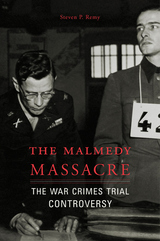
During the Battle of the Bulge, Waffen SS soldiers shot 84 American prisoners near the Belgian town of Malmedy—the deadliest mass execution of U.S. soldiers during World War II. The bloody deeds of December 17, 1944, produced the most controversial war crimes trial in American history. Drawing on newly declassified documents, Steven Remy revisits the massacre—and the decade-long controversy that followed—to set the record straight.
After the war, the U.S. Army tracked down 74 of the SS men involved in the massacre and other atrocities and put them on trial at Dachau. All the defendants were convicted and sentenced to death or life imprisonment. Over the following decade, however, a network of Germans and sympathetic Americans succeeded in discrediting the trial. They claimed that interrogators—some of them Jewish émigrés—had coerced false confessions and that heat of battle conditions, rather than superiors’ orders, had led to the shooting. They insisted that vengeance, not justice, was the prosecution’s true objective. The controversy generated by these accusations, leveled just as the United States was anxious to placate its West German ally, resulted in the release of all the convicted men by 1957.
The Malmedy Massacre shows that the torture accusations were untrue, and the massacre was no accident but was typical of the Waffen SS’s brutal fighting style. Remy reveals in unprecedented depth how German and American amnesty advocates warped our understanding of one of the war’s most infamous crimes through a systematic campaign of fabrications and distortions.
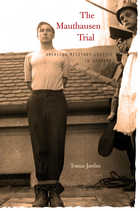
Shortly after 9:00 a.m. on May 27, 1947, the first of forty-nine men condemned to death for war crimes at Mauthausen concentration camp mounted the gallows at Landsberg prison near Munich. The mass execution that followed resulted from an American military trial conducted at Dachau in the spring of 1946—a trial that lasted only thirty-six days and yet produced more death sentences than any other in American history.
The Mauthausen trial was part of a massive series of proceedings designed to judge and punish Nazi war criminals in the most expedient manner the law would allow. There was no doubt that the crimes had been monstrous. Yet despite meting out punishment to a group of incontestably guilty men, the Mauthausen trial reveals a troubling and seldom-recognized face of American postwar justice—one characterized by rapid proceedings, lax rules of evidence, and questionable interrogations.
Although the better-known Nuremberg trials are often regarded as epitomizing American judicial ideals, these trials were in fact the exception to the rule. Instead, as Tomaz Jardim convincingly demonstrates, the rough justice of the Mauthausen trial remains indicative of the most common—and yet least understood—American approach to war crimes prosecution. The Mauthausen Trial forces reflection on the implications of compromising legal standards in order to guarantee that guilty people do not walk free.
The Japanese Army committed numerous atrocities during its pitiless campaigns in China from 1931 to 1945. When the Chinese emerged victorious with the Allies at the end of World War II, many seemed ready to exact retribution for these crimes. Rather than resort to violence, however, they chose to deal with their former enemy through legal and diplomatic means. Focusing on the trials of, and policies toward, Japanese war criminals in the postwar period, Men to Devils, Devils to Men analyzes the complex political maneuvering between China and Japan that shaped East Asian realpolitik during the Cold War.
Barak Kushner examines how factions of Nationalists and Communists within China structured the war crimes trials in ways meant to strengthen their competing claims to political rule. On the international stage, both China and Japan propagandized the tribunals, promoting or blocking them for their own advantage. Both nations vied to prove their justness to the world: competing groups in China by emphasizing their magnanimous policy toward the Japanese; Japan by openly cooperating with postwar democratization initiatives. At home, however, Japan allowed the legitimacy of the war crimes trials to be questioned in intense debates that became a formidable force in postwar Japanese politics.
In uncovering the different ways the pursuit of justice for Japanese war crimes influenced Sino-Japanese relations in the postwar years, Men to Devils, Devils to Men reveals a Cold War dynamic that still roils East Asian relations today.
Chamberlain highlights the differing views of Filipinos and Japanese about the trials. The Philippine government aimed to show its commitment to impartial proceedings with just outcomes. In Japan, it appeared that defendants were selected arbitrarily, judges and prosecutors were biased, and lower-ranking soldiers were punished for crimes ordered by their superior officers. She analyzes the broader implications of this divergence as bilateral relations between the two nations evolved and contends that these competing narratives were reimagined in a way that, paradoxically, aided a path toward postwar reconciliation.
In marked contrast to other massacres, the Horthy regime investigated the incident and tried and convicted the commanding officers in 1943-44. Other trials would follow. During the 1960s, a novel and film telling the story of the massacre sparked the first public open debate about the Hungarian Holocaust.
This book examines public contentions over the Novi Sad massacre from its inception in 1942 until the final trial in 2011. It demonstrates how attitudes changed over time toward this war crime and the Holocaust through different political regimes and in Hungarian society. The book also views how the larger European context influenced Hungarian debates, and how Yugoslavia dealt with memories of the massacre.
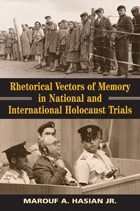
During the past several decades, the twentieth century Holocaust has become a defining event in many histories. This newfound respect for the Judeocide has been cathartic for both individuals and communities, in that it provides evidence that audiences around the world are rethinking the significance of the World War II narratives of bystanders, perpetrators, and victims. Given the complexities of these issues, scholars who are interested in studying Holocaust memory make choices about the questions on which they focus, the artifacts they select for analysis, and the perspectives they want to present.
Hasian reviews how national and international courts have used Holocaust trials as forums for debates about individuated justice, historical record keeping, and pedagogical memory work. He concludes that the trials involving Auschwitz, Demjanjuk, Eichmann, Finta, Nuremberg, Irving, Kastner, Keegstra, Sawoniuk, and Zündel are highly problematic. The author provides a rhetorical analysis of holocaust trials as a way of looking into the question of what role court proceedings play in the creation of Holocaust collective memories.
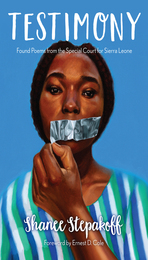
Sierra Leone’s devastating civil war barely caught the attention of Western media, but it raged on for over a decade, bringing misery to millions of people in West Africa from 1991 to 2002. The atrocities committed in this war and the accounts of its survivors were duly recorded by international organizations, but they run the risk of being consigned to dusty historical archives.
Derived from public testimonies at a UN-backed war crimes tribunal in Freetown, this remarkable poetry collection aims to breathe new life into the records of Sierra Leone’s civil war, delicately extracting heartbreaking human stories from the morass of legal jargon. By rendering selected trial transcripts in poetic form, Shanee Stepakoff finds a novel way to communicate not only the suffering of Sierra Leone’s people, but also their courage, dignity, and resilience. Her use of innovative literary techniques helps to ensure that the voices of survivors are not forgotten, but rather heard across the world.
This volume also includes an introduction that explores how the genre of “found poetry” can serve as a uniquely powerful means through which writers may bear witness to atrocity. This book’s unforgettable excavation and shaping of survivor testimonies opens new possibilities for speaking about the unspeakable.

This book assesses the historical significance of the International Military Tribunal for the Far East (IMTFE)—commonly called the Tokyo trial—established as the eastern counterpart of the Nuremberg trial in the immediate aftermath of World War II.
Through extensive research in Japanese, American, Australian, and Indian archives, Yuma Totani taps into a large body of previously underexamined sources to explore some of the central misunderstandings and historiographical distortions that have persisted to the present day. Foregrounding these voluminous records, Totani disputes the notion that the trial was an exercise in “victors’ justice” in which the legal process was egregiously compromised for political and ideological reasons; rather, the author details the achievements of the Allied prosecution teams in documenting war crimes and establishing the responsibility of the accused parties to show how the IMTFE represented a sound application of the legal principles established at Nuremberg.
This study deepens our knowledge of the historical intricacies surrounding the Tokyo trial and advances our understanding of the Japanese conduct of war and occupation during World War II, the range of postwar debates on war guilt, and the relevance of the IMTFE to the continuing development of international humanitarian law.
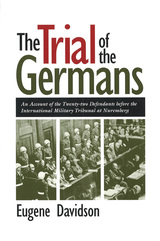
The "definitive one-volume study of Nuremberg," The Trial of the Germans is now available in paperback. An astute observer of the Nuremberg trial, Eugene Davidson has struggled with the issues it raised: Was it a necessary response to the heinous crimes of the Third Reich? How were Germany and the Germans capable of such extraordinary evil? Was the trial just, given the claims that the defendants were simply serving their country, doing as they had been told to do? And if not just, was it nonetheless necessary as a warning to prevent future crimes against humanity? Davidson's approach to these and other large questions of justice is made through examination of each of the defendants in the trial. His reluctant, but firm, conclusion is: "In a world of mixed human affairs where a rough justice is done that is better than lynching or being shot out of hand, Nuremberg may be defended as a political event if not as a court." Some sentences may have seemed too severe, but none was harsher than the punishments meted out to innocent people by the regime these men served. "In a certain sense," says Davidson, "the trial succeeded in doing what judicial proceedings are supposed to do: it convinced even the guilty that the verdict against them was just."
Faulty as the trial was from the legal point of view, a catharsis of the pent-up emotions of millions of people had to be provided and a record of what had taken place duly preserved for whatever use later generations would make of it.
READERS
Browse our collection.
PUBLISHERS
See BiblioVault's publisher services.
STUDENT SERVICES
Files for college accessibility offices.
RECENTLY PUBLISHED



UChicago Accessibility Resources
home | accessibility | search | about | contact us
BiblioVault ® 2001 - 2024
The University of Chicago Press