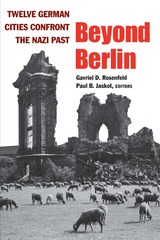
front cover of Beyond Berlin
Beyond Berlin
Twelve German Cities Confront the Nazi Past
Gavriel D. Rosenfeld and Paul B. Jaskot, Editors
University of Michigan Press, 2015

Beyond Berlin breaks new ground in the ongoing effort to understand how memorials, buildings, and other spaces have figured in Germany's confrontation with its Nazi past. The contributors challenge reigning views of Germany's postwar memory work by examining how specific urban centers apart from the nation's capital have wrestled with their respective Nazi legacies. A wide range of West and East German cities is profiled in the volume: prominent metropolises like Hamburg, dynamic regional centers like Dresden, gritty industrial cities like Wolfsburg, and idyllic rural towns like Quedlinburg. In employing historical, art historical, anthropological, and geographical methodologies to examine these and other important urban centers, the volume's case studies shed new light upon the complex ways in which the confrontation with the Nazi past has directly shaped the German urban landscape since the end of the Second World War.

"Beyond Berlin is one of the most fascinating, deeply probing collections ever published on Germany's ongoing confrontation with its Nazi past. Its editors, Gavriel Rosenfeld and Paul Jaskot, have taken the exploration of Germany's urban memorial landscape to its highest level yet."
---James E. Young, Professor and Chair, Department of Judaic and Near Eastern Studies, University of Massachusetts Amherst, and author of The Texture of Memory and At Memory's Edge

"This is a top-notch collection of essays that positions itself in the populated field of memory studies by bringing together original contributions representing the best of new scholarship on architecture, urban design, monuments, and memory in East and West Germany. Taken together, the essays remind readers that the Nazi past is always present when German architects, urban planners, and politicians make decisions to tear down, rebuild, restore, and memorialize."
---S. Jonathan Wiesen, Department of History, Southern Illinois University, Carbondale

[more]

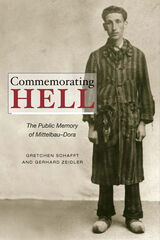
front cover of Commemorating Hell
Commemorating Hell
The Public Memory of Mittelbau-Dora
Gretchen Schafft and Gerhard Zeidler
University of Illinois Press, 2011
This powerful, wide-ranging history of the Nazi concentration camp Mittelbau-Dora is the first book to analyze how memory of the Third Reich evolved throughout changes in the German regime from World War II to the present. Building on intimate knowledge of the history of the camp, where a third of the 60,000 prisoners did not survive the war, Gretchen Schafft and Gerhard Zeidler examine the political and cultural aspects of the camp's memorialization in East Germany and, after 1989, in unified Germany.

Prisoners at Mittelbau-Dora built the V-1 and V-2 missiles, some of them coming into direct contact with Wernher von Braun and Arthur Rudolph, who later became leading engineers in the U.S. space program. Through the continuing story of Mittelbau-Dora, from its operation as a labor camp to its social construction as a monument, Schafft and Zeidler reflect an abiding interest in the memory and commemoration of notorious national events. In extending the analysis of Mittelbau-Dora into post-war and present-day Germany, Commemorating Hell uncovers the intricate relationship between the politics of memory and broader state and global politics, revealing insights about the camp's relationship to the American space pioneers and the fate of the nearby city of Nordhausen.
[more]

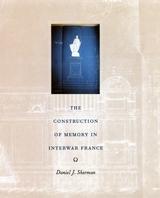
front cover of The Construction of Memory in Interwar France
The Construction of Memory in Interwar France
Daniel J. Sherman
University of Chicago Press, 2000
One of the bloodiest conflicts in human history, World War I devastated France, leaving behind battlefields littered with the remains of the dead. Daniel Sherman takes a close look at the human impact of this Great War by examining the ways in which the French remembered their veterans and war dead after the armistice. Arguing that memory is more than just a record of experience, Sherman's cultural history offers a radically new perspective on how commemoration of WWI helped to shape postwar French society and politics.

Sherman shows how a wartime visual culture saturated with images of ordinary foot soldiers, together with contemporary novels, memoirs, and tourist literature, promoted a distinctive notion of combat experience. The contrast between battlefield and home front, soldier and civilian was the basis for memory and collective gratitude. Postwar commemoration, however, also grew directly out of the long and agonized search for the remains of hundreds of thousands of missing soldiers, and the sometimes contentious debates over where to bury them. For this reason, the local monument, with its inscribed list of names and its functional resemblance to tombstones, emerged as the focal point of commemorative practice. Sherman traces every step in the process of monument building as he analyzes commemoration's competing goals—to pay tribute to the dead, to console the bereaved, and to incorporate mourners' individual memories into a larger political discourse.

Extensively illustrated, Sherman's study offers a visual record of a remarkable moment in the history of public art. It is at once a moving account of a culture haunted by war and a sophisticated analysis of the political stakes of memory in the twentieth century.

Winner of the 2000 J. Russell Major Prize of the American Historical Association
[more]

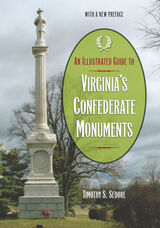
front cover of An Illustrated Guide to Virginia's Confederate Monuments
An Illustrated Guide to Virginia's Confederate Monuments
Timothy S. Sedore
Southern Illinois University Press, 2011

From well-known battlefields, such as Manassas, Fredericksburg, and Appomattox, to lesser-known sites, such as Sinking Spring Cemetery and Rude’s Hill, Sedore leads readers on a vivid journey through Virginia’s Confederate history. Tablets, monoliths, courthouses, cemeteries, town squares, battlefields, and more are cataloged in detail and accompanied by photographs and meticulous commentary. Each entry contains descriptions, fascinating historical information, and location, providing a complete portrait of each site.

Much more than a visual tapestry or a tourist’s handbook, An Illustrated Guide to Virginia’s Confederate Monuments draws on scholarly and field research to reveal these sites as public efforts to reconcile mourning with Southern postwar ideologies. Sedore analyzes in depth the nature of these attempts to publicly explain Virginia’s sense of grief after the war, delving deep into the psychology of a traumatized area. From commemorations of famous generals to memories of unknown soldiers, the dead speak from the pages of this sweeping companion to history.
 
[more]

front cover of Memorial Mania
Memorial Mania
Public Feeling in America
Erika Doss
University of Chicago Press, 2010

In the past few decades, thousands of new memorials to executed witches, victims of terrorism, and dead astronauts, along with those that pay tribute to civil rights, organ donors, and the end of Communism have dotted the American landscape. Equally ubiquitous, though until now less the subject of serious inquiry, are temporary memorials: spontaneous offerings of flowers and candles that materialize at sites of tragic and traumatic death. In Memorial Mania, Erika Doss argues that these memorials underscore our obsession with issues of memory and history, and the urgent desire to express—and claim—those issues in visibly public contexts.

Doss shows how this desire to memorialize the past disposes itself to individual anniversaries and personal grievances, to stories of tragedy and trauma, and to the social and political agendas of diverse numbers of Americans. By offering a framework for understanding these sites, Doss engages the larger issues behind our culture of commemoration. Driven by heated struggles over identity and the politics of representation, Memorial Mania is a testament to the fevered pitch of public feelings in America today.
[more]

front cover of Memorializing Pearl Harbor
Memorializing Pearl Harbor
Unfinished Histories and the Work of Remembrance
Geoffrey M. White
Duke University Press, 2016
Memorializing Pearl Harbor examines the challenge of representing history at the site of the attack that brought America into World War II. Analyzing moments in which history is re-presented—in commemorative events, documentary films, museum design, and educational programming—Geoffrey M. White shows that the memorial to the Pearl Harbor bombing is not a fixed or singular institution. Rather, it has become a site in which many histories are performed, validated, and challenged. In addition to valorizing military service and sacrifice, the memorial has become a place where Japanese veterans have come to seek recognition and reconciliation, where Japanese Americans have sought to correct narratives of racial mistrust, and where Native Hawaiians have challenged their ongoing erasure from their own land. Drawing on extended ethnographic fieldwork, White maps these struggles onto larger controversies about public history, museum practices, and national memory.
[more]

front cover of Monuments and Territory
Monuments and Territory
War Memorials in Russian-Occupied Ukraine
Mischa Gabowitsch
Central European University Press, 2025

From the very first weeks of Russia’s large-scale attack on Ukraine in February 2022, Russian soldiers, politicians, and proxy administrators expended considerable effort interacting with monuments on newly occupied territory. Why did the invaders care enough about war memorials to divert scarce resources to destroying, maintaining, or building them amid a massive war? Why did they remove some memorials and spare others? What was the point of commemorating past victories and defeats while bombing Ukrainian cities, and how did commemorative ceremonies in the occupied territories

change over the first year of the war? What was the broader impact of monument-related practices beyond the local settings in which they occurred? And what does the Ukrainian case teach us more generally about how memorials to past wars can be used to justify new conquests? These are some of the questions this book explores, based on fieldwork in occupied Ukraine and online research.

[more]


Send via email Share on Facebook Share on Twitter