
 A SCHOLARLY BOOK REPOSITORY
47 start with A start with A
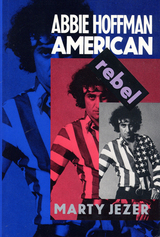
"... Abbie, more than any other radical, showed potheads how to demonstrate and radicals how to dance." -- Chicago Tribune
"... deeply sympathetic and scrupulously detached-a triumph of judicious empathy." -- MARTIN DUBERMAN, Distinguished Professor of History, Lehman/The Graduate School, C.U.N.Y.
"... details Hoffman's humor, manic energy, depressive spells, political skills, and above all, his Incurable and still contagious optimism." -- Entertainment Weekly
"Here's the Abbie I knew and loved! Marty Jezer has captured him in all his complexity, dedication, humor, and heart." -- ANITA HOFFMAN
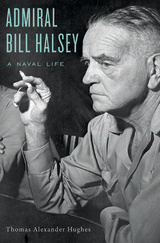
William Halsey was the most famous naval officer of World War II. His fearlessness in carrier raids against Japan, his steely resolve at Guadalcanal, and his impulsive blunder at the Battle of Leyte Gulf made him the “Patton of the Pacific” and solidified his reputation as a decisive, aggressive fighter prone to impetuous errors of judgment in the heat of battle. In this definitive biography, Thomas Hughes punctures the popular caricature of the “fighting admiral” to reveal the truth of Halsey’s personal and professional life as it was lived in times of war and peace.
Halsey, the son of a Navy officer whose alcoholism scuttled a promising career, committed himself wholeheartedly to naval life at an early age. An audacious and inspiring commander to his men, he met the operational challenges of the battle at sea against Japan with dramatically effective carrier strikes early in the war. Yet his greatest contribution to the Allied victory was as commander of the combined sea, air, and land forces in the South Pacific during the long slog up the Solomon Islands chain, one of the war’s most daunting battlegrounds. Halsey turned a bruising slugfest with the Japanese navy into a rout. Skillfully mediating the constant strategy disputes between the Army and the Navy—as well as the clashes of ego between General Douglas MacArthur and Admiral Chester Nimitz—Halsey was the linchpin of America’s Pacific war effort when its outcome was far from certain.
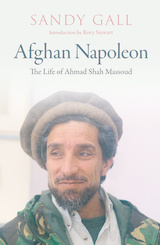
When the Soviets invaded Afghanistan in 1979, the forces of resistance were disparate. Many groups were caught up in fighting each other and competing for Western arms. The exception were those commanded by Ahmad Shah Massoud, the military strategist and political operator who solidified the resistance and undermined the Russian occupation, leading resistance members to a series of defensive victories.
Sandy Gall followed Massoud during Soviet incursions and reported on the war in Afghanistan, and he draws on this first-hand experience in his biography of this charismatic guerrilla commander. Afghan Napoleon includes excerpts from the surviving volumes of Massoud’s prolific diaries—many translated into English for the first time—which detail crucial moments in his personal life and during his time in the resistance. Born into a liberalizing Afghanistan in the 1960s, Massoud ardently opposed communism, and he rose to prominence by coordinating the defense of the Panjsher Valley against Soviet offensives. Despite being under-equipped and outnumbered, he orchestrated a series of victories over the Russians. Massoud’s assassination in 2001, just two days before the attack on the Twin Towers, is believed to have been ordered by Osama bin Laden. Despite the ultimate frustration of Massoud’s attempts to build political consensus, he is recognized today as a national hero.

Over the last twenty years, a concerted effort has been made to uncover the history of the Holodomor, the Great Famine of 1932–1933 in Ukraine. Now, with the archives opened and the essential story told, it becomes possible to explore in detail what happened after the Holodomor and to examine its impact on Ukraine and its people.
In 2008 the Ukrainian Research Institute at Harvard University hosted an international conference entitled “The Great Famine in Ukraine: The Holodomor and Its Consequences, 1933 to the Present.” The papers, most of which are contained in this volume, concern a wide range of topics, such as the immediate aftermath of the Holodomor and its subsequent effect on Ukraine’s people and communities; World War II, with its wartime and postwar famines; and the impact of the Holodomor on subsequent generations of Ukrainians and present-day Ukrainian culture. Through the efforts of the historians, archivists, and demographers represented here, a fuller history of the Holodomor continues to emerge.
Gathering material from politically active scholars, artists, and authors from Europe, Asia, and North America, this collection reflects on the likely fallout from the corruptive U.S. strategy of preemption. In the introduction, the editors criticize the American press for being, with few exceptions, easily if not willingly deceived by the Bush administration’s propaganda regarding weapons of mass destruction. One contributor redefines fascism as a situation in which contradictions are evident but blatantly ignored, one which creates a false sense of cohesion between events. Another argues that U.S. military bases around the world are now maintained not for military defense and quick mobilization but to create a culture of American militarism, noting that troops were sent from the U.S. for the invasion of Iraq rather than from closer bases around the world. Finally, the issue raises a formidable question: how do we end war waged against what might come to pass rather than what actually is?
Contributors. Tani Barlow, Jim Bonk, Josh Brown, Bei Dao, Carolyn Eisenberg, Lawrence Ferlinghetti, Matthew Fryslie, Sue Golding (as johnny de philo), Freda Guttman, Yukiko Hanawa, Harry Harootunian, Sharon Hayashi, Reynaldo C. Ileto, Joy Kogawa, Thomas LaMarre, The Liberal Islam Network, Sumit K. Mandal, Edoarda Masi, Brian Massumi, Anne McKnight, Carel Moiseiwitsch, Alberto Moreiras, Claudia Pozzana, Alessandro Russo, Ukai Satoshi, Laurie Sears, Kuang Xinnian, Marilyn Young
A powerful work by the heralded writer, this collection is a touchstone event in German literature of the post-war era.
On April 8, 1945, several American bomber squadrons were informed that their German targets were temporarily unavailable due to cloud cover. As it was too late to turn back, the assembled ordnance of more than two hundred bombers was diverted to nearby Halberstadt. A mid-sized cathedral town of no particular industrial or strategic importance, Halberstadt was almost totally destroyed, and a then-thirteen-year-old Alexander Kluge watched his town burn to the ground.
In this compelling account of the decisive World War II battle of El Alamein, Jon Latimer brings to life the harsh desert conflict in North Africa. In October 1942, after a two-year seesaw campaign across the wasteland of western Egypt and eastern Libya, the British Eighth Army not only achieved a significant military victory over the combined German-Italian Panzer Army but also provided an enormous psychological boost for the Allies.
This is the story of two of the most intriguing commanders of the war. Latimer offers remarkably balanced portraits of Bernard Law Montgomery, whose real achievement was overshadowed by his prickly ego, and Erwin Rommel, whose tactical brilliance could not overcome his disdain for the administrative side of war. Alamein, Latimer notes, was a victory for modern armaments, with concentrated artillery used on a scale not seen since 1918. Equally important were the critical contributions of naval and air forces in cutting off the German supply lines and supporting the ground troops, roles largely overlooked in standard accounts.
But Alamein is at heart the story of the infantry soldiers who fought in a scorched wilderness. Often using their own words, Latimer vividly describes the experiences of the gunners, sappers, cavalrymen, and airmen--Britons, Canadians, Australians, Indians, Germans, Italians, and others--who struggled in the heat, sand, and dust of this brutal environment.
With their success at El Alamein, the British forces would drive Rommel's army into Tunisia--and ultimate destruction in the North African Campaign of 1943.
Alaska's Hidden Wars tells the story of the war in the North Pacific, a story of savage weather, isolation, and sacrifice.
Two island chains, the Aleutians and the Kuriles, became the focus of a series of major campaigns that pitted the Americans against the Japanese. Alaska's Hidden Wars chronicles the role of Japanese-American intelligence specialists and reveals a Japanese eyewitness account of the defense of Attu. Two virtually unknown aspects of the North Pacific war are also exposed: the brutal North Pacific weather and the imprisonment of American airmen in Kamchatka.
In 1942, the Japanese raided Dutch Harbor in the Aleutian Islands and occupied the islands of Kiska and Attu. The Americans mounted a vigorous campaign, and the Japanese retreated to the Kuriles. For the next two years, the Americans launched air raids and fleet bombardments, while American soldiers maintained lonely outposts along Aleutian coasts. But in 1945, when Japan finally surrendered, the Kuriles were taken, not by the waiting Americans, but by the Soviets.
Alaska's Hidden Wars is a fast-moving history that brings declassified archival sources to light and draws the reader into the lonely, bitter war fought in the North Pacific.

Frank Kearns was the go-to guy at CBS News for danger- ous stories in Africa and the Middle East in the 1950s, ‘60s, and early ‘70s. By his own account, he was nearly killed 114 times. He took stories that nobody else wanted to cover and was challenged to get them on the air when nobody cared about this part of the world. But his stories were warning shots for conflicts that play out in the headlines today.
In 1957, Senator John Kennedy described America’s view of the Algerian war for independence as the Eisenhower Administration’s “head in the sand policy.” So CBS News decided to find out what was really happening there and to determine where Algeria’s war for independence fit into the game plan for the Cold War. They sent Frank Kearns to find out.
Kearns took with him cameraman Yousef (“Joe”) Masraff and 400 pounds of gear, some of which they shed, and they hiked with FLN escorts from Tunisia, across a wide “no-man’s land,” and into the Aures Mountains of eastern Algeria, where the war was bloodiest. They carried no passports or visas. They dressed as Algerians. They refused to bear weapons. And they knew that if captured, they would be executed and left in unmarked graves. But their job as journalists was to seek the truth whatever it might turn out to be.
This is Frank Kearns’s diary.
In May 1941, Gertrude van Tijn arrived in Lisbon on a mission of mercy from German-occupied Amsterdam. She came with Nazi approval to the capital of neutral Portugal to negotiate the departure from Hitler’s Europe of thousands of German and Dutch Jews. Was this middle-aged Jewish woman, burdened with such a terrible responsibility, merely a pawn of the Nazis, or was her journey a genuine opportunity to save large numbers of Jews from the gas chambers? In such impossible circumstances, what is just action, and what is complicity?
A moving account of courage and of all-too-human failings in the face of extraordinary moral challenges, The Ambiguity of Virtue tells the story of Van Tijn’s work on behalf of her fellow Jews as the avenues that might save them were closed off. Between 1933 and 1940 Van Tijn helped organize Jewish emigration from Germany. After the Germans occupied Holland, she worked for the Nazi‐appointed Jewish Council in Amsterdam and enabled many Jews to escape. Some later called her a heroine for the choices she made; others denounced her as a collaborator.
Bernard Wasserstein’s haunting narrative draws readers into the twilight world of wartime Europe, to expose the wrenching dilemmas that confronted Jews under Nazi occupation. Gertrude van Tijn’s experience raises crucial questions about German policy toward the Jews, about the role of the Jewish Council, and about Dutch, American, and British responses to the persecution and mass murder of Jews on an unimaginable scale.
As World War II dawned in Europe, General George C. Marshall, the new Army Chief of Staff, had to acknowledge that American society—and the citizens who would soon become soldiers—had drastically changed in the previous few decades. Almost every home had a radio, movies could talk, and driving in an automobile to the neighborhood soda fountain was part of everyday life. A product of newly created mass consumerism, the soldier of 1940 had expectations of material comfort, even while at war. Historian James J. Cooke presents the first comprehensive look at how Marshall’s efforts to cheer soldiers far from home resulted in the enduring morale services that the Army provides still today.
Marshall understood that civilian soldiers provided particular challenges and wanted to improve the subpar morale services that had been provided to Great War doughboys. Frederick Osborn, a civilian intellectual, was called to head the newly formed morale branch, which quickly became the Special Services Division. Hundreds of on-post movie theaters showing first-run movies at reduced prices, service clubs where GIs could relax, and inexpensive cafeterias were constructed. The Army Exchange System took direction under Brigadier General Joseph Byron, offering comfort items at low prices; the PX sold everything from cigarettes and razor blades to low-alcohol beer in very popular beer halls.
The great civic organizations—the YMCA, the Salvation Army, the Jewish Welfare Board, and others—were brought together to form the United Service Organizations (USO). At USO Camp Shows, admired entertainers like Bob Hope, Bing Crosby, and Frances Langford brought home-style entertainment to soldiers within the war zones. As the war heightened in intensity, the Special Service Companies grew to over forty in number, each containing more than one hundred enlisted men. Trained in infantry skills, soldiers in the companies at times would have to stop showing movies, pick up their rifles, and fight.
The Special Services Division, PX, and USO were crucial elements in maintaining GI morale, and Cooke’s work makes clear the lasting legacy of these efforts to boost the average soldier’s spirits almost a century ago. The idea that as American soldiers serve abroad, they should have access to at least some of the comforts of home has become a cultural standard.

Compared to the writings of other American observers of the Third Reich, Plotkin's diary is unique in style, scope, themes, and time span. Most accounts of Hitler's rise to power emphasize political institutions by focusing on the Nazi party's clashes with other political forces. In contrast, Plotkin is especially attentive to socioeconomic factors, providing an alternative view from the left that stems from his access to key German labor and socialist leaders. Chronologically, the diary reports on the moment when Hitler's seizure of power was not yet inevitable and when leaders on the left still believed in a different outcome of the crisis, but it also includes Plotkin's account of the complete destruction of German labor in May 1933.
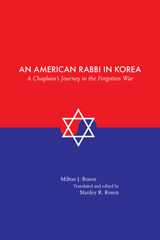
During the height of the Korean conflict, 1950–51, Orthodox Jewish chaplain Milton J. Rosen wrote 19 feature-length articles for Der Morgen Zhornal, a Yiddish daily in New York, documenting his wartime experiences as well as those of the servicemen under his care. An American Rabbi in Korea is an English translation of Rosen's important articles prepared by his son and annotated with background about Rosen's military service, a general introduction to the war and conflict on the Korean peninsula, and numerous maps and photographs.
Rosen was among those nearly caught in the Chinese entrapment of American and Allied forces in North Korea in late 1950, and some of his most poignant writing details the trying circumstances that faced both soldiers and civilians during that time. As chaplain, Rosen was able to offer a unique account of the American Jewish experience on the frontlines and in the United States military while also describing the impact of the American presence on Korean citizens and their culture. His interest in Korean attitudes toward Jews is also a significant theme within these articles. The sum is a readable account of war and its turmoil from an astute and compassionate observer.
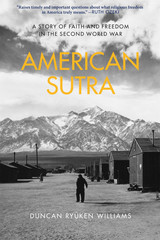
Winner of the Grawemeyer Award in Religion
A Los Angeles Times Bestseller
“Raises timely and important questions about what religious freedom in America truly means.”
—Ruth Ozeki
“A must-read for anyone interested in the implacable quest for civil liberties, social and racial justice, religious freedom, and American belonging.”
—George Takei
On December 7, 1941, as the bombs fell on Pearl Harbor, the first person detained was the leader of the Nishi Hongwanji Buddhist sect in Hawai‘i. Nearly all Japanese Americans were subject to accusations of disloyalty, but Buddhists aroused particular suspicion. From the White House to the local town council, many believed that Buddhism was incompatible with American values. Intelligence agencies targeted the Buddhist community, and Buddhist priests were deemed a threat to national security.
In this pathbreaking account, based on personal accounts and extensive research in untapped archives, Duncan Ryūken Williams reveals how, even as they were stripped of their homes and imprisoned in camps, Japanese American Buddhists launched one of the most inspiring defenses of religious freedom in our nation’s history, insisting that they could be both Buddhist and American.
“A searingly instructive story…from which all Americans might learn.”
—Smithsonian
“Williams’ moving account shows how Japanese Americans transformed Buddhism into an American religion, and, through that struggle, changed the United States for the better.”
—Viet Thanh Nguyen, author of The Sympathizer
“Reading this book, one cannot help but think of the current racial and religious tensions that have gripped this nation—and shudder.”
—Reza Aslan, author of Zealot
Fought as fiercely by politicians and the public as by troops in Southeast Asia, the Vietnam War--its origins, its conduct, its consequences--is still being contested. In what will become the classic account, based on newly opened archival sources, David Kaiser rewrites what we know about this conflict. Reviving and expanding a venerable tradition of political, diplomatic, and military history, he shows not only why we entered the war, but also why our efforts were doomed to fail.
American Tragedy is the first book to draw on complete official documentation to tell the full story of how we became involved in Vietnam--and the story it tells decisively challenges widely held assumptions about the roles of Eisenhower, Kennedy, and Johnson. Using an enormous range of source materials from these administrations, Kaiser shows how the policies that led to the war were developed during Eisenhower's tenure and nearly implemented in the closing days of his administration in response to a crisis in Laos; how Kennedy immediately reversed course on Laos and refused for three years to follow recommendations for military action in Southeast Asia; and how Eisenhower's policies reemerged in the military intervention mounted by the Johnson administration. As he places these findings in the context of the Cold War and broader American objectives, Kaiser offers the best analysis to date of the actual beginnings of the war in Vietnam, the impact of the American advisory mission from 1962 through 1965, and the initial strategy of General Westmoreland.
A deft re-creation of the deliberations, actions, and deceptions that brought two decades of post-World War II confidence to an ignominious end, American Tragedy offers unparalleled insight into the Vietnam War at home and abroad--and into American foreign policy in the 1960s.
After more than four decades, the Viet Nam War continues to haunt our national memory, culture, politics, and military actions. In this probing interdisciplinary study, Susan Lyn Eastman examines a range of cultural productions—from memorials and poetry to cinematic and fictional narratives—that have tried to grapple with the psychic afterlife of traumatic violence resulting from the ill-fated conflict in Southeast Asia.
Underpinning the book is the notion of “prosthetic memory,” which involves memories acquired by those with no direct experience of the war, such as readers and filmgoers. Prosthetic memories, Eastman argues, refuse to relegate the war to the forgotten past and challenge the authenticity of experience, thus ensuring its continued relevance to debates over America’s self-conception, specifically her coinage of the “New Vietnam Syndrome,” and the country’s role in world affairs when it comes to contemporary military interventions.
With the notable exception of the Veterans’ Memorial in Washington, Eastman’s focus is on works produced from the Persian Gulf War (1990–91) through the post-9/11 “War on Terror.” She looks not only at American representations of the war—from movies like Randall Wallace’s We Were Soldiers to poems by W. D. Ehrhart, Yusef Komunyakaa, and others—but also at novels by Vietnamese authors Bao Ninh and Huong Thu Duong. The experiences of women figure prominently in the book: Eastman devotes a chapter to the Vietnam Women’s Memorial and another to Sandie Frazier’s novel I Married Vietnam and Oliver Stone’s film Heaven and Earth, based on memoirs by Le Ly Hayslip. And by examining Jessica Hagedorn’s Dream Jungle, a novel inspired by the filming of Apocalypse Now, she considers how the war’s repercussions were felt in other countries, in this case the Philippines. Her investigation of Vietnamese American authors Lan Cao, Andrew Lam, and GB Tran adds a transnational dimension to the study.
With its up-to-date perspective on recent works that have heretofore received scant critical notice, this book offers new ways of thinking about one of the most polemic chapters in U.S. history.
SUSAN LYN EASTMAN teaches in the Department of English at the University of Tennessee at Chattanooga.

After more than four decades, the Viet Nam War continues to haunt our national memory, culture, politics, and military actions. In this probing interdisciplinary study, Susan Lyn Eastman examines a range of cultural productions—from memorials and poetry to cinematic and fictional narratives—that have tried to grapple with the psychic afterlife of traumatic violence resulting from the ill-fated conflict in Southeast Asia.
Underpinning the book is the notion of “prosthetic memory,” which involves memories acquired by those with no direct experience of the war, such as readers and filmgoers. Prosthetic memories, Eastman argues, refuse to relegate the war to the forgotten past and challenge the authenticity of experience, thus ensuring its continued relevance to debates over America’s self-conception, specifically her coinage of the “New Vietnam Syndrome,” and the country’s role in world affairs when it comes to contemporary military interventions.
With the notable exception of the Veterans’ Memorial in Washington, Eastman’s focus is on works produced from the Persian Gulf War (1990–91) through the post-9/11 “War on Terror.” She looks not only at American representations of the war—from movies like Randall Wallace’s We Were Soldiers to poems by W. D. Ehrhart, Yusef Komunyakaa, and others—but also at novels by Vietnamese authors Bao Ninh and Huong Thu Duong. The experiences of women figure prominently in the book: Eastman devotes a chapter to the Vietnam Women’s Memorial and another to Sandie Frazier’s novel I Married Vietnam and Oliver Stone’s film Heaven and Earth, based on memoirs by Le Ly Hayslip. And by examining Jessica Hagedorn’s Dream Jungle, a novel inspired by the filming of Apocalypse Now, she considers how the war’s repercussions were felt in other countries, in this case the Philippines. Her investigation of Vietnamese American authors Lan Cao, Andrew Lam, and GB Tran adds a transnational dimension to the study.
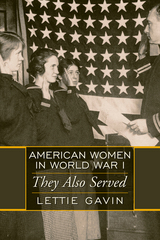
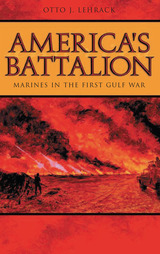
Building from interviews with the members of the battalion, Otto Lehrack examines the nature of warfare in the Persian Gulf. The terrain of the Arabian Peninsula and the disposition of the enemy dictated conventional warfare requiring battalion and regimental assaults coordinated at the division level, so interviewees are primarily the officers and senior non-commissioned officers concerned.
The 3rd of the 3rd, also known as “America’s Battalion,” had just returned from deployment in the summer of 1990 when they were required to immediately re-deploy to a strange land to face a battle-hardened enemy after Iraq invaded Kuwait. Theirs was only the second Marine battalion to arrive in Saudi Arabia. They participated in the first allied ground operation of the war, played a key role in the battle for the city of Khafji, and were the first to infiltrate the Iraqi wire and minefield barrier in order to provide flank security for the beginning of the allied offensive.
Facing an enemy that had used some of the most fearsome weapons of mass destruction—chemical and biological agents—against its former opponents and against its own people, the Marines had been prepared for the worst. Lehrack has documented this unit’s remarkable performance through the accounts of those who participated in the historic events in the Persian Gulf and returned home to tell of them.
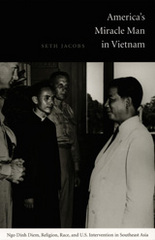
A diplomatic and cultural history, America’s Miracle Man in Vietnam draws on government archives, presidential libraries, private papers, novels, newspapers, magazines, movies, and television and radio broadcasts. Jacobs shows in detail how, in the 1950s, U.S. policymakers conceived of Cold War anticommunism as a crusade in which Americans needed to combine with fellow Judeo-Christians against an adversary dangerous as much for its atheism as for its military might. He describes how racist assumptions that Asians were culturally unready for democratic self-government predisposed Americans to excuse Diem’s dictatorship as necessary in “the Orient.” By focusing attention on the role of American religious and racial ideologies, Jacobs makes a crucial contribution to our understanding of the disastrous commitment of the United States to “sink or swim with Ngo Dinh Diem.”
Honorable Mention, 2016 Lyman Awards, presented by the North American Society for Oceanic History
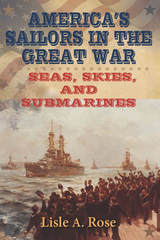
This book is a thrillingly-written story of naval planes, boats, and submarines during World War I.
When the U.S. entered World War I in April 1917, America’s sailors were immediately forced to engage in the utterly new realm of anti-submarine warfare waged on, below and above the seas by a variety of small ships and the new technology of airpower. The U.S. Navy substantially contributed to the safe trans-Atlantic passage of a two million man Army that decisively turned the tide of battle on the Western Front even as its battleship division helped the Royal Navy dominate the North Sea. Thoroughly professionalized, the Navy of 1917–18 laid the foundations for victory at sea twenty-five years later.
“A retired major general of the Marine Corps offers here an interpretive history of the campaign culminating in the battle of New Orleans, based on a meticulous review of the sources and employing the perceptive of modern military doctrine. Written with a military regard for precision . . . [the book] nevertheless gathers force and even suspense though its emphasis on the importance f the events at hand . . [T]his is now probably the best book on the topic.”—Choice
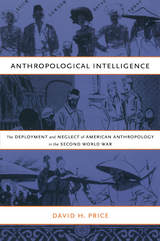
Anthropological Intelligence is based on interviews with anthropologists as well as extensive archival research involving many Freedom of Information Act requests. Price looks at the role played by the two primary U.S. anthropological organizations, the American Anthropological Association and the Society for Applied Anthropology (which was formed in 1941), in facilitating the application of anthropological methods to the problems of war. He chronicles specific projects undertaken on behalf of government agencies, including an analysis of the social effects of postwar migration, the design and implementation of OSS counterinsurgency campaigns, and the study of Japanese social structures to help tailor American propaganda efforts. Price discusses anthropologists’ work in internment camps, their collection of intelligence in Central and South America for the FBI’s Special Intelligence Service, and their help forming foreign language programs to assist soldiers and intelligence agents. Evaluating the ethical implications of anthropological contributions to World War II, Price suggests that by the time the Cold War began, the profession had set a dangerous precedent regarding what it would be willing to do on behalf of the U.S. government.
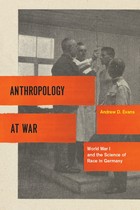
Between 1914 and 1918, German anthropologists conducted their work in the midst of full-scale war. The discipline was relatively new in German academia when World War I broke out, and, as Andrew D. Evans reveals in this illuminating book, its development was profoundly altered by the conflict. As the war shaped the institutional, ideological, and physical environment for anthropological work, the discipline turned its back on its liberal roots and became a nationalist endeavor primarily concerned with scientific studies of race.
Combining intellectual and cultural history with the history of science, Anthropology at War examines both the origins and consequences of this shift. Evans locates its roots in the decision to allow scientists access to prisoner-of-war camps, which prompted them to focus their research on racial studies of the captives. Caught up in wartime nationalism, a new generation of anthropologists began to portray the country’s political enemies as racially different. After the war ended, the importance placed on racial conceptions and categories persisted, paving the way for the politicization of scientific inquiry in the years of the ascendancy of National Socialism.
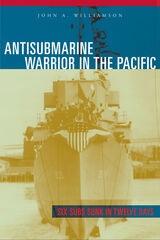
A first-hand account of the USS England's accomplishments, written by its commanding officer
The USS England was a 1200-ton, 306-foot, long-hull destroyer escort. Commissioned into service in late 1943 and dispatched to the Pacific the following February, the England and its crew, in one 12-day period in 1944, sank more submarines than any other ship in U.S. naval history: of the six targets attacked, all six were destroyed. For this distinction, legendary in the annals of antisubmarine warfare, the ship and her crew were honored with the Presidential Unit Citation.
After convoying in the Atlantic, John A. Williamson was assigned to the England—first as its executive officer, then as its commanding officer—from the time of her commissioning until she was dry-docked for battle damage repairs in the Philadelphia Naval Yard fifteen months later. Besides being a key participant in the remarkable antisubmarine actions, Williamson commanded the England in the battle of Okinawa, where she was attacked by kamikaze planes.
Williamson narrates his memoir with authority and authenticity, describes naval tactics and weaponry precisely, and provides information gleaned from translations of the orders from the Japanese high command to Submarine Squadron 7. The author details the challenges of communal life aboard ship and explains the intense loyalty that bonds crew members for life. Ultimately, Williamson offers a compelling portrait of himself, an inexperienced naval officer who, having come of age in Alabama during the Depression, rose to become the most successful World War II antisubmarine warfare officer in the Pacific.
*

In 1937 thirty-six nervous young men dressed in ill-fitting blue suits, wearing berets, and carrying identical black valises, were given tickets for an American Export Lines ship. They were told to conduct themselves as ordinary tourists, to be "inconspicuous." They were volunteers for the Abraham Lincoln Brigade, traveling the French underground to join in the fight against Franco. Among them was Milt Felsen, a young New Yorker and radical antiwar activist on the University of Iowa campus who had decided that fascism had to be opposed. Some of these young men never made it to their destination. But Milt Felsen did, beginning a march across the Pyrenees which was only the first of his many battles and adventures.
Told with uncommon wit and verve, this memoir of war and resistance is a stirring account of Felsen's involvement in two decades of battle. Surprisingly, this is a spirited and even funny book, infused with Felsen's unbeatable personality. After the Spanish Civil War, Felsen helped form the O.S.S. in World War II. Taken prisoner of war, he escaped in his inimitable style during a 1,200-mile prisoner-of-war march and drove out of Nazi Germany in a Mercedes-Benz. He returned to the United States more convinced than ever of war's insanity and its extreme human cost.
Most of us are only spectators of the world's larger events. Milt Felsen knew the excitement and despair of being a participant. While most war books abound in details of what happened, this one also delves into why. Felsen's straightforward account is refreshingly frank and doesn't pretend to be more than it is—his own lived version of war and common truths.
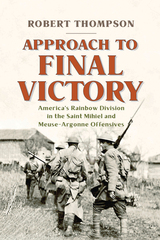
Approach to Final Victory: America's Rainbow Division in the Saint Mihiel and Meuse-Argonne Offensives by historian Robert Thompson, chronicles the efforts of the Rainbow Division during these final two Allied offensives that were key to the ultimate Allied victory. Based on letters, journals, action reports, and unit histories, the challenges, set-backs, and accomplishments of the division stand as a fitting symbol of American valor and sacrifice during the “war to end all wars.”

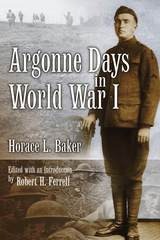
This poignant memoir recalls the great battle of the Meuse-Argonne, an epic conflict waged by well over a million men that saw casualties of 26,277 killed and 95,786 wounded. Many books have been written about General Pershing’s planning of the offensive; this one tells what happened to the soldiers who had to carry out his orders.
The Thirty-second was a shock division made up largely of National Guard units—farm boys from the Upper Midwest. But as casualties mounted, replacements were rushed into battle with little training—and devastating results. Baker knew friends and tent mates who were alive one day, dead the next, and he kept track of the battle in diary entries tucked into his Bible—and made evasively short in case of capture.
He shares his and his comrades’ thoughts about fighting in a harsh climate and terrain, relates their ongoing problems with short supplies, and tells how they managed to overcome their fears. It is a straightforward narrative that doesn’t glorify battle or appeal to patriotism yet conveys the horrors of warfare with striking accuracy. Historian Robert Ferrell’s new introduction puts Baker’s recollections in the context of the larger theater of war.
Baker fleshed out his diary in a book that saw limited publication in 1927 but has remained essentially unknown. Argonne Days in World War I is a masterpiece brimming with insight about the ordinary doughboys who fought in the European trenches. It conveys the spirit of a man who did his duty in a time of trouble—and is a testament to the spirit shared by thousands like him.
While many associate the concept commonly referred to as the “military-industrial complex” with President Dwight D. Eisenhower’s 1961 farewell address, the roots of it existed two hundred years earlier. This concept, as Benjamin Franklin Cooling writes, was “part of historical lore” as a burgeoning American nation discovered the inextricable relationship between arms and the State. In Arming America through the Centuries, Cooling examines the origins and development of the military-industrial complex (MIC) over the course of American history. He argues that the evolution of America’s military-industrial-business-political experience is the basis for a contemporary American Sparta. Cooling explores the influence of industry on security, the increasing prevalence of outsourcing, ever-present economic and political influence, and the evolving nature of modern warfare. He connects the budding military-industrial relations of the colonial era and Industrial Revolution to their formal interdependence during the Cold War down to the present-day resurrection of Great Power competition. Across eight chronological chapters, Cooling weaves together threads of industry, finance, privatization, appropriations, and technology to create a rich historical tapestry of US national defense in one comprehensive volume.
Integrating information from both recent works as well as canonical, older sources, Cooling’s ambitious single-volume synthesis is a uniquely accessible and illuminating survey not only for scholars and policymakers but for students and general readers as well.
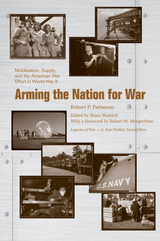
In Arming the Nation for War, a previously unpublished account long buried among the late author’s papers and originally marked confidential, Patterson describes the vast challenges the United States faced as it had to equip, in a desperately short time, a fighting force capable of confronting a formidable enemy. Brimming with data and detail, the book also abounds with deep insights into the myriad problems encountered on the domestic mobilization front—including the sometimes divergent interests of wartime planners and industrial leaders—along with the logistical difficulties of supplying far-flung theaters of war with everything from ships, planes, and tanks to food and medicine. Determined to remind his contemporaries of how narrow the Allied margin of victory was and that the war’s lessons not be forgotten, Patterson clearly intended the manuscript (which he wrote between 1945 and ’47, when he was President Truman’s secretary of war) to contribute to the postwar debates on the future of the military establishment. That passage of the National Security Act of 1947, to which Patterson was a key contributor, answered many of his concerns may explain why he never published the book during his lifetime.
A unique document offering an insider’s view of a watershed historical moment, Patterson’s text is complemented by editor Brian Waddell’s extensive introduction and notes. In addition, Robert M. Morgenthau, former Manhattan district attorney and a protégé of Patterson’s for four years prior to the latter’s death in a 1952 plane crash, offers a heartfelt remembrance of a man the New York Herald-Tribune called “an example of the public-spirited citizen.”
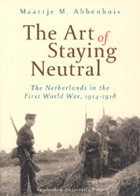
This book is a major contribution both to the study of neutrality and the domestic history of the Netherlands.
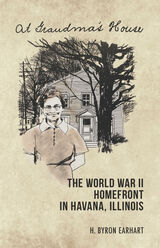
When H. Byron Earhart’s father enlisted in the U.S. Navy in 1942, young Byron and his family moved into his grandparents' old-fashioned home with a coal-fired range and potbelly stove, and his mother took charge of the family business, a frozen food locker. Grandma was the undisputed head of the family. While his father served on the battleship USS Missouri, his grandparents and mother held the family and the business together. At Grandma’s House is a tribute to everyday Americans who provided the social glue for a country at war as they balanced fear and anxiety for loved ones with the challenges and pleasures of daily life. The experiences of the Earhart family and this Midwestern community, supplemented by contemporary documents, family photos, and professional illustrations, recount with vivid local color the drama that played out on the national and international stage.
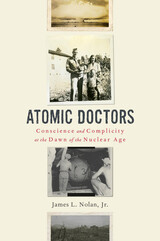
An unflinching examination of the moral and professional dilemmas faced by physicians who took part in the Manhattan Project.
After his father died, James L. Nolan, Jr., took possession of a box of private family materials. To his surprise, the small secret archive contained a treasure trove of information about his grandfather’s role as a doctor in the Manhattan Project. Dr. Nolan, it turned out, had been a significant figure. A talented ob-gyn radiologist, he cared for the scientists on the project, organized safety and evacuation plans for the Trinity test at Alamogordo, escorted the “Little Boy” bomb from Los Alamos to the Pacific Islands, and was one of the first Americans to enter the irradiated ruins of Hiroshima and Nagasaki.
Participation on the project challenged Dr. Nolan’s instincts as a healer. He and his medical colleagues were often conflicted, torn between their duty and desire to win the war and their oaths to protect life. Atomic Doctors follows these physicians as they sought to maximize the health and safety of those exposed to nuclear radiation, all the while serving leaders determined to minimize delays and maintain secrecy. Called upon both to guard against the harmful effects of radiation and to downplay its hazards, doctors struggled with the ethics of ending the deadliest of all wars using the most lethal of all weapons. Their work became a very human drama of ideals, co-optation, and complicity.
A vital and vivid account of a largely unknown chapter in atomic history, Atomic Doctors is a profound meditation on the moral dilemmas that ordinary people face in extraordinary times.
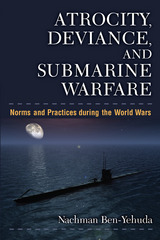
In the early 20th century, the diesel-electric submarine made possible a new type of unrestricted naval warfare. Such brutal practices as targeting passenger, cargo, and hospital ships not only violated previous international agreements; they were targeted explicitly at civilians. A deviant form of warfare quickly became the norm.
In Atrocity, Deviance, and Submarine Warfare, Nachman Ben-Yehuda recounts the evolution of submarine warfare, explains the nature of its deviance, documents its atrocities, and places these developments in the context of changing national identities and definitions of the ethical, at both social and individual levels. Introducing the concept of cultural cores, he traces the changes in cultural myths, collective memory, and the understanding of unconventionality and deviance prior to the outbreak of World War I. Significant changes in cultural cores, Ben-Yehuda concludes, permitted the rise of wartime atrocities at sea.
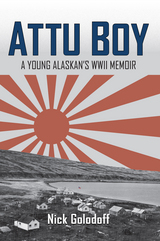
One of those survivors, Nick Golodoff, became a prisoner of war at just six years old. He was among the dozens of Unangan Attu residents swept away to Hokkaido, and one of only twenty-five to survive. Attu Boy tells Golodoff’s story of these harrowing years as he found both friendship and cruelty at the hands of the Japanese. It offers a rare look at the lives of civilian prisoners and their captors in WWII-era Japan. It also tells of Golodoff’s bittersweet return to a homeland torn apart by occupation and forced internments. Interwoven with other voices from Attu, this richly illustrated memoir is a testament to the struggles, triumphs, and heartbreak of lives disrupted by war.
READERS
Browse our collection.
PUBLISHERS
See BiblioVault's publisher services.
STUDENT SERVICES
Files for college accessibility offices.
RECENTLY PUBLISHED




UChicago Accessibility Resources
home | accessibility | search | about | contact us
BiblioVault ® 2001 - 2024
The University of Chicago Press