
 A SCHOLARLY BOOK REPOSITORY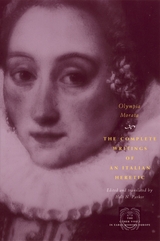
A brilliant scholar and one of the finest writers of her day, Olympia Morata (1526-1555) was attacked by some as a "Calvinist Amazon" but praised by others as an inspiration to all learned women. This book publishes, for the first time, all her known writings—orations, dialogues, letters, and poems—in an accessible English translation.
Raised in the court of Ferrara in Italy, Morata was educated alongside the daughters of the nobility. As a youth she gave public lectures on Cicero, wrote commentaries on Homer, and composed poems, dialogues, and orations in both Latin and Greek. She also became a prominent Protestant evangelical, studying the Bible extensively and corresponding with many of the leading theologians of the Reformation. After fleeing to Germany in search of religious freedom, Morata tutored students in Greek and composed what many at the time felt were her finest works—a series of translations of the Psalms into Greek hexameters and sapphics.
Feminists and historians will welcome these collected writings from one of the most important female humanists of the sixteenth century.
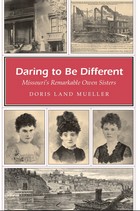
In the 1800s, American women were largely restricted to the private sphere. Most had no choice but to spend their lives in the home, marrying in their teens and living only as wives, mothers, and pillars of domesticity. Even as the women’s movement came along midcentury, it focused more on gaining legal and political rights for women than on expanding their career opportunities. So in that time period, in which the options and expectations for women’s professional lives were so limited, it is remarkable that three sisters born in the 1850s, the Owen daughters of Missouri, all achieved success and appreciation in their careers.
In 1837, when Queen Victoria came to the throne, no institution of higher education in Britain was open to women. By the end of the century, a quiet revolution had occurred: women had penetrated even the venerable walls of Oxford and Cambridge and could earn degrees at the many new universities founded during Victoria's reign. During the same period, novelists increasingly put intellectually ambitious heroines students, teachers, and frustrated scholars—at the center of their books. Educating Women analyzes the conflict between the higher education movement's emphasis on intellectual and professional achievement and the Victorian novel's continuing dedication to a narrative in which women's success is measured by the achievement of emotional rather than intellectual goals and by the forging of social rather than institutional ties.
Focusing on works by Charlotte Brontë, George Eliot, Anna Leonowens, and Thomas Hardy, Laura Morgan Green demonstrates that those texts are shaped by the need to mediate the conflict between the professionalism and publicity increasingly associated with education, on the one hand, and the Victorian celebration of women as emblems of domesticity, on the other. Educating Women shows that the nineteenth-century “heroines” of both history and fiction were in fact as indebted to domestic ideology as they were eager to transform it.

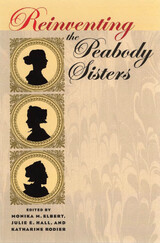
This is the first full-length biography of Elizabeth Palmer Peabody, one of the three notable Peabody sisters of Salem, Massachusetts, and sister-in-law of Nathaniel Hawthorne and Horace Mann. In elegant prose it traces the intricate private life and extraordinary career of one of nineteenth-century America's most important Transcendental writers and educational reformers. Yet Peabody has also been one of the most scandalously neglected and caricatured female intellectuals in American history.
Bruce Ronda has recaptured Peabody from anecdotal history and even blue-stocking portrayals in film--most recently by Jessica Tandy in Henry James's The Bostonians. Peabody was a reformer devoted to education in the broadest, and yet most practical, senses. She saw the classroom as mediating between the needs of the individual and the claims of society. She taught in her own private schools and was an assistant in Bronson Alcott's Temple School. In her contacts with Ralph Waldo Emerson's Transcendental circle in the 1830s, and as publisher of the famous Dial and other imprints, she took a mediating position once more, claiming the need for historical knowledge to balance the movement's stress on individual intuition. She championed antislavery, European liberal revolutions, Spiritualism, and, in her last years, the Paiute Indians. She was, as Theodore Parker described her, the Boswell of her age.
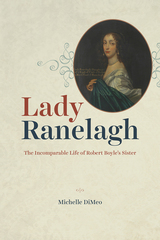
Philosophers, mathematicians, politicians, and religious authorities sought her opinion on everything from decimalizing the currency to producing Hebrew grammars. She practiced medicine alongside distinguished male physicians, treating some of the most elite patients in London. Her medical recipes, political commentaries, and testimony concerning the philosophers’ stone gained international circulation. She was an important influence on Boyle and a formidable thinker in her own right.
Drawing from a wealth of new archival sources, Michelle DiMeo fills out Lady Ranelagh’s legacy in the context of a historically sensitive and nuanced interpretation of gender, science, and religion. The book re-creates the intellectual life of one of the most respected and influential women in seventeenth-century Europe, revealing how she managed to gain the admiration of diverse contemporaries, effect social change, and shape contemporary science.
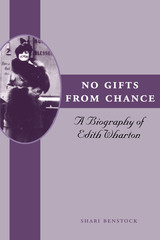
The first new biography of America's foremost woman of letters in twenty years, No Gifts from Chance presents an Edith Wharton for our times. Far from the emotionally withdrawn and neurasthenic victim of earlier portraits, she is revealed here as an ambitious, disciplined, and self-determined woman who fashioned life to her own desires. Drawing on government records, legal and medical documents, and recently opened collections of Wharton's letters, Shari Benstock's biography offers new information on what have been called the key mysteries of her life: the question of her paternity, her troubled relations with her mother and older brothers, her marriage to manic-depressive Teddy Wharton, and her extramarital affair with Morton Fullerton.
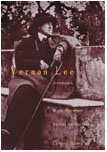
The subject of renewed interest among literary and cultural scholars, Vernon Lee wrote more than forty books, in a broad range of genres, including fiction, history, aesthetics, and travel literature. Early on, Lee established her reputation as a public critic whose unconventional viewpoints stood out among those of her contemporaries.
To feminist and cultural critics, she is a fascinating model of the independent female intellectual who, as Desmond MacCarthy once put it, provides a rare combination of intellectual curiosity and imaginative sensibility.
A startlingly original critical study, Vernon Lee adds new dimensions to the legacy of this woman of letters whose career spans the transition from the late Victorian to the modernist period. Zorn draws on archival materials to discuss Lee’s work in terms of British aestheticism and in the context of the Western European history of ideas.
Zorn contends that Lee’s fiction and nonfiction represent a literary position that bridges and surpasses both the Victorian sage and the modernist aesthetic critic.
Through Professor Zorn’s approach, which combines theoretical framings of texts in terms of recent feminist and cultural criticism with passages of close reading, Vernon Lee emerges as an influential figure in late-nineteenth-century British and continental European thinking on history, art, culture, and gender.
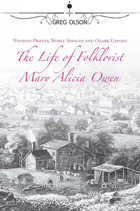
Folklorist Wayland Hand once called Mary Alicia Owen “the most famous American Woman Folklorist of her time.” Drawing on primary sources, such as maps, census records, court documents, personal letters and periodicals, and the scholarship of others who have analyzed various components of Owen’s multifaceted career, historian Greg Olson offers the most complete account of her life and work to date. He also offers a critical look at some of the short stories Owen penned, sometimes under the name Julia Scott, and discusses how the experience she gained as a fiction writer helped lead her to a successful career in folklore.
Olson analyzes many of the nineteenth-century theories, stereotypes, and popular beliefs that influenced the work of Owen and many of her peers. By taking a cross-disciplinary look at her works of fiction, poetry, folklore, history, and anthropology, this volume sheds new light on elements of Owen’s career that have not previously been discussed in print. Examples of the romance stories that Owen wrote for popular magazines in the 1880’s are identified and examined in the context of the time in which Owen wrote them.
This groundbreaking biography shows that Owen was more than just a folklorist—she was a nineteenth-century woman of many contradictions. She was an independent woman of many interests who possessed a keen intellect and a genuine interest in people and their stories. Specialists in folklore, anthropology, women’s studies, local and regional history, and Missouriana will find much to like in this thoroughly researched study.
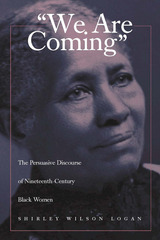
Shirley Wilson Logan analyzes the distinctive rhetorical features in the persuasive discourse of nineteenth-century black women, concentrating on the public discourse of club and church women from 1880 until 1900.
Logan develops each chapter in this illustrated study around a feature of public address as best exemplified in the oratory of a particular woman speaker of the era. She analyzes not only speeches but also editorials, essays, and letters.
Logan first focuses on the prophetic oratory of Maria Stewart, the first American-born black woman to speak publicly. Turning to Frances Harper, she considers speeches that argue for common interests between divergent communities. And she demonstrates that central to the antilynching rhetoric of Ida Wells is the concept of "presence," or the tactic of enhancing certain selected elements of the presentation.
In her discussion of Fannie Barrier Williams and Anna Cooper, Logan shows that when speaking to white club women and black clergymen, both Williams and Cooper employ what Kenneth Burke called identification. To analyze the rhetoric of Victoria Matthews, she applies Carolyn Miller's modification of Lloyd Bitzer's concept of the rhetorical situation.
Logan also examines the discourse of women associated with the black Baptist women's movement and those participating in college-affiliated conferences.
The book includes an appendix with little-known speeches and essays by Anna Julia Cooper, Selena Sloan Butler, Lucy Wilmot Smith, Mary V. Cook, Adella Hunt Logan, Victoria Earle Matthews, Lucy C. Laney, and Georgia Swift King.
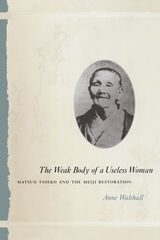
In telling Taseko's story, Anne Walthall gives us not just the first full biography in English of a peasant woman of the Tokugawa period (1603-1868), but also fresh perspectives on the practices and intellectual concerns of rural entrepreneurs and their role in the Meiji Restoration. Writing about Taseko with a depth and complexity that has thus far been accorded only to men of that time, Walthall has uncovered a tale that will captivate anyone concerned with women's lives and with Japan's dramatic transition to modernity.
READERS
Browse our collection.
PUBLISHERS
See BiblioVault's publisher services.
STUDENT SERVICES
Files for college accessibility offices.
RECENTLY PUBLISHED


UChicago Accessibility Resources
home | accessibility | search | about | contact us
BiblioVault ® 2001 - 2024
The University of Chicago Press