
 A SCHOLARLY BOOK REPOSITORY
Results by Title
2 books about Young, Robin Darling
2 books about Young, Robin Darling
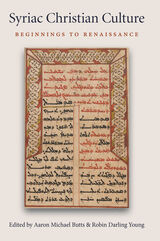
Syriac Christian Culture
Beginnings to Renaissance
Aaron Michael Butts
Catholic University of America Press, 2021
Syriac Christianity developed in the first centuries CE in the Middle East, where it continued to flourish throughout Late Antiquity and the Medieval period, while also spreading widely, as far as India and China. Today, Syriac Christians are found in the Middle East, in India, as well in diasporas scattered across the globe. Over this extended time period and across this vast geographic expanse, Syriac Christians have built impressive churches and monasteries, crafted fine pieces of art, and written and transmitted a sizable body of literature. Though often overlooked, neglected, and even persecuted, Syriac Christianity has been – and continues to be – an important part of the humanistic heritage of the last two millennia.
The present volume brings together fourteen studies that offer fresh perspectives on Syriac Christianity, especially its literary texts and authors. The timeframes of the individual studies span from the second-century Syriac translation of the Hebrew Bible up to the thirteenth century with the end of the Syriac Renaissance. Several studies analyze key authors from Late Antiquity, such as Aphrahat, Ephrem, Narsai, and Jacob of Serugh. Others investigate translations into Syriac, both from Hebrew and from Greek, while still others examine hagiography, especially its formation and transmission. Reflecting a growing trend in the field, the volume also devotes significant attention to the Medieval period, during which Syriac Christians lived under Islamic rule. The studies in the volume are united in their quest to explore the richness, diversity, and vibrance of Syriac Christianity.
[more]
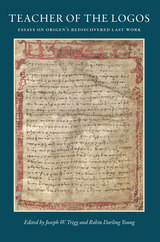
Teacher of the Logos
Essays on Origen's Rediscovered Last Work
Joseph W. Trigg
Catholic University of America Press
In 2012 Marina Molin Pradel, an archivist at the Bavarian State Library discovered that CMG 314, a long-neglected Byzantine manuscript , contained twenty-nine homilies by Origen, the most important and most talented genius of early Christianity. He delivered these homilies around 259 CE, shortly before arrest and torture during the Decian persecution would put an end to his work. Thus, along with the Contra Celsum, Origen’s lengthy defense of Christianity, written after 248, when that persecution was clearly impending, they enable readers to appreciate Origen’s fully-developed thought.
Except for the four of these homilies that had been translated into Latin in the fifth century, scholars of Origen thought that all the homilies on the Psalms had been lost. In 2015 Lorenzo Perrone of the University of Bologna, an eminent Origen scholar, assisted by a team including Dr. Pradel, produced a magnificent critical edition of the text.
In 2017 the editors of this volume organized a colloquium in Washington, DC, generously hosted by the program in Early Christian Studies. The authors of this volume, a group of American and Canadian scholars, invited Professor Perrone to address the discovery of the homilies and his edition, and to join their discussion of their interpretation. This volume represents the group’s energetic investigations and discussion over the two days of the conference. The essays address Origen’s use of language, his philosophical interests, his relationship with Judaism, and his scholarly patrimony in the next century.
[more]
READERS
Browse our collection.
PUBLISHERS
See BiblioVault's publisher services.
STUDENT SERVICES
Files for college accessibility offices.
RECENTLY PUBLISHED



UChicago Accessibility Resources
home | accessibility | search | about | contact us
BiblioVault ® 2001 - 2025
The University of Chicago Press