
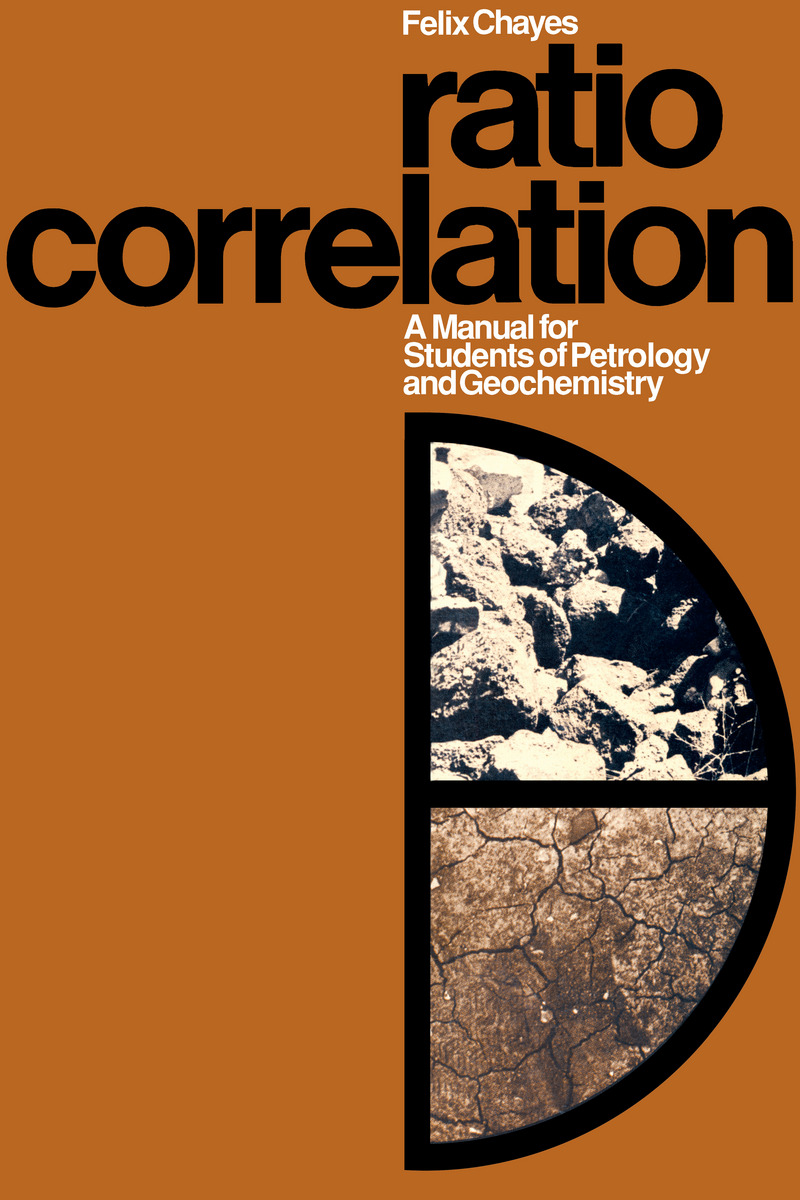
Ratio Correlation: A Manual for Students of Petrology and Geochemistry
by Felix Chayes
University of Chicago Press, 1971
Cloth: 978-0-226-10218-4 | Paper: 978-0-226-10220-7
Library of Congress Classification QE431.5.C47
Dewey Decimal Classification 552.001519537
TOC
- Contents
- Preface
- 1.
- Ratios, Relatedness, and Correlation in Petrography
- 1.
- Ratios in Petrography
- 2.
- Petrographic Relation and Numerical Correlation
- 3.
- Notation
- 4.
- Approximation Technique
- 2.
- The Simple Ratio Correlations
- 1.
- Null Correlation of a Ratio with Its Numerator
- 2.
- Other Forms of Simple Ratio Correlation
- 3.
- Some Sampling Experiments in Ratio Correlation
- 4.
- Simple Ratios Formed from Proportions
- 5.
- Correlation of a Ratio with Its Numerator When Numerator and Denominator are Correlated
- 3.
- The Part-Whole and Common-Element Correlations
- 1.
- The Part-Whole Correlation
- 2.
- The Common-Element Correlation
- 3.
- Correlation between the Whole and the Ratio of a Part to the Whole
- 4.
- Correlation between the Whole and the Ratio of a Part to the Whole When Both Are Proportions
- 5.
- Correlation between Two Ratios When the Denominator of Each Is the Sum of Its Numerator and a Common Term
- 4.
- Correlations between Proportions: The Closed Array
- 1.
- The Closure Effect
- 2.
- Null Correlation between Ratios Whose Numerators Are Common Elements in Their Common Denominator
- 3.
- The Sign of the Closure Correlation
- 4.
- Closure Correlation When Variances and Means are Homogeneous in X
- 5.
- Closure Correlation When Variances are Proportional to Means in X
- 6.
- The Ternary Closed Array
- 5.
- Assigning Values to the Parameters of the Hypothetical Open Array
- 1.
- Relations between the Means and Variances of X and Y
- 2.
- An Alternative Method for Computing the Variances of X
- 6.
- Testing the Significance of an Observed Correlation between Proportions
- 1.
- Calculating the Closure Correlation
- 2.
- The Fisher z Transformation
- 3.
- Closure Correlation in Reference Material G-2
- 4.
- Two Major Limitations of the Test
- 5.
- The Interpretation of Negative Elements in σ
- 6.
- A Further Note on the Ternary Array
- 7.
- The Effect of Ratio Formation on Regression
- 1.
- The Analytical Relation between Regression and Correlation Coefficients
- 2.
- Null Regression Coefficients for the Simple Ratios
- 3.
- Null Regression Coefficients between Ratios Whose Numerators Are Common Elements in the Sum Which Is Their Common Denominator
- 4.
- Testing the Regression Coefficient
- 5.
- Alternative Forms of Regression Analysis
- 8.
- The Remaining-Space Transformation and the Niggli Variation Diagram
- 1.
- Rationale of the Remaining-Space Transformation
- 2.
- The Remaining-Space Transformation
- 3.
- The Niggli-Number Transformation
- 4.
- Null Correlations for the Remaining-Space and Niggli-Number Correlations
- 9.
- Harker and Related Variation Diagrams
- 1.
- Factors Controlling the Sign of σi² in Harker and Similar Arrays
- 2.
- Negative Elements in σ Computed from some Harker Arrays
- 3.
- The Elimination of Negative Elements in σ
- 4.
- Modifying Sample Variables by Linear Combination
- 5.
- Some Linear Transformations Applicable to the Harker Array
- 6.
- Testing the Significance of Correlations between Transformed Harker Variables
- References
See other titles from University of Chicago Press