
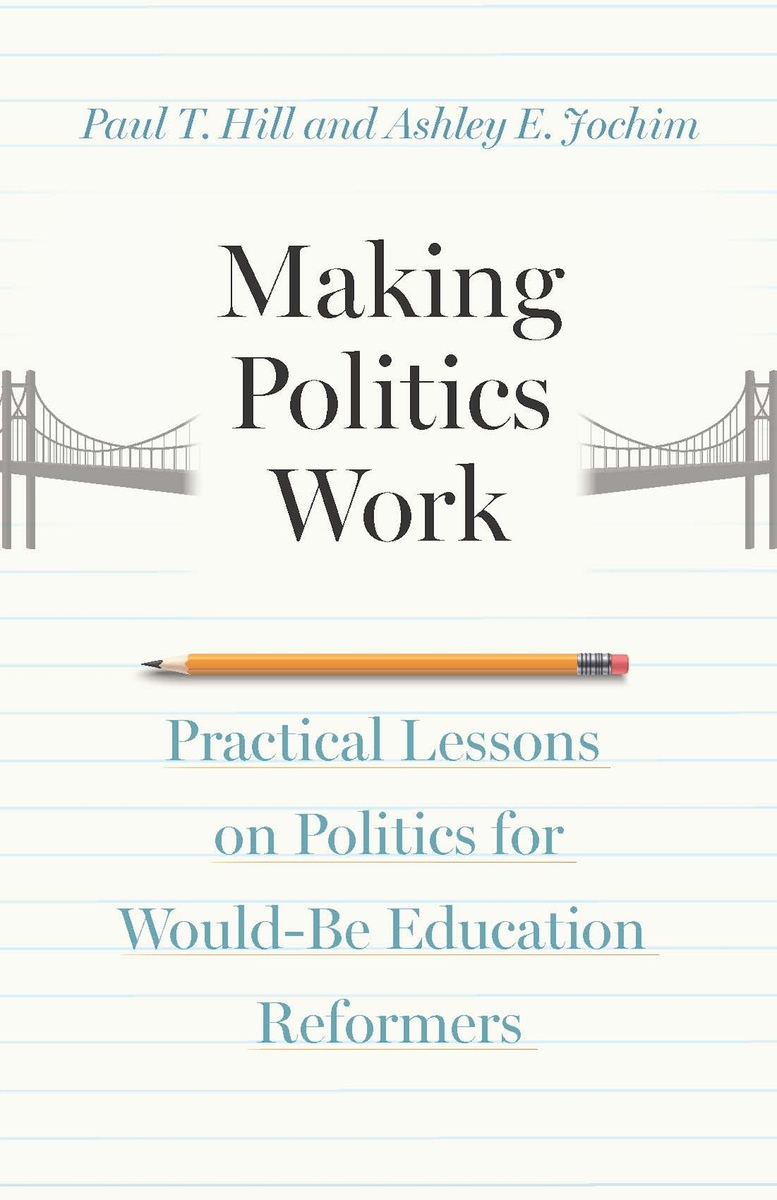
Making Politics Work: Practical Lessons on Politics for Would-Be Education Reformers
by Paul T. Hill and Ashley E. Jochim
University of Chicago Press, 2025
Cloth: 978-0-226-83794-9 | Paper: 978-0-226-83796-3 | eISBN: 978-0-226-83795-6 (all)
Library of Congress Classification LB2806.23.H555 2025
Dewey Decimal Classification 370.973
ABOUT THIS BOOK
An expansive study shows how politics can work for, not just against, efforts to improve America’s schools.
The education reform project has always been about making America’s schools more effective for the children who attend them. In Making Politics Work, authors Paul T. Hill and Ashley E. Jochim show that this project cannot succeed without mastering what is the single largest constraint on its success: politics.
Drawing upon more than a decade of work with dozens of school systems, Hill and Jochim show how failures to secure political support or mitigate inevitable opposition dooms the education reform project from the start. But this outcome is not inevitable. By tracing the evolution of the “portfolio strategy” across 27 localities that implemented it, they uncover practical lessons that superintendents, state leaders, and foundation officials can use to increase the likelihood that their ideas for improving public education don’t join the list of once-promising initiatives that could not be sustained in the face of intractable political conflict.
See other books on: Educational change | Local | Longitudinal studies | Planning | School management and organization
See other titles from University of Chicago Press