
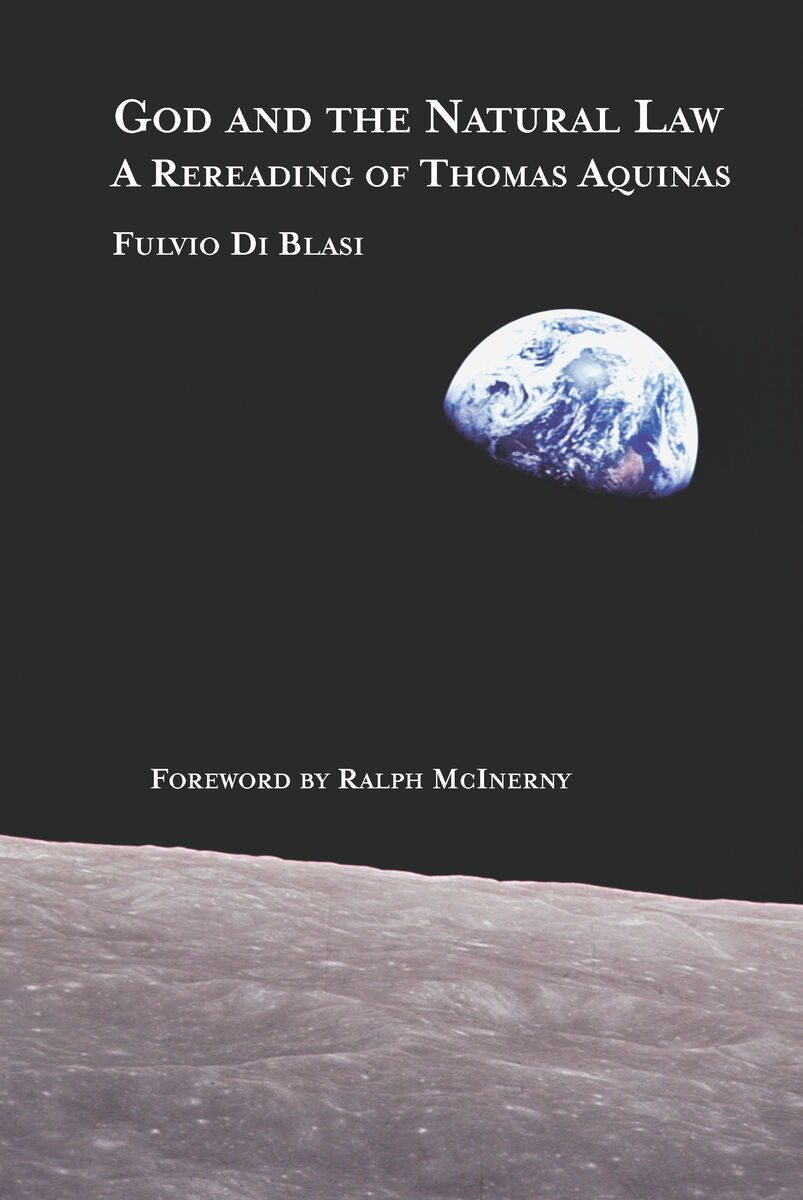
God and the Natural Law: Reading of Thomas Aquinas
by Fulvio Di Blasi
St. Augustine's Press, 2006
Cloth: 978-1-58731-351-6
Library of Congress Classification K447.T45D5313 2006
Dewey Decimal Classification 340.112
ABOUT THIS BOOK
It seems that to retain credibility in a post-Kantian and analytic world, contemporary natural law theory has tried to show its independence both from God and from human nature. But can there be a natural-law theory without the “natural” – not grounded in facts of nature – and without “law” – not in need of a Legislator? In God and the Natural Law, Fulvio Di
Blasi begins with an original analysis of the current debate in ethics, jurisprudence, and politics in order to set the stage for a sound understanding of the concept of natural law. This leads to the heart of the book: a recovery of the authentic meaning of the two main concepts of classical natural-law theory as synthesized by Thomas Aquinas – the will of God and the order of nature.
The wide revival of practical philosophy and ethics of objective-values in recent decades has involved a robust rediscovery of classical natural-law theory. This rediscovery is marked by two main traits: an emphasis on the autonomy of practical reason (as a reaction to modern voluntarism centered on the external will of the legislator); and an emphasis on the originality of practical reason (as a reaction to the idea of a rational deduction of
moral truths from the facts of nature). Without denying an autonomous character to ethics, or the need for a strong critique of moral rationalism, Di Blasi argues that Aquinas’s thought remains unintelligible if we remove from it either God or the metaphysical understanding of
nature.
See other titles from St. Augustine's Press