
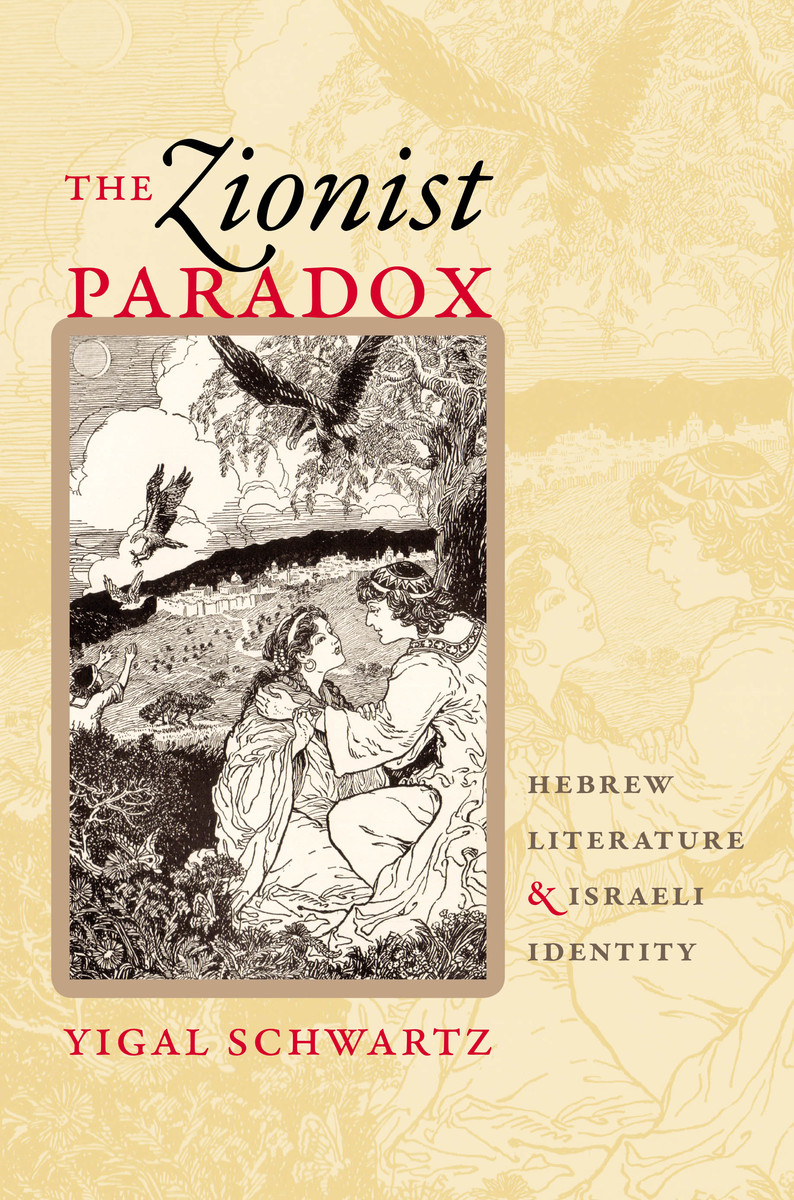
The Zionist Paradox: Hebrew Literature and Israeli Identity
by Yigal Schwartz
translated by Michal Sapir
Brandeis University Press, 2014
Cloth: 978-1-58465-894-8 | Paper: 978-1-61168-601-2 | eISBN: 978-1-61168-602-9
Library of Congress Classification PJ5030.Z55S5813 2014
Dewey Decimal Classification 892.4093585694
ABOUT THIS BOOK
Many contemporary Israelis suffer from a strange condition. Despite the obvious successes of the Zionist enterprise and the State of Israel, tension persists, with a collective sense that something is wrong and should be better. This cognitive dissonance arises from the disjunction between “place” (defined as what Israel is really like) and “Place” (defined as the imaginary community comprised of history, myth, and dream). Through the lens of five major works in Hebrew by writers Abraham Mapu (1853), Theodor Herzl (1902), Yosef Luidor (1912), Moshe Shamir (1948), and Amos Oz (1963), Schwartz unearths the core of this paradox as it evolves over one hundred years, from the mid-nineteenth century to the 1960s.
See other books on: Hebrew fiction | Hebrew Literature | Israel & Palestine | Israeli fiction | Zionism in literature
See other titles from Brandeis University Press