
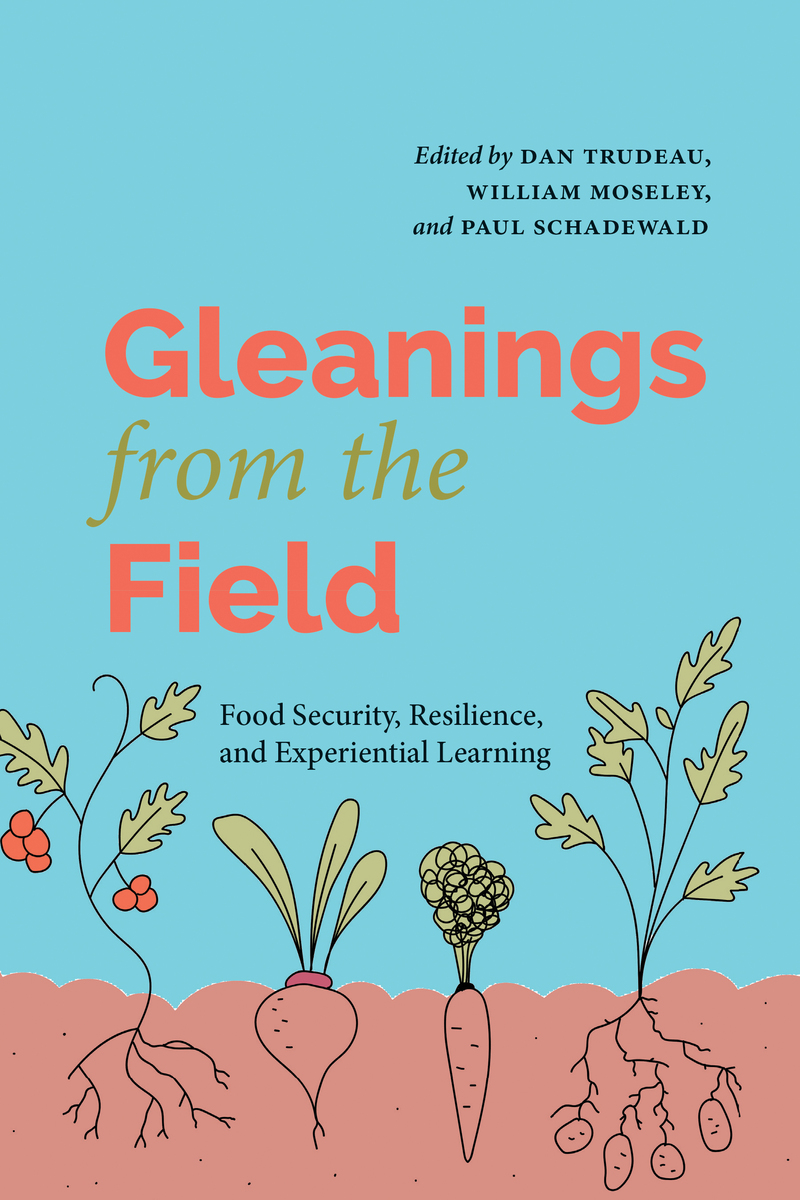
Gleanings from the Field: Food Security, Resilience, and Experiential Learning
Gleanings from the Field: Food Security, Resilience, and Experiential Learning
edited by Dan Trudeau, William Moseley and Paul Schadewald
Lever Press, 2025
ISBNs
Paper: 978-1-64315-072-7
eISBN: 978-1-64315-073-4
About the Book
In recent years, the concept of “food security” has garnered significant attention among policymakers, activists, and educators. Stemming from a growing awareness of the complexities surrounding access to sufficient food globally, movements advocating for food justice and sovereignty have emerged in response to these systemic inequities and health disparities, particularly in local communities. With the COVID-19 pandemic, conflicts in regions such as Ukraine and Gaza, and the escalating impacts of climate change, reliable food security has become exacerbated by these existing disparities. Gleanings from the Field argues that addressing food security is essential for tackling broader sustainability challenges facing humanity and recognizes the role of food in community-building, cultural exchange, and quality of life. However, promoting food security entails navigating intricate trade-offs, such as balancing economic interests in food supply with environmental concerns.
This timely essay collection frames our food security challenges as “wicked problems,” puzzles without clear solutions that are characterized by evolving complexities and divergent stakeholder priorities. In classroom settings, they argue for the usage of experiential learning to cultivate “wicked problem-solving skills” among students. Gleanings from the Field exemplifies this approach, offering pedagogical interventions to prepare students for tackling these wicked problems, while advocating for high-impact learning experiences that enable students to grapple with the interconnected systems influencing food security. Through hands-on experiences and reflective practice, students gain a deeper understanding of these systems and their societal implications. Importantly, the contributions outlined in this volume underscore the need for a multidimensional view of food security, thus examining the intersections of economic interests, government policies, and social movements. By contextualizing food security within broader political-economic arrangements, educators can empower students to enact meaningful change.
Gleanings from the Field argues for a holistic approach to food security education, one that acknowledges the fraught nature of wicked problems and equips students with the skills and knowledge needed for effective action. By integrating experiential learning, conceptual frameworks about food security and resilience, and real-world engagement, educators can cultivate a new generation of resilient problem-solvers committed to addressing food insecurity and other wicked problems.
This timely essay collection frames our food security challenges as “wicked problems,” puzzles without clear solutions that are characterized by evolving complexities and divergent stakeholder priorities. In classroom settings, they argue for the usage of experiential learning to cultivate “wicked problem-solving skills” among students. Gleanings from the Field exemplifies this approach, offering pedagogical interventions to prepare students for tackling these wicked problems, while advocating for high-impact learning experiences that enable students to grapple with the interconnected systems influencing food security. Through hands-on experiences and reflective practice, students gain a deeper understanding of these systems and their societal implications. Importantly, the contributions outlined in this volume underscore the need for a multidimensional view of food security, thus examining the intersections of economic interests, government policies, and social movements. By contextualizing food security within broader political-economic arrangements, educators can empower students to enact meaningful change.
Gleanings from the Field argues for a holistic approach to food security education, one that acknowledges the fraught nature of wicked problems and equips students with the skills and knowledge needed for effective action. By integrating experiential learning, conceptual frameworks about food security and resilience, and real-world engagement, educators can cultivate a new generation of resilient problem-solvers committed to addressing food insecurity and other wicked problems.
About the Author
Dan Trudeau is Professor in the Department of Geography at Macalester College in Saint Paul, Minnesota, USA.
William G. Moseley is DeWitt Wallace Professor of Geography, and Director of the Food, Agriculture and Society Program, at Macalester College. He formerly served on the UN High Level Panel of Experts for Food Security and Nutrition and is the author of 11 books.
Paul Schadewald is Senior Project Manager for Bringing Theory to Practice, a national initiative to advance engaged, holistic, and equitable change in higher education, based at Elon University in Elon, N.C.
William G. Moseley is DeWitt Wallace Professor of Geography, and Director of the Food, Agriculture and Society Program, at Macalester College. He formerly served on the UN High Level Panel of Experts for Food Security and Nutrition and is the author of 11 books.
Paul Schadewald is Senior Project Manager for Bringing Theory to Practice, a national initiative to advance engaged, holistic, and equitable change in higher education, based at Elon University in Elon, N.C.
Reviews
“Building off work in both critical service learning and food studies, this volume is useful for anyone teaching food courses who is interested in helping students reach their potential for tackling big problems. In short, Gleanings from the Field is an extremely useful and timely edited volume and will make a meaningful contribution to both the literature on food security and the praxis of solving it.”
— Daina Cheyenne Harvey, Food and Foodways“Gleanings from the Field offers a powerful and inspiring exploration of the intersection of critical pedagogy and community engagement, showcasing how transformative educational experiences can address the multifaceted challenge of food security. With richly detailed case studies and incisive analysis, this volume empowers educators to reimagine learning as a collaborative process that transcends classroom walls. Contributions from multiple disciplinary backgrounds demonstrate possibilities for engaging students with the everyday complexities of food insecurity, which are frequently found on the doorstep of campuses across the country. A must-read for anyone committed to making education a force for meaningful change.”— Thomas Smucker, Ohio University
“Gleanings from the Field: Food Security, Resilience, and Experiential Learning redefines how we address the complexities of food systems through the transformative power of experiential education. Blending real-world case studies with innovative teaching strategies, this collection empowers educators to cultivate resilient problem-solvers equipped to navigate the "wicked problems" of food security, sustainability, and cultural foodways. Thought-provoking and action-driven, this book is an essential resource for educators, practitioners, and change-makers seeking to inspire a new generation of leaders dedicated to creating equitable and sustainable food systems.”— Marina Barnett, Widener University
“In this timely and engaging volume, faculty from seven liberal arts colleges share how they developed and conducted experiential learning on the six dimensions of food security. They make a compelling case for how this pedagogy enhances multiple classes, especially those dealing with hunger and food insecurity. Abundant examples of specific exercises and assignments can be adopted by readers.”— Molly Anderson, Middlebury College
Tags
Experiential Learning, Gleanings, Subjects, Agriculture & Food, Agriculture & Food Policy, Teaching, Public Policy, Education, Political Science, Social Science
Open Access Information
Label: The Lever Initiative
License: CC BY-NC-ND

 Loading...