ABOUT THIS BOOK
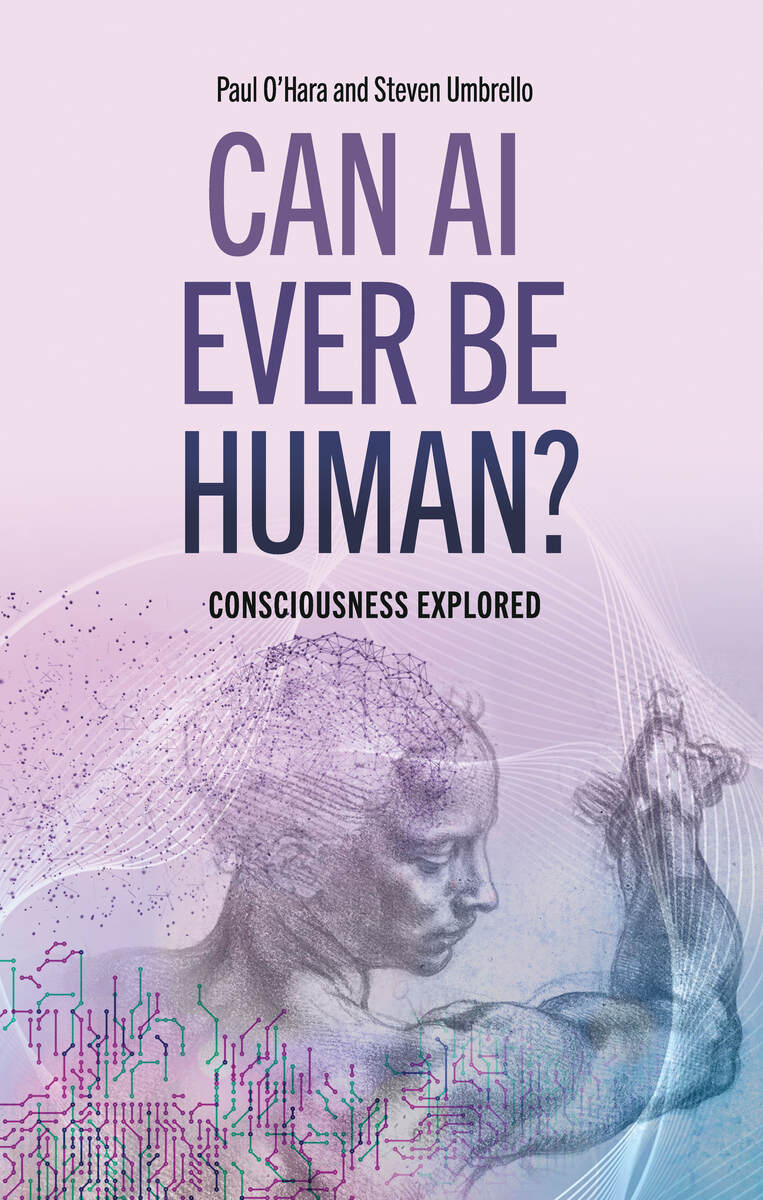
Can a machine ever truly be human? In an age where artificial intelligence writes poems, diagnoses illnesses, and converses with uncanny fluency, the line between human and machine seems to blur. Yet beneath the surface lies a fundamental distinction. Drawing on Bernard Lonergan’s insights as well as the rich Catholic intellectual tradition,
Can AI Ever Be Human? argues that while machines can simulate aspects of human behavior, they cannot cross the threshold into genuine consciousness.
O’Hara and Umbrello guide readers through the essential structures of human knowing:
experience, understanding, judgment, and
decision. In doing so, they show how each involves intentionality, self-awareness, and freedom. These uniquely human capacities cannot be reduced to algorithms or replicated by even the most advanced neural networks.
The book also addresses pressing ethical and theological questions: What does it mean to be made in the image of God? How do we preserve human dignity in a world increasingly shaped by artificial intelligence? Far from being anti-technology, O’Hara and Umbrello affirm the value of AI as a tool that emulates a Turing machine, although constrained by Gödel’s theorem, while rejecting the illusion that it can replace human beings.
Accessible yet rigorous,
Can AI Ever Be Human? speaks to scholars, students, clergy, and general readers alike. It is essential reading for anyone interested in the intersection of technology, scientific methodology, philosophy, and theology, and for all who seek to understand what makes us irreducibly human in an era of rapid technological change.
TABLE OF CONTENTS
Contents
Introduction
Chapter 1. Insight and Sensibility: The Foundation of Understanding
Chapter 2. Through the Looking Glass: The Foundation of Experience
Chapter 3. To Be or Not to Be: The Role of Judgment
Chapter 4. Recognizing the “I”: The Self-Affirmation of the Knower
Chapter 5. Transcending Choice: Decision, Love, and Rational Self-Consciousness
Conclusion
Epilogue: The Chatter of ChatGPT
Appendix: Quantum Computers
Bibliography
Index