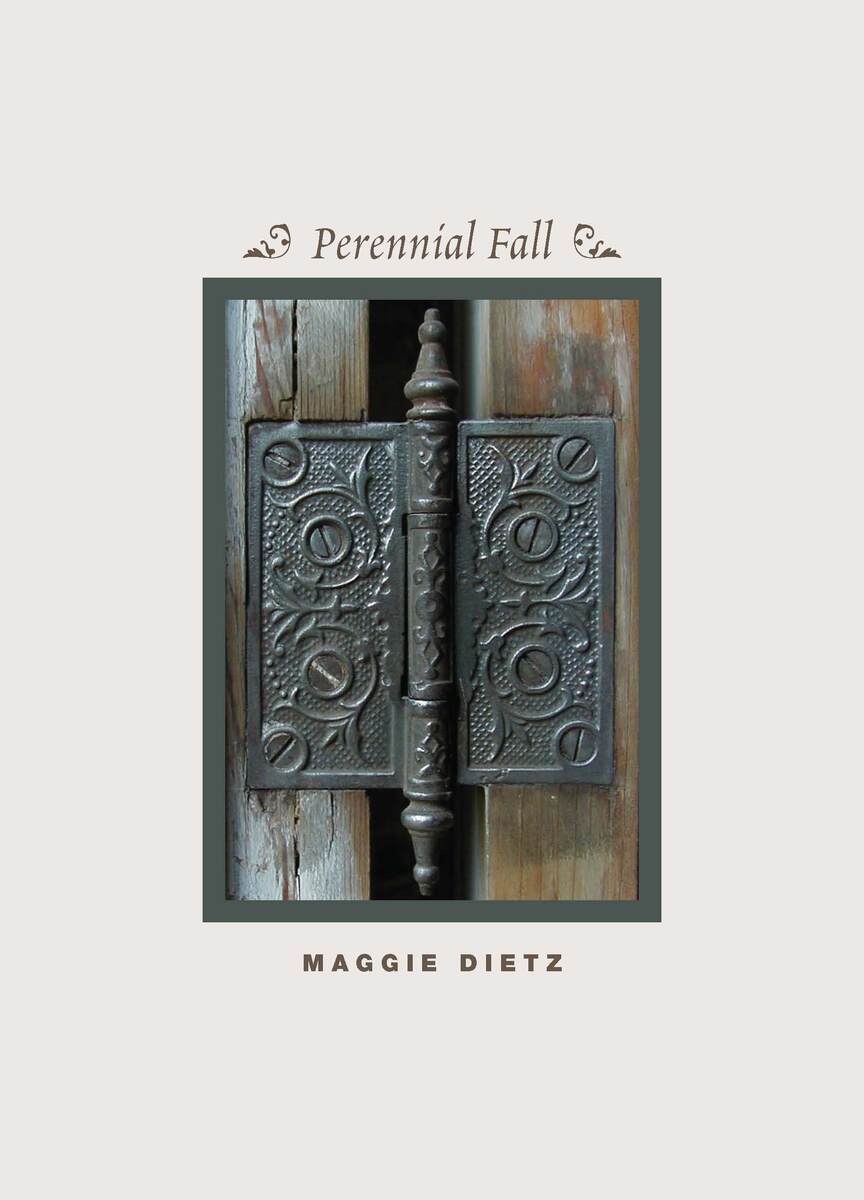
Perennial Fall
University of Chicago Press, 2006
Paper: 978-0-226-14850-2 | Cloth: 978-0-226-14849-6
Library of Congress Classification PS3604.I375P47 2006
Dewey Decimal Classification 811.6
Paper: 978-0-226-14850-2 | Cloth: 978-0-226-14849-6
Library of Congress Classification PS3604.I375P47 2006
Dewey Decimal Classification 811.6
ABOUT THIS BOOK | AUTHOR BIOGRAPHY | REVIEWS | TOC | REQUEST ACCESSIBLE FILE
ABOUT THIS BOOK
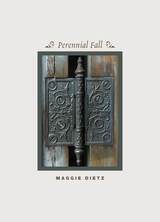
At the heart of this unusually accomplished and affecting first book of poetry is the idea of the hinge—the point of connection, of openings and closings. Maggie Dietz situates herself in the liminal present, bringing together past and future, dream and waking, death and life. Formally exact, rigorous, and tough, these poems accept no easy answers or equations.
Dietz creates a world alive with detail and populated with the everyday and strange: amusement-park horses named Virgil and Sisyphus, squirrels hanging over tree branches “like fish.” By turns humorous and pained, direct and mysterious, elegiac and elegant, the poems trace for us the journey and persistence of the spirit toward and through its “perennial fall”—both the season and the human condition. Cumulatively, the work moves toward a fragile transcendence, surrendering to difficulty, splendor, and strangeness.
“In Perennial Fall, distinct, hard-edged images create a haunting counter-play of distortion, troubled insight or menace. The simultaneous clarity and shadow has the quality of a dream that can be neither forgotten nor settled. This is a spectacular debut and more than that—a wonderful book.”—Robert Pinsky
Dietz creates a world alive with detail and populated with the everyday and strange: amusement-park horses named Virgil and Sisyphus, squirrels hanging over tree branches “like fish.” By turns humorous and pained, direct and mysterious, elegiac and elegant, the poems trace for us the journey and persistence of the spirit toward and through its “perennial fall”—both the season and the human condition. Cumulatively, the work moves toward a fragile transcendence, surrendering to difficulty, splendor, and strangeness.
“In Perennial Fall, distinct, hard-edged images create a haunting counter-play of distortion, troubled insight or menace. The simultaneous clarity and shadow has the quality of a dream that can be neither forgotten nor settled. This is a spectacular debut and more than that—a wonderful book.”—Robert Pinsky
See other books on: American | Dietz, Maggie | Poetry
See other titles from University of Chicago Press