Results by title
3 books match the query 'Coin'

A Coin in Nine Hands
A NovelMarguerite Yourcenar
University of Chicago Press, 1994
"A Coin in Nine Hands has . . . passages that move close to poetry and a story that belongs in both literature and history."—Doris Grumbach, Los Angeles Times Book Review
"What lingers at the end of A Coin in Nine Hands is the shadowiness and puppetlike vagueness of the Dictator, and the compelling specificity of the so-called 'common people' revolving all around him."—Anne Tyler, The New Republic
"Within a few pages we have met half the major characters in this haunting, brilliantly constructed novel. . . . The studied perfection, the structural intricacy and brevity remind one of Camus. Yet by comparison, Yourcenar's prose is lavish, emotional and imagistic."—Cynthia King, Houston Post
"Transcends its specific time and place to become a portrait of vividly delineated characters caught in the vise of a tragically familiar political situation."—Publisher's Weekly
Best known as the author of Memoirs of Hadrian and The Abyss, Marguerite Yourcenar (1903-87) achieved countless literary honors and was the first woman ever elected to the Académie Française.
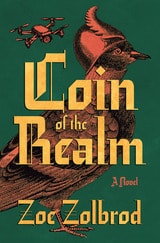
Coin of the Realm
A NovelZoe Zolbrod
Northwestern University Press, 2027
Can liberation be found in the unexpected corners of a Renaissance faire?
In a near-future United States, the government has just stripped away the protections of birthright citizenship, and eighteen-year-old Raven is facing deportation. Her best hope: finding her long-gone father, an off-the-grid Renaissance faire entrepreneur called Tom the Hunter. If Raven can convince Tom to affirm his paternity, she will be able to remain in the only country she has ever known.
But Tom is no easy man locate, let alone tell what to do. The charismatic leader of an underground resistance movement based at a Ren faire in Bristol, Wisconsin, he has spent his life agitating against the ever-increasing reach of corporate and government surveillance while avoiding its gaze. In a society overrun by drones, self-driving cars, and wearable devices that track mood and behavior, he sends messages by pigeon and trains hawks to attack invaders. The only thing from the “regular world” allowed to enter his self-contained realm has been Gwen, his new lover. Facing economic and emotional headwinds after losing her job, Gwen has fled her family and a home dangerously in need of remediation, and she dives headfirst into an affair with the passionate yet conniving Tom. But when Tom’s machinations threaten those around him, Gwen begins to question her choice to leave her children behind for a world that may not be as empowering as it seems.
As Raven and Gwen become enmeshed in the vibrant and insurgent community of Bristol’s Ren faire and Tom’s antics reach unsettling new heights, each must make a choice on where they stand—and with whom.
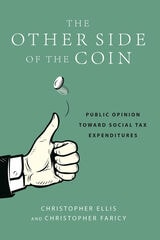
The Other Side of the Coin
Public Opinion toward Social Tax ExpendituresChristopher G. Faricy
Russell Sage Foundation, 2021
Tax expenditures seek to accomplish many of the goals of direct government expenditures, but they distribute money indirectly, through tax refunds or reductions in taxable income, rather than direct payments on goods and services or benefits. They tend to privilege market-based solutions to social problems such as employer-based tax subsidies for purchasing health insurance versus government-provided health insurance. Drawing on nationally representative surveys and survey experiments, Ellis and Faricy show that social welfare policies designed as tax expenditures, as opposed to direct spending on social welfare programs, are widely popular with the general public. Contrary to previous research suggesting that recipients of these subsidies are often unaware of indirect government aid—sometimes called “the hidden welfare state”—Ellis and Faricy find that citizens are well aware of them and act in their economic self-interest in supporting tax breaks for social welfare purposes. The authors find that many people view the beneficiaries of social tax expenditures to be more deserving of government aid than recipients of direct public social programs, indicating that how government benefits are delivered affects people’s views of recipients’ worthiness. Importantly, tax expenditures are more likely to appeal to citizens with anti-government attitudes, low levels of trust in government, or racial prejudices. As a result, social spending conducted through the tax code is likely to be far more popular than direct government spending on public programs that have the same goals.
The first empirical examination of the broad popularity of tax expenditures, The Other Side of the Coin provides compelling insights into constructing a politically feasible—and potentially bipartisan—way to expand the scope of the American welfare state.