Results by title
3 books match the query 'Ecopoetry'
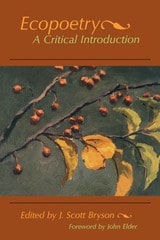
Ecopoetry
Critical IntroductionScott Bryson
University of Utah Press, 2002
The burgeoning field of ecocriticism is beginning to address the work of such ecopoets as Gary Snyder, Mary Oliver, W. S. Merwin, and Wendell Berry, among others, whose poems increasingly deal with ecological and environmental issues. Ecopoetry: A Critical Introduction assembles previously unpublished contributions from many of the most important scholars in the field as they discuss the historical and crosscultural roots of ecopoetry, while expanding the boundaries to include such themes as genocide and extinction, the lesbian body, and post colonialism. This volume gathers these necessary voices in the emerging conversation regarding poetry’s place in the environmental debate.
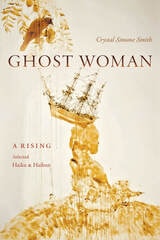
Ghost Woman
A RisingCrystal Simone Smith
Duke University Press, 2026
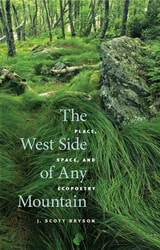
The West Side of Any Mountain
Place, Space, and EcopoetryJ. Scott Bryson
University of Iowa Press, 2005
Informed in general by current thinking in environmental theory and specifically by the work of cultural geographer Yi-Fu Tuan, The West Side of Any Mountain participates in and furthers this scholarly attention by offering an overarching theoretical framework with which to approach the field.
One area that contemporary theorists have found problematic is the dualistic civilization/wilderness binary that focuses on the divisions between culture and nature, thereby increasing the modern sense of alienation. Tuan’s place-space framework offers a succinct vocabulary for describing the attitudes of ecological poets and other nature writers in a way that avoids setting up an adversarial relationship between place and space. Scott Bryson describes the Tuanian framework and employs it to offer fresh readings of the work of four major ecopoets: Wendell Berry, Joy Harjo, Mary Oliver, and W. S. Merwin.
The West Side of Any Mountain will be of great interest to scholars and teachers working in the field of contemporary nature poetry. It is recommended for nature-writing courses as well as classes dealing with 20th-century poetry, contemporary literary criticism, and environmental theory.