Results by title
2 books match the query 'Fireflies'
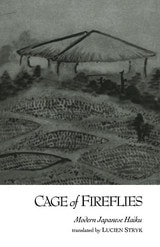
Cage Of Fireflies
Modern Japanese HaikuLucien Stryk
Ohio University Press, 1993
In all arts — music, painting, dance, theatre — change has come with that startling moment of dissatisfaction when the artist upends complacency, shocks the old to its foundations, and emerges with clear vision. He has had the courage to rescue his art from dullness. Two of Japan’s “Great Four” of haiku, Basho (1644-94) and Shiki (1862-1902), were such revolutionaries, albeit two hundred years apart. Before Basho, haiku was but a pleasant occupation for the idle. He set about transforming it with such success that experts to this day agree that his were the first true haiku.
Shiki, who lived into the 20th century, was passionate in his attempt to salvage haiku from its past, sending out shock waves by dismissing virtually all earlier work, including most of Basho’s. He saw it as his mission to make a difference — to let nothing, not even the most revered, stand in the way. He proclaimed, “A poem has no meaning. It is feeling alone.” And he practiced what he preached.
Autumn wind:
gods, Buddha—
lies, lies, lies.
These modern Japanese poets, many of whom are translated here into English for the first time, learned as much from Basho as from Shiki, and from Buson (1715-83) and Issa (1763-1827), the “Great Four.” Yet in a sense they are followers of Shiki, in spite of the harshness of his views and the impossibly high standards he demanded. They were forced to reckon with him, became willing participants in a heated dialogue with him. They had to: his spirit dominated the age. Stryk captures that spirit here, in this Cage of Fireflies.
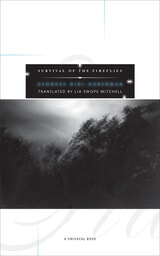
Survival of the Fireflies
Georges Didi-Huberman
University of Minnesota Press, 2018
Seeking out the minor lights of friendship in a time of fascism
Dante once spoke, in his Divine Comedy, of the miniscule lights, in the twenty-sixth canto of the Inferno, who, contrary to the great lights that shined bright within the sublime circles of Paradise, frailly wandered in the somber pockets of glimmering light within the darkness. Pliny the Elder was once preoccupied by a type of fly named pyrallis or pyrotocon, which was only able to fly within fire: “as long as it remains in the fire, it can fly; when its flight takes it out too far a distance, it dies.”
Through his readings of Dante, Pasolini, Walter Benjamin, and others, Georges Didi-Huberman seeks again to understand this strange, minor light, the signals of small beings in search of love and friendship. Their flickering presence serves as a counterforce to the blinding sovereign power that Giorgio Agamben calls The Kingdom and the Glory, that artificial brilliance that once surrounded dictators and today emanates from every screen. In this timely reflection, much needed in our time of excessive light, Didi-Huberman’s Survival of the Fireflies offers a humble yet powerful image of individual hope and desire: the firefly-image.