Results by title
3 books match the query 'Hold'
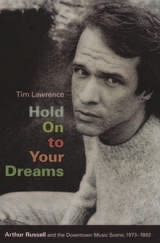
Hold On to Your Dreams
Arthur Russell and the Downtown Music Scene, 1973-1992Tim Lawrence
Duke University Press, 2009
Tim Lawrence traces Russell's odyssey from his hometown of Oskaloosa, Iowa, to countercultural San Francisco, and eventually to New York, where he lived from 1973 until his death from AIDS-related complications in 1992. Resisting definition while dreaming of commercial success, Russell wrote and performed new wave and disco as well as quirky rock, twisted folk, voice-cello dub, and hip-hop-inflected pop. “He was way ahead of other people in understanding that the walls between concert music and popular music and avant-garde music were illusory,” comments the composer Philip Glass. "He lived in a world in which those walls weren't there." Lawrence follows Russell across musical genres and through such vital downtown music spaces as the Kitchen, the Loft, the Gallery, the Paradise Garage, and the Experimental Intermedia Foundation. Along the way, he captures Russell's openness to sound, his commitment to collaboration, and his uncompromising idealism.

Poetics of the Hold
Variations on the Slave ShipFabienne Kanor
University of Chicago Press, 0
An essential reflection on the haunting legacy of the transatlantic slave trade from award-winning French filmmaker and writer Fabienne Kanor.
A century and a half after the passage of the last known slave ship, the hold—in which captives were imprisoned together under inhuman conditions—still haunts collective memory, particularly that of Afro-descendant artists, thinkers, and writers. With The Poetics of the Hold, scholar, writer, and filmmaker Fabienne Kanor offers a series of meditations on the transatlantic slave trade and on how the experience of the Middle Passage has been represented in modern culture of the United States, Francophone Africa, and the French West Indies.
In this important book, Kanor draws from a multitude of sources—history, literature, art, philosophy, the Négritude tradition, and Caribbean thinkers—to take readers on a journey from colonial archives to public spaces, museums, and other places of commemoration. Throughout, the image of the hold serves as a spectral monument, the traumatic reverberations of which can be felt in both the texts Kanor examines and in her own writing. While archives, logbooks, and sea reports provide information about slave ships, the stories of the slaves themselves too often remain shrouded in silence. This powerful and poetic book seeks to rectify that amnesia and to wrestle with these neglected histories and their afterlives.
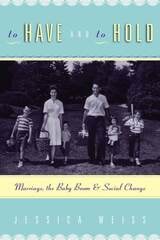
To Have and to Hold
Marriage, the Baby Boom, and Social ChangeJessica Weiss
University of Chicago Press, 2000
Jessica Weiss delves beneath these mythic images and paints a far more complex picture that reveals strong continuities between the baby boomers and their parents. Drawing on interviews with American couples from the 1950s to the 1980s, Weiss creates a dynamic portrait of family and social change in the postwar era. She pairs these firsthand accounts with a deft analysis of movies, television shows, magazines, and advice books from each decade, providing an unprecedented and intimate look at ordinary marriages in a time of sweeping cultural change.
Weiss shows how young couples in the 1950s attempted to combine egalitarian hopes with traditional gender roles. Middle-class women encouraged their husbands to become involved fathers. Midlife wives and mothers reshaped the labor force and the home by returning to work in the 1960s. And couples strove for fulfilling marriages as they dealt with the pressures of childrearing in the midst of the sexual and divorce revolutions of the 1960s and 1970s. By the 1980s, they were far more welcoming to the ideas of the women's movement than has often been assumed. More than simply changing with the times, the parents of the baby boom contributed to changing times themselves.
Weiss's excellent use of family interviews that span three decades, her imaginative examination of popular culture, and her incisive conclusions make her book an invaluable contribution not only to our understanding of the past but also to our understanding of men's and women's roles in today's family.
"Weiss has written an enlightening book that examines the dynamics of American families past and present. . . . Since Weiss is a historian, she provides analyses of her arguments that are factual rather than emotive, and her use of family interviews further contributes to a strong presentation. Overall, this is a unique works because its multidisciplinary approach informs but never preaches on the emotionally charged topic of the American family.—Sheila Devaney, Library Journal