Results by title
2 books match the query 'Ithaca'
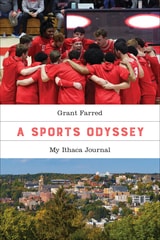
A Sports Odyssey
My Ithaca JournalGrant Farred
Temple University Press, 2025
Grant Farred has long had a passionate connection with sports. In A Sports Odyssey, he weaves together an account of his own sports fandom that is profoundly personal and universal.
As readers of his Long Distance Love know, Grant Farred has been a supporter of the English Premier League club, Liverpool Football Club, for decades. His fandom for that team launched an unexpected connection with a world beyond the limits of the apartheid state of his upbringing in South Africa. However, A Sports Odyssey shows that as Farred’s fervor for Liverpool ended, he developed a new set of sports attachments in Ithaca, New York: to his son’s youth basketball career, to the men’s basketball team at Cornell University and its coach, and even to professional teams like the New York Knicks. Farred’s bemusement at finding himself a sports parent, a New Yorker, and a company man, only underline the sincerity of his affections.
In A Sports Odyssey, Farred writes elegantly and eloquently about how sports and sports fandom create a sense of belonging, but also loss. This is a heartfelt examination of how we find “home” in who and what we love.
In the series Sporting
[more]
How Places Make Us
Novel LBQ Identities in Four Small CitiesJaponica Brown-Saracino
University of Chicago Press, 2017
We like to think of ourselves as possessing an essential self, a core identity that is who we really are, regardless of where we live, work, or play. But places actually make us much more than we might think, argues Japonica Brown-Saracino in this novel ethnographic study of lesbian, bisexual, and queer individuals in four small cities across the United States.
Taking us into communities in Ithaca, New York; San Luis Obispo, California; Greenfield, Massachusetts; and Portland, Maine; Brown-Saracino shows how LBQ migrants craft a unique sense of self that corresponds to their new homes. How Places Make Us demonstrates that sexual identities are responsive to city ecology. Despite the fact that the LBQ residents share many demographic and cultural traits, their approaches to sexual identity politics and to ties with other LBQ individuals and heterosexual residents vary markedly by where they live. Subtly distinct local ecologies shape what it feels like to be a sexual minority, including the degree to which one feels accepted, how many other LBQ individuals one encounters in daily life, and how often a city declares its embrace of difference. In short, city ecology shapes how one “does” LBQ in a specific place. Ultimately, Brown-Saracino shows that there isn’t one general way of approaching sexual identity because humans are not only social but fundamentally local creatures. Even in a globalized world, the most personal of questions—who am I?—is in fact answered collectively by the city in which we live.
Taking us into communities in Ithaca, New York; San Luis Obispo, California; Greenfield, Massachusetts; and Portland, Maine; Brown-Saracino shows how LBQ migrants craft a unique sense of self that corresponds to their new homes. How Places Make Us demonstrates that sexual identities are responsive to city ecology. Despite the fact that the LBQ residents share many demographic and cultural traits, their approaches to sexual identity politics and to ties with other LBQ individuals and heterosexual residents vary markedly by where they live. Subtly distinct local ecologies shape what it feels like to be a sexual minority, including the degree to which one feels accepted, how many other LBQ individuals one encounters in daily life, and how often a city declares its embrace of difference. In short, city ecology shapes how one “does” LBQ in a specific place. Ultimately, Brown-Saracino shows that there isn’t one general way of approaching sexual identity because humans are not only social but fundamentally local creatures. Even in a globalized world, the most personal of questions—who am I?—is in fact answered collectively by the city in which we live.
[more]