Results by title

4 books match the query 'Novellas'

cover of In the Mouth: Stories and Novellas

In the Mouth

Stories and Novellas

Eileen Pollack

Four Way Books, 2008

“…an American talent…”—Stephen King Pollack writes about times of tragedy and transition insightfully, aware of their everyday quality and of their gravity. In the Mouth is a window onto the amazing tenderness and irrationality of human life. One story, “The Bris,” has been selected for The Best American Short-Stories 2008 (Edited by Stephen King and Heidi Pitlor). “Eileen Pollock writes with great acuity, humor, and intelligent resign-ation about the various ways family love is called upon and revealed. This book is terrific company.”—Lorrie Moore “These are funny, rueful, wise stories, steeped in absurdity, pain, possibility —the work of a writer who has lived.”—Gish Jen
[more]
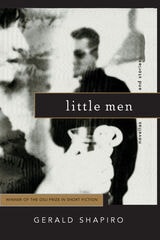
cover of LITTLE MEN: NOVELLAS AND STORIES

LITTLE MEN

NOVELLAS AND STORIES

GERALD SHAPIRO

The Ohio State University Press, 2004

Ira Mittelman, the middle-aged hero of “A Box of Ashes,” one of two novellas in Little Men, is wrestling with a dilemma: should he fulfill his late father’s dying wish by taking the old man’s ashes back to Missouri, to scatter them on the grounds of Camp HaHaTonka, the Boy Scout camp where Ira spent several summers as a boy? It’s a long way to go just to dump some ashes, and if Ira makes this pilgrimage, his absence might jeopardize the fragile relationship he’s managed to maintain with his ex-wife (they’re still having sex every Friday night).

In “Spivak in Babylon,” Little Men’s other novella, it’s 1982, and Leo Spivak, an ambitious 30-year-old copywriter at a large Chicago advertising agency, is about to get his big break: a chance to go to Hollywood to participate for the first time in the filming of a television commercial. A week in Hollywood, on the company’s expense account! A room at the fabled Chateau Marmont (Garbo’s old suite, in fact)! The only problem is the subject of the commercial itself: a new feminine hygiene spray to be marketed to pre-adolescent girls. Hovering over all the proceedings in “Spivak in Babylon” is the genial, befuddled presence of President Ronald Reagan, the Leader of the Free World, who haunts Leo’s dreams.

[more]
cover of Night of Denial: Stories and Novellas

Night of Denial

Stories and Novellas

Ivan Bunin

Northwestern University Press, 2006

The first Russian to be awarded the Nobel Prize for literature, Ivan Bunin is often considered the last of the great Russian masters. Already renowned in Russia before the revolution, he fled the country in 1920 and lived the remainder of his life in France, where he continued to write for thirty years. Bunin made his name as a short-story writer with such masterpieces as "The Gentleman from San Francisco," the title piece in one of his collections and one of the stories in this volume. His last book of stories, Dark Avenues, was published in the 1940s. Among his longer works were a fictional autobiography, The Life of Arseniev (1930), and its sequel, Youth (1939), which were later collected into one volume, and two memoirs, The Accursed Days (1926), and Memories and Portraits (1950). He also wrote books on Tolstoy and Chekhov, both of whom he knew personally. Bunin, in fact, serves as a link-both personal and literary-between Tolstoy, whom he met as a young man, Chekhov, a close friend, and Vladimir Nabokov, who was influenced by Bunin early in his career and who moved in the same émigré literary circles in the twenties and thirties.

Bunin achieved his greatest mastery in the short story, and much of his finest work appears in this volume-the largest collection of his prose works ever published in English. In Robert Bowie's fine translation, with extensive annotations and a lengthy critical afterword, this work affords readers of English their first opportunity for a sustained encounter with a Russian classic, and one of the great writers of the twentieth century.

[more]
cover of The Clouds in Memphis: Stories and Novellas

The Clouds in Memphis

Stories and Novellas

C. J. Hribal

University of Massachusetts Press, 2000

The late Raymond Carver wrote of Matty's Heart, C. J. Hribal's first book, "our literature is healthier, and wiser with the publication of this collection of short fiction." Commenting on the same volume, Anne Tyler wrote, "some of these pieces are real masterpieces." Now Hribal is back with a new collection that charts both the recesses of the human heart and the resiliency of the human spirit. In three novellas and two short stories, Hribal traces the arcs of emotion and action that can follow on the heels of calamity. In the title novella, a divorced woman whose oldest son is hit and killed by a reckless driver struggles to come to terms with both her grief and the wreckage of her life since her marriage ended. In "War Babies," the sister of a woman killed in what may or may not have been an industrial accident tries to imagine the circumstances leading up to her sister's death, believing that in knowledge there can be solace. A different tack is taken by the central character in "Consent," a real estate developer who has to deal with a drowning that occurs in his newest subdivision: his reconstruction of the event carries him into dangerous moral territory. But not all the territory here is dangerous. The novella "And That's the Name of That Tune" features a narrator who recalls his father's escapades in a bar when the son was his seven-year-old companion. Tender, compassionate, bewildered, the son strives to understand the havoc his father inflicts on his family. In a starred review, Publishers Weekly wrote that Hribal "establishes an American landscape in the tradition of Cheever and Updike, though his is a world not of cocktail parties but of trailer parks, bars, and courtrooms. The subtle power of these stories will leave the reader hungry for more."
[more]