Results by title
5 books match the query 'Paying'

Paying the Piper
Productivity, Incentives, and Financing in U.S. Higher EducationMichael S. McPherson, Morton Owen Schapiro, and Gordon C. Winston, Editors
University of Michigan Press, 1994
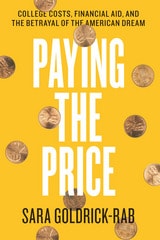
Paying the Price
College Costs, Financial Aid, and the Betrayal of the American DreamSara Goldrick-Rab
University of Chicago Press, 2016
Not necessarily, says Sara Goldrick-Rab, and with Paying the Price, she shows in damning detail exactly why. Quite simply, college is far too expensive for many people today, and the confusing mix of federal, state, institutional, and private financial aid leaves countless students without the resources they need to pay for it.
Drawing on an unprecedented study of 3,000 young adults who entered public colleges and universities in Wisconsin in 2008 with the support of federal aid and Pell Grants, Goldrick-Rab reveals the devastating effect of these shortfalls. Half the students in the study left college without a degree, while less than 20 percent finished within five years. The cause of their problems, time and again, was lack of money. Unable to afford tuition, books, and living expenses, they worked too many hours at outside jobs, dropped classes, took time off to save money, and even went without adequate food or housing. In many heartbreaking cases, they simply left school—not with a degree, but with crippling debt. Goldrick-Rab combines that shocking data with devastating stories of six individual students, whose struggles make clear the horrifying human and financial costs of our convoluted financial aid policies.
America can fix this problem. In the final section of the book, Goldrick-Rab offers a range of possible solutions, from technical improvements to the financial aid application process, to a bold, public sector–focused “first degree free” program. What’s not an option, this powerful book shows, is doing nothing, and continuing to crush the college dreams of a generation of young people.

Paying the Price
Ignacio Ellacuría and the Murdered Jesuits of El SalvadorTeresa Whitfield
Temple University Press, 1994
On November 16, 1989, on the campus of El Salvador's University of Central America, six Jesuits and two women were murdered by members of the Salvadoran army, an army funded and trained by the United States. One of the murdered Jesuits was Ignacio Ellacuría, the university's Rector and a key, although controversial, figure in Salvadoran public life. From an opening account of this terrible crime, Paying the Price asks, Why were they killed and what have their deaths meant? Answers come through Teresa Whitfield's detailed examination of Ellacuría's life and work. His story is told in juxtaposition with the crucial role played by the unraveling investigation of the Jesuits' murders within El Salvador's peace process.
A complex and nuanced book, Paying the Price offers a history of the Church in El Salvador in recent decades, an analysis of Ellacuría's philosophy and theology, an introduction to liberation theology, and an account of the critical importance of the University of Central America. In the end, Whitfield's comprehensive picture of conditions in El Salvador suggest that the Jesuits' murders were almost inevitable. A crime that proved a turning point in El Salvador's civil war, the murders expressed the deep tragedy of the Salvadoran people beyond suffering the heartless cruelty, violence, and deceitfulness of a corrupt military and their patrons in the U.S. government.
Whitfield draws on her extensive research of Jesuit archives and private papers, Ellacuría's diaries, documents declassified by the U.S. government, and 200 interviews conducted with sources ranging from Jesuits to Salvadoran military officers, U.S. officials and congressmen to human rights campaigners.

Paying with Their Bodies
American War and the Problem of the Disabled VeteranJohn M. Kinder
University of Chicago Press, 2015
America has grappled with the questions posed by injured veterans since its founding, and with particular force since the early twentieth century: What are the nation’s obligations to those who fight in its name? And when does war’s legacy of disability outweigh the nation’s interests at home and abroad? In Paying with Their Bodies, John M. Kinder traces the complicated, intertwined histories of war and disability in modern America. Focusing in particular on the decades surrounding World War I, he argues that disabled veterans have long been at the center of two competing visions of American war: one that highlights the relative safety of US military intervention overseas; the other indelibly associating American war with injury, mutilation, and suffering. Kinder brings disabled veterans to the center of the American war story and shows that when we do so, the history of American war over the last century begins to look very different. War can no longer be seen as a discrete experience, easily left behind; rather, its human legacies are felt for decades.
The first book to examine the history of American warfare through the lens of its troubled legacy of injury and disability, Paying with Their Bodies will force us to think anew about war and its painful costs.

The Visibility Bind
Being Seen, Getting Paid, and Paying the Price of Social Media SuccessBrooke Erin Duffy
University of Chicago Press, 0
A revelatory look at the people, platforms, and power struggles shaping work in the creator economy.
More than two decades after YouTube first invited scrappy amateurs to “broadcast yourself,” social media content creation has transformed into one of the fastest growing labor markets. Today, some two hundred million people work as platform-dependent content creators, influencers, or streamers. Social media platforms boldly tout the rewards of the digital creator economy: independence, flexibility, and the chance to convert one’s ingenuity into cash. Yet the image of work in this entrepreneurial Promised Land conceals a starker reality—one marked by labor precarity, exploitation, and entrenched structural inequalities.
In this essential work, award-winning communication scholar Brooke Erin Duffy analyzes the paradox of the “visibility bind.” On the one hand, labor devaluation and algorithmic suppression—where unseen forces and so-called “shadowbans” bury worker output—threaten to render creators invisible. On the other, excessive visibility introduces harms of its own, from scrutiny and surveillance to networked harassment. For creators at the margins—among them, creators of color, LGBTQ+ voices, and disability advocates—the bind is especially pronounced, belying the promise of a talent meritocracy.
Drawing on extensive, in-depth interviews and more than a decade of insight, Duffy situates creators’ experiences within the broader landscapes of self-commodification and platform capitalism. But while platforms hold immense power to structure the pathways to success, creators and influencers wield newfound sway in this high-stakes visibility game. They are organizing, building solidarity, and experimenting with new forms of labor consciousness.
Refuting conventional wisdom about creator careers, Duffy illuminates the hidden labor dynamics for a class of workers shaping everything from culture and commerce to civil liberties and geopolitical conflict. The Visibility Bind reveals the price and perils for anyone who “puts themselves out there.”