Results by title
2 books match the query 'Tsar'
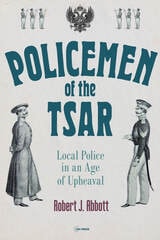
Policemen of the Tsar
Local Police in an Age of UpheavalRobert J. Abbott
Central European University Press, 2022
Founded by Peter the Great in 1718, Russia’s police were key instruments of tsarist power. In the reign of Alexander II (1855-1881), local police forces took on new importance. The liberation of 23 million serfs from landlord control, growing fear of crime, and the terrorist violence of the closing years challenged law enforcement with new tasks that made worse what was already a staggering burden. (“I am obliged to inform Your Imperial Highness that the police often fail to carry out their assignments and, when they do execute them, they do so poorly because of their moral corruption…”) This book describes the regime’s decades-long struggle to reform and strengthen the police. The author reviews the local police’s role and performance in the mid-nineteenth century and the implications of the largely unsuccessful effort to transform them. From a longer-term perspective, the study considers how the police’s systemic weaknesses undermined tsarist rule, impeded a range of liberalizing reforms, perpetuated reliance on the military to maintain law and order, and gave rise to vigilante justice.
While its primary focus is on European Russia, the analysis also covers much of the imperial periphery, discussing the police systems in the Baltic Provinces, Congress Poland, the Caucasus, Central Asia, and Siberia.
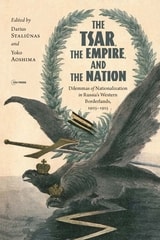
The Tsar, The Empire, and The Nation
Dilemmas of Nationalization in Russia's Western Borderlands, 1905-1915Darius Staliunas
Central European University Press, 2021
This collection of essays addresses the challenge of modern nationalism to the tsarist Russian Empire. First appearing on the empire’s western periphery this challenge, was most prevalent in twelve provinces extending from Ukrainian lands in the south to the Baltic provinces in the north, as well as to the Kingdom of Poland.
At issue is whether the late Russian Empire entered World War I as a multiethnic state with many of its age-old mechanisms run by a multiethnic elite, or as a Russian state predominantly managed by ethnic Russians. The tsarist vision of prioritizing loyalty among all subjects over privileging ethnic Russians and discriminating against non-Russians faced a fundamental problem: as soon as the opportunity presented itself, non-Russians would increase their demands and become increasingly separatist.
The authors found that although the imperial government did not really identify with popular Russian nationalism, it sometimes ended up implementing policies promoted by Russian nationalist proponents. Matters addressed include native language education, interconfessional rivalry, the “Jewish question,” the origins of mass tourism in the western provinces, as well as the emergence of Russian nationalist attitudes in the aftermath of the first Russian revolution.