
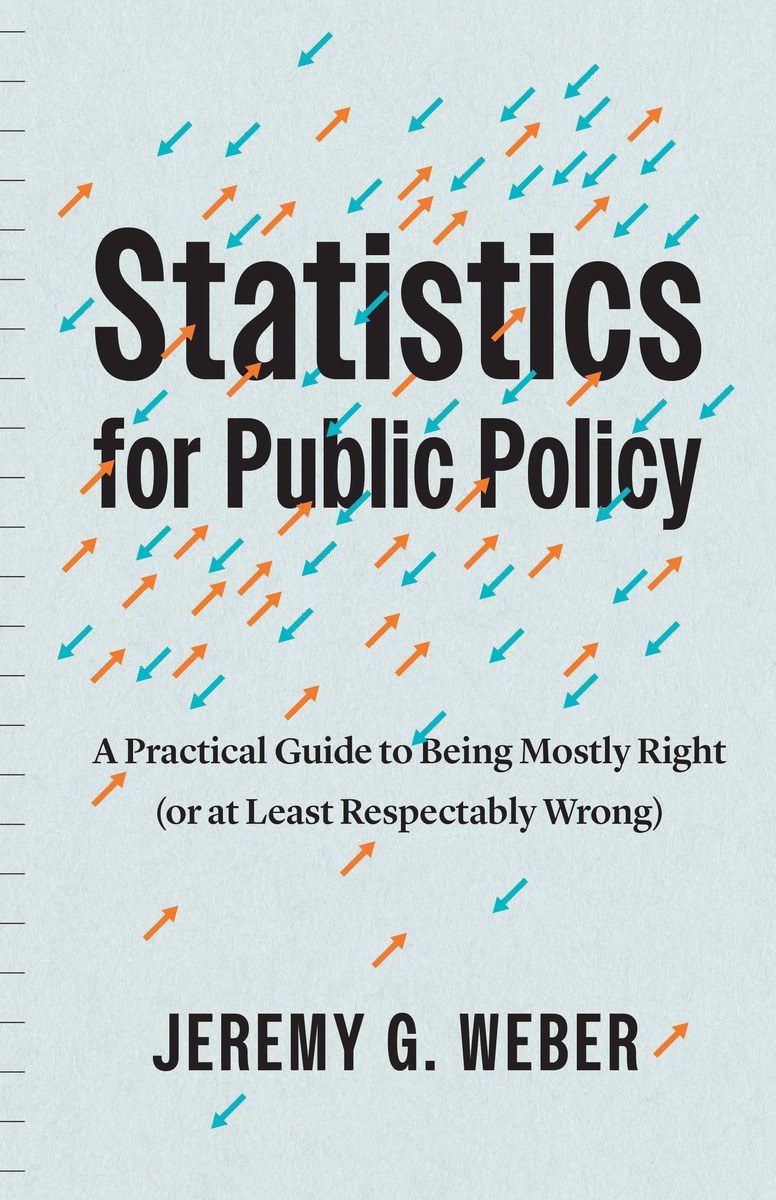
Statistics for Public Policy: A Practical Guide to Being Mostly Right (or at Least Respectably Wrong)
by Jeremy G. Weber
University of Chicago Press, 2024
Cloth: 978-0-226-82565-6 | Paper: 978-0-226-83075-9 | eISBN: 978-0-226-83074-2 (all)
Library of Congress Classification HA29.W399 2024
Dewey Decimal Classification 300.151
ABOUT THIS BOOK
A long-overdue guide on how to use statistics to bring clarity, not confusion, to policy work.
Statistics are an essential tool for making, evaluating, and improving public policy. Statistics for Public Policy is a crash course in wielding these unruly tools to bring maximum clarity to policy work. Former White House economist Jeremy G. Weber offers an accessible voice of experience for the challenges of this work, focusing on seven core practices:
- Thinking big-picture about the role of data in decisions
- Critically engaging with data by focusing on its origins, purpose, and generalizability
- Understanding the strengths and limits of the simple statistics that dominate most policy discussions
- Developing reasons for considering a number to be practically small or large
- Distinguishing correlation from causation and minor causes from major causes
- Communicating statistics so that they are seen, understood, and believed
- Maintaining credibility by being right (or at least respectably wrong) in every setting
See other books on: Practical Guide | Probability & Statistics | Social sciences | Statistical methods | Statistics
See other titles from University of Chicago Press