
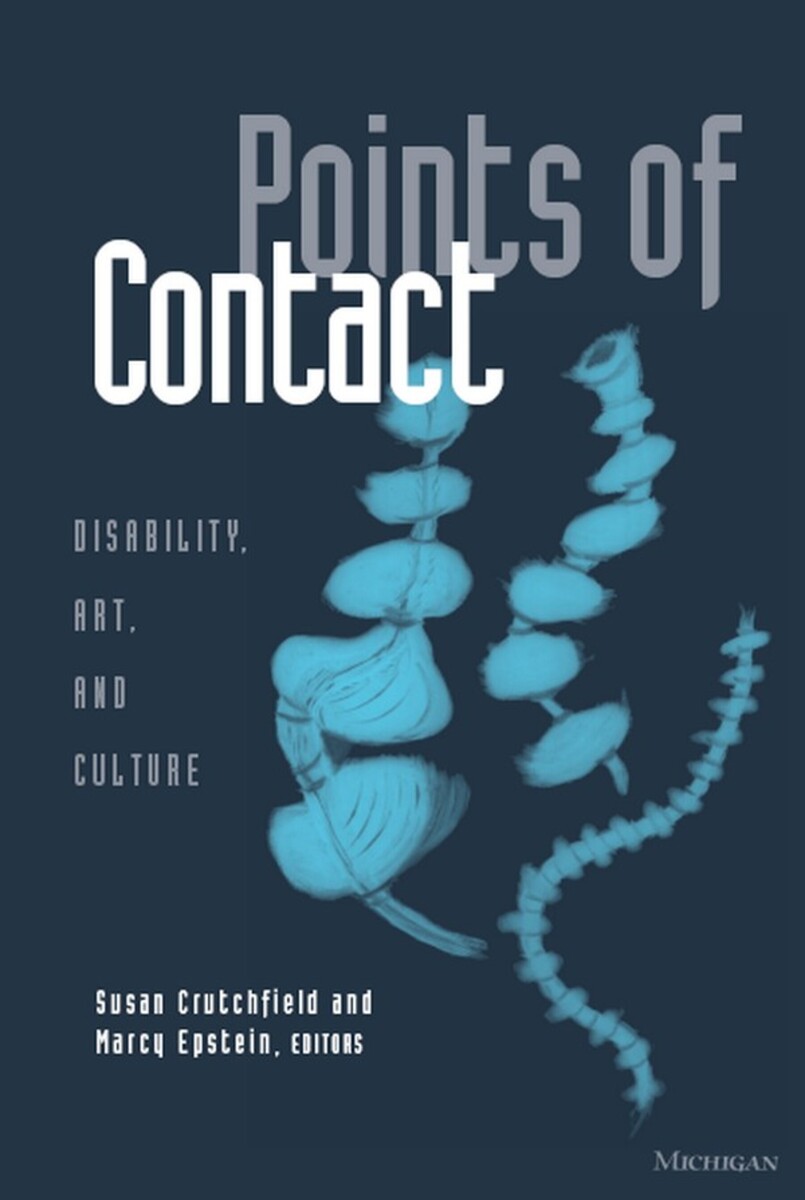
Points of Contact: Disability, Art, and Culture
edited by Susan Crutchfield, Marcy J. Epstein and Marcy Joy Epstein
University of Michigan Press, 2000
Cloth: 978-0-472-09711-1 | Paper: 978-0-472-06711-4 | eISBN: 978-0-472-90684-0 (OA) | eISBN: 978-0-472-22602-3 (standard)
Library of Congress Classification HV1568.2.P65 2000
Dewey Decimal Classification 305.90816
ABOUT THIS BOOK
Points of Contact brings together contributions by leading writers, artists, scholars, and critics to provide a remarkably broad and consistently engaging look at the intersection of disability and the arts. The contributions include essays and memoirs by a wide range of disabled and nondisabled writers, including Bell Gale Chevigny, Sandra Gilbert, Joseph Grigely, Georgina Kleege, Victoria Ann Lewis, Carol Poore, Tobin Siebers, and Rosemarie Garland Thomson among others; poetry by Brooke Horvath, Joan Seliger Sidney, William Stafford, and others; fiction by Stephen Dixon, Michael Downs, Georgina Kleege, Dallas Wiebe, and others. The collection covers a broad range of subjects and concerns that lie at the intersection of disability and the arts, including fetal alcohol syndrome, education, and identity; representations of disability in the visual arts and the complicated position of the disabled spectator; the impact of cancer on the patient and the caregiver; the similarities between beauty pageants and freak shows; Alzheimer's disease; prosthetic devices; the mechanized disabled body; disability and performance; and profiles of Helen Keller and Annie Sullivan, Christopher Reeve, Franklin Roosevelt, and sado-masochistic performance artist Bob Flanagan. Points of Contact: Disability, Art, and Culture was originally published as a special double issue of the well regarded literary magazine, the Michigan Quarterly Review. Now available in a single, convenient paperback volume, its broad range of perspectives on disability and its entertaining and engaging selections will appeal to general readers, scholars, and students alike.
See other books on: Contact | Disability studies | People with disabilities | Points | Sociology of disability
See other titles from University of Michigan Press