Results by title
10 books match the query 'Points'

POINTS OF RESISTANCE
Lauren Rabinovitz
University of Illinois Press, 2003
[more]
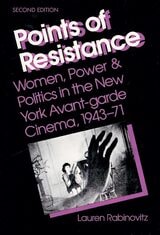
POINTS OF RESISTANCE
Lauren Rabinovitz
University of Illinois Press, 2003
In detailing the relationship of three women filmmakers’ lives and films to the changing institutions of the post-World War II era, Lauren Rabinovitz has created the first feminist social history of the North American avant-garde cinema.
At a time when there were few women directors in commercial films, the postwar avant-garde movement offered an opportunity. Rabinovitz argues that avant-garde cinema, open to women because of its marginal status in the art world, included women as filmmakers, organizers, and critics.
Focusing on Maya Deren, Shirley Clarke, and Joyce Wieland, Rabinovitz illustrates how women used bold physical images to enhance their work and how each provided entrée to her subversive art while remaining culturally acceptable. She combines archival materials with her own interviews to show how the women’s labor and films, even their identities as women filmmakers, were produced, disseminated, and understood. With a new preface and an updated bibliography, Points of Resistance simultaneously demonstrates the avant-garde’s importance as an organizational network for women filmmakers and the processes by which women remained marginal figures within that network.
[more]
Points of Contact
Disability, Art, and CultureSusan Crutchfield and Marcy Epstein, Editors
University of Michigan Press, 2000
Points of Contact brings together contributions by leading writers, artists, scholars, and critics to provide a remarkably broad and consistently engaging look at the intersection of disability and the arts. The contributions include essays and memoirs by a wide range of disabled and nondisabled writers, including Bell Gale Chevigny, Sandra Gilbert, Joseph Grigely, Georgina Kleege, Victoria Ann Lewis, Carol Poore, Tobin Siebers, and Rosemarie Garland Thomson among others; poetry by Brooke Horvath, Joan Seliger Sidney, William Stafford, and others; fiction by Stephen Dixon, Michael Downs, Georgina Kleege, Dallas Wiebe, and others. The collection covers a broad range of subjects and concerns that lie at the intersection of disability and the arts, including fetal alcohol syndrome, education, and identity; representations of disability in the visual arts and the complicated position of the disabled spectator; the impact of cancer on the patient and the caregiver; the similarities between beauty pageants and freak shows; Alzheimer's disease; prosthetic devices; the mechanized disabled body; disability and performance; and profiles of Helen Keller and Annie Sullivan, Christopher Reeve, Franklin Roosevelt, and sado-masochistic performance artist Bob Flanagan. Points of Contact: Disability, Art, and Culture was originally published as a special double issue of the well regarded literary magazine, the Michigan Quarterly Review. Now available in a single, convenient paperback volume, its broad range of perspectives on disability and its entertaining and engaging selections will appeal to general readers, scholars, and students alike.
[more]

Points of Departure
Rethinking Student Source Use and Writing Studies Research MethodsTricia Serviss
Utah State University Press, 2017
Points of Departure encourages a return to empirical research about writing, presenting a wealth of transparent, reproducible studies of student sources. The volume shows how to develop methods for coding and characterizing student texts, their choice of source material, and the resources used to teach information literacy. In so doing, the volume advances our understanding of how students actually write.
The contributors offer methodologies, techniques, and suggestions for research that move beyond decontextualized guides to grapple with the messiness of research-in-process, as well as design, development, and expansion. Serviss and Jamieson’s model of RAD writing studies research is transcontextual and based on hybridized or mixed methods. Among these methods are citation context analysis, research-aloud protocols, textual and genre analysis, surveys, interviews, and focus groups, with an emphasis on process and knowledge as contingent. Chapters report on research projects at different stages and across institution types—from pilot to multi-site, from community college to research university—focusing on the methods and artifacts employed.
A rich mosaic of research about research, Points of Departure advances knowledge about student writing and serves as a guide for both new and experienced researchers in writing studies.
Contributors: Crystal Benedicks, Katt Blackwell-Starnes, Lee-Ann Kastman Breuch, Kristi Murray Costello, Anne Diekema, Rebecca Moore Howard, Sandra Jamieson, Elizabeth Kleinfeld, Brian N. Larson, Karen J. Lunsford, M. Whitney Olsen, Tricia Serviss, Janice R. Walker
[more]
Points of Departure
Samuel Weber between Spectrality and ReadingEdited by Peter Fenves, Kevin McLaughlin, and Marc Redfield
Northwestern University Press, 2016
Since the late 1960s, when he introduced Theodor Adorno’s work on literature and cultural critique to an English-speaking public, Samuel Weber has stimulated the discovery of new and unexpected links within a broad spectrum of humanistic disciplines, including critical theory and psychoanalysis, media studies and literary analysis, continental philosophy and theater studies. The international group of scholars who contribute to Points of Departure demonstrate the persistent fecundity of Weber’s work. Centered around his essay on the Ghost of Hamlet, as reflected in the writings of Walter Benjamin and Carl Schmitt, the volume is broadly divided into explorations of the nature of spectrality, on the one hand, and the dynamics of reading, on the other. Each of the twelve essays thus takes its point of departure from “Weber’s singular path between languages, cultures, and traditions”—to quote Jacques Derrida, whose fictive “interview with a passing journalist” is published here for the first time.
[more]

Points of Honor
Short Stories of the Great War by a US Combat MarineThomas Boyd, Edited and with an Introduction by Steven Trout
University of Alabama Press, 2018
A masterwork of World War I short stories portraying the experiences of Marines in battle.
Points of Honor: Short Stories of the Great War by a US Combat Marine is based on author Thomas Alexander Boyd’s personal experiences as an enlisted Marine. First published in 1925 and long out of print, this edition rescues from obscurity a vivid, kaleidoscopic vision of American soldiers, US Marines mostly, serving in a global conflict a century ago. It is a true forgotten masterpiece of World War I literature.
The stories in Points of Honor deal almost entirely with Marines in the midst of battle—or faced with the consequences of military violence. The eleven stories in this collection offer a panoramic view of war experience and its aftermath, what Boyd described as “a mass of more human happenings.” The themes are often antiheroic: dehumanization, pettiness, betrayal by loved ones at home, and the cruelty of military justice. But Boyd’s vision also accommodates courage and loyalty. Like all great works of war literature, this collection underscores the central paradox of armed conflict—its ability to bring out both the best and worst in human beings.
This reissue of Points of Honor is edited, annotated, and introduced by Steven Trout. Trout provides an overview of Thomas Boyd’s war experience and writing career and situates the stories within the broader context of World War I American literature.
Points of Honor received strong reviews at the time of its initial publication and remains an overwhelming reading experience today. While each of the stories is a freestanding work of art, when read together they carry the force of a novel.
[more]
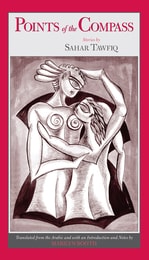
Points of the Compass
StoriesSahar Tawfiq
University of Arkansas Press, 1995
This collection of short stories, recipient of a 1994 University of Arkansas Press Award for Arabic Literature in Translation, presents one of Egypt’s most innovative contemporary fiction writers. In her first collection published in English, Sahar Tawfiq explores the consciousnesses of young women alienated from their surroundings in today’s rapidly changing Egyptian society. In questioning the place of long-powerful myths and beliefs, she is in the forefront of writers examining the legacy of the Pharaohs as it permeates current Egyptian identities and practices, especially in the countryside. Her characters are shaped by journeys through modern social and economic trials and the ageless troubles of the human spirit and heart.
[more]

Points on the Dial
Golden Age Radio beyond the NetworksAlexander Russo
Duke University Press, 2010
The golden age of radio is often recalled as a time when the medium unified the nation, when families gathered around the radios in homes across the country to listen to live, commercially sponsored network broadcasts. In Points on the Dial, Alexander Russo revises our understanding of radio’s past by revealing the hidden histories of production, distribution, and reception practices during this era, which extended from the 1920s into the 1950s. Russo brings to light a tiered broadcasting system with intermingling but distinct national, regional, and local programming forms, sponsorship patterns, and methods of program distribution. Examining a wide range of practices, including regional networking, sound-on-disc transcription, the use of station representatives, spot advertising, and programming aimed at homes with several radios, he not only recasts our understanding of the relationship between national networks and local stations but also charts the development of new ways of listening—often distractedly rather than attentively—that set the stage for radio in the second half of the twentieth century.
[more]
Preferences and Situations
Points of Intersection Between Historical and Rational Choice In.Ira Katznelson
Russell Sage Foundation, 2005
A scholarly gulf has tended to divide historians, political scientists, and social movement theorists on how people develop and act on their preferences. Rational choice scholars assumed that people—regardless of the time and place in which they live—try to achieve certain goals, like maximizing their personal wealth or power. In contrast, comparative historical scholars have emphasized historical context in explaining people's behavior. Recently, a common emphasis on how institutions—such as unions or governments—influence people's preferences in particular situations has emerged, promising to narrow the divide between the two intellectual camps. In Preferences and Situations, editors Ira Katnelson and Barry Weingast seek to expand that common ground by bringing together an esteemed group of contributors to address the ways in which institutions, in their wider historical setting, induce people to behave in certain ways and steer the course of history. The contributors examine a diverse group of topics to assess the role that institutions play in shaping people's preferences and decision-making. For example, Margaret Levi studies two labor unions to determine how organizational preferences are established. She discusses how the individual preferences of leaders crystallize and become cemented into an institutional culture through formal rules and informal communication. To explore how preferences alter with time, David Brady, John Ferejohn, and Jeremy Pope examine why civil rights legislation that failed to garner sufficient support in previous decades came to pass Congress in 1964. Ira Katznelson reaches back to the 13th century to discuss how the institutional development of Parliament after the signing of the Magna Carta led King Edward I to reframe the view of the British crown toward Jews and expel them in 1290. The essays in this book focus on preference formation and change, revealing a great deal of overlap between two schools of thought that were previously considered mutually exclusive. Though the scholarly debate over the merits of historical versus rational choice institutionalism will surely rage on, Preferences and Situations reveals how each field can be enriched by the other.
[more]
Qualifying Times
Points of Change in U.S. Women's SportJaime Schultz
University of Illinois Press, 2014
This perceptive, lively study explores U.S. women's sport through historical "points of change": particular products or trends that dramatically influenced both women's participation in sport and cultural responses to women athletes.
Beginning with the seemingly innocent ponytail, the subject of the Introduction, scholar Jaime Schultz challenges the reader to look at the historical and sociological significance of now-common items such as sports bras and tampons and ideas such as sex testing and competitive cheerleading. Tennis wear, tampons, and sports bras all facilitated women’s participation in physical culture, while physical educators, the aesthetic fitness movement, and Title IX encouraged women to challenge (or confront) policy, financial, and cultural obstacles.
While some of these points of change increased women's physical freedom and sporting participation, they also posed challenges. Tampons encouraged menstrual shame, sex testing (a tool never used with male athletes) perpetuated narrowly-defined cultural norms of femininity, and the late-twentieth-century aesthetic fitness movement fed into an unrealistic beauty ideal.
Ultimately, Schultz finds that U.S. women's sport has progressed significantly but ambivalently. Although participation in sports is no longer uncommon for girls and women, Schultz argues that these "points of change" have contributed to a complex matrix of gender differentiation that marks the female athletic body as different than--as less than--the male body, despite the advantages it may confer.
[more]