
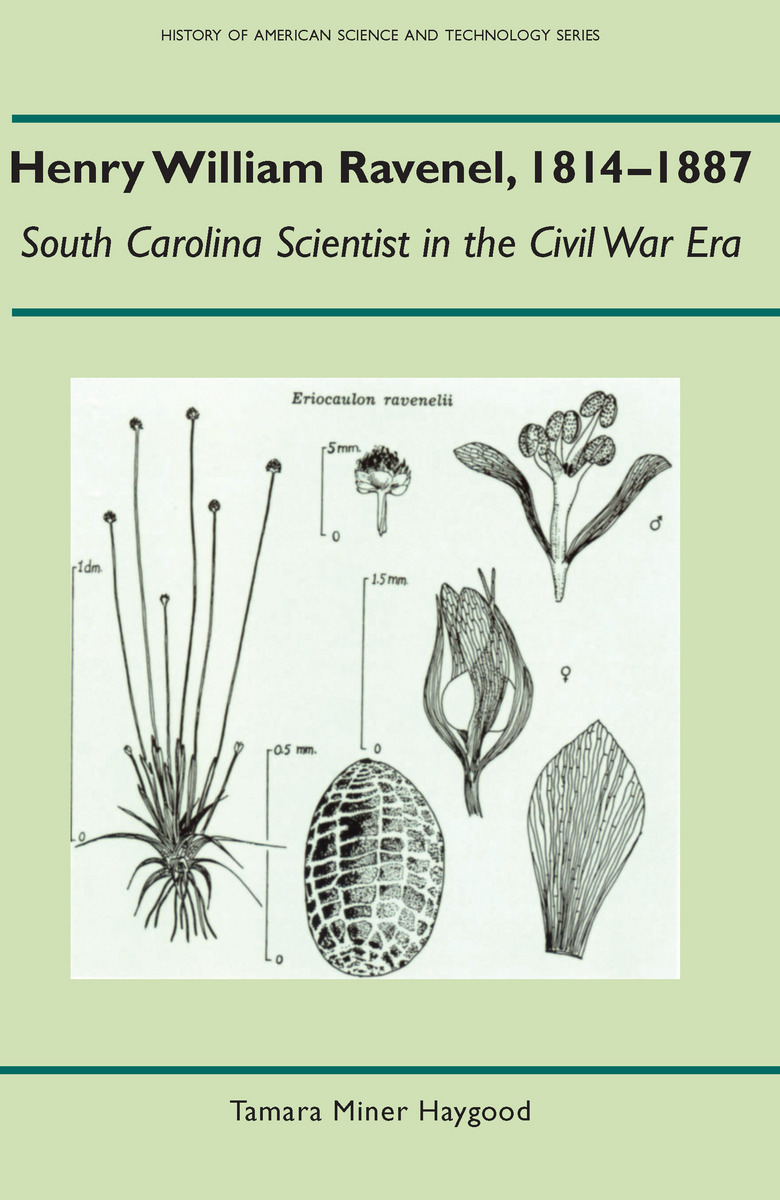
Henry William Ravenel, 1814-1887: South Carolina Scientist in the Civil War Era
ABOUT THIS BOOK
The life of a pioneering Southern scientist in an era of war, change, and discovery.
Henry William Ravenel, 1814–1887: South Carolina Scientist in the Civil War Era is a compelling biography of one of nineteenth-century America's most accomplished yet largely overlooked natural scientists. Through meticulous archival research, Tamara Miner Haygood brings to life the story of Henry William Ravenel, a South Carolina planter, botanist, and pioneering mycologist whose work earned international recognition while he lived far from the major scientific centers of the United States.
Born into the Lowcountry planter class, Ravenel developed a lifelong fascination with the natural world and became a leading authority on the study of fungi and plants. Despite limited formal scientific training, he built an extensive network of correspondents that included some of the most prominent botanists in America and Europe. His collections, publications, and exchanges of specimens contributed significantly to the advancement of botanical science and established his reputation as one of the foremost naturalists of his generation.
Haygood places Ravenel's scientific achievements within the broader context of Southern society, demonstrating how intellectual pursuits flourished in unexpected ways within a region often overlooked in histories of American science. At the same time, the biography confronts the realities of slavery, plantation life, religion, and regional identity that shaped Ravenel's world. His experience challenges long-held assumptions about the relationship between Southern culture and scientific inquiry.
The Civil War and its aftermath transformed Ravenel's life, disrupting his finances, professional networks, and daily routines. Yet he remained committed to scientific work, continuing to collect, study, and publish despite enormous challenges. More than a biography, this volume offers a fascinating exploration of science, society, and survival during one of the most turbulent periods in American history. Essential reading for historians of science, Civil War scholars, environmental historians, botanists, and students of Southern culture.