
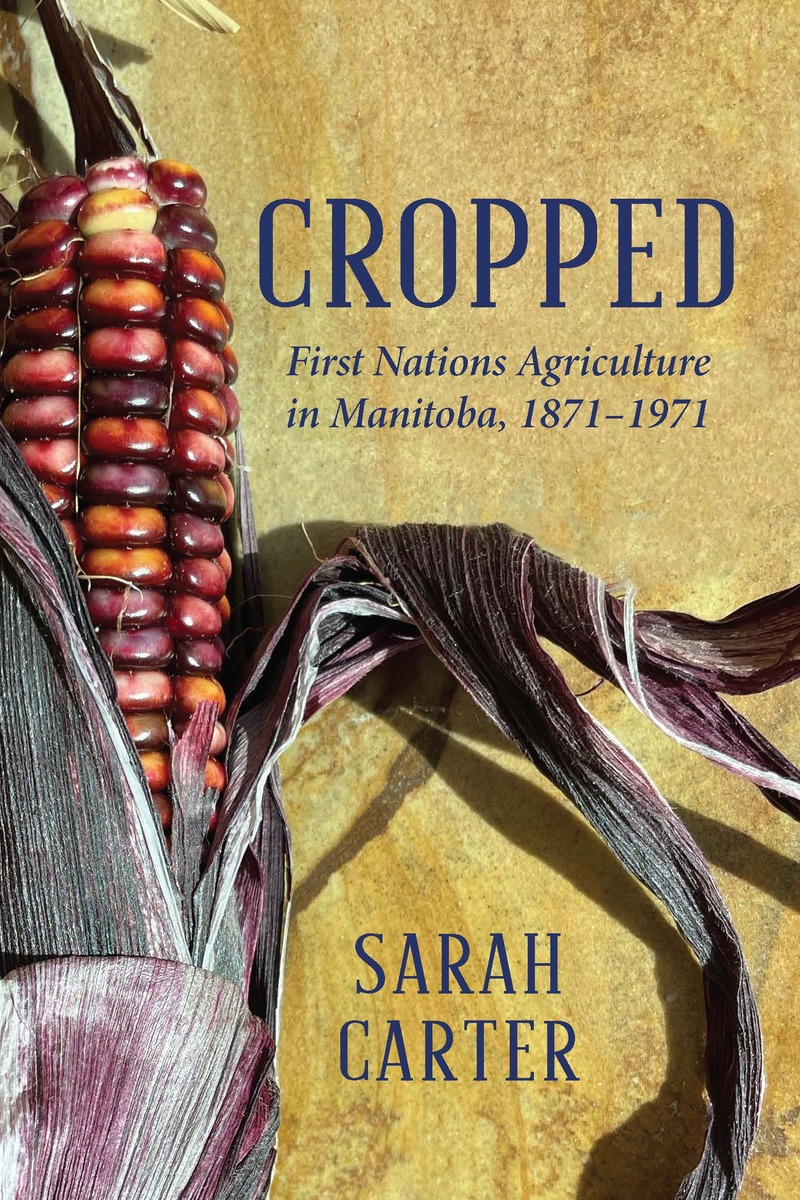
Cropped: First Nations Agriculture in Manitoba, 1871–1971
by Sarah Carter
University of Manitoba Press, 2026
Paper: 978-1-77284-146-6 | eISBN: 978-1-77284-149-7 (epub) | eISBN: 978-1-77284-148-0 (PDF)
TOC
Cover
Contents
Illustrations
Foreword
Origins of the Book
Indigenous Agriculture and Settler Colonialism
Pre-Treaty History of Indigenous Agriculture
Outline of the Book
The Endurance of First Nations Agriculture
1. “A State of General Dissatisfaction”:
Treaties 1 and 2, 1871
Indigenous Peoples’ Understandings and Recordings of the Stone Fort Treaty and the So-Called “Outside” Promises
Treaty 4, 1874
Treaty 5, 1875
Treaty 6, 1876 and Treaty 10, 1906
Farm-Making Costs
Slow Surveys of Reserves and Early Contests with Settlers over Lands and Resources
The Roseau River/Pembina Peoples of Treaty 1
The Indian Act of 1876, Predecessors, and Voting Rights
The Dakota
The Maladministration of the Indian Branch and the J.A.N. Provencher Scandal
Smallpox and the New Spatial and Colonial Order
Removing Property Rights, Indigenous Farms, and Settlements off Reserves
“Indians” and Homestead Lands
Agriculture in Manitoba in the 1870s
Farm Instructors and Model Farms . . . not for Manitoba
The Myth of No Agriculture before the Settlers
2. Challenges, Obstacles, and a Few Advances with Continuing Contests over Land: 1880s–96
Claims to Land: Roseau Rapids, Kaquaygooniash versus Ben Brewster
Conditions Shared with Settlers and Those Unique to First Nations
Rations
Off-Reserve Labour
DIA Policy on “Peasant” Farming in Manitoba
First Nations Reserves and Agriculture
The Permit System
The Sioux Valley Dakota Nation and the Permit System Protest
Homesteading and First Nations, the Indian Act, and Enfranchisement
Agriculture in Manitoba to 1896
3. Reserve Land Dispossession, Farming Challenges and Setbacks, and “Rudimentary” Agricultural Training at Residential Schools, 1896–1918
The Failure of the 1898 Plan to Remove and Consolidate Some First Nations in Manitoba
The Gambler First Nation (Silver Creek) Surrenders, 1892 and 1898
The Roseau River Anishinabe First Nation Land Surrender, 1903
The St. Peter’s Surrender, 1907
The Swan Lake First Nation Land Surrender, 1908
Other Land Surrender Schemes
Opaskwayak, Pinaymootang, and Brokenhead First Nations
Pressure on the Long Plain First Nation to Surrender Land
Pressure on the Dakota to Surrender Land
The Use of Capital and Interest Funds of Bands
The Roseau River Anishinabe First Nation Band Funds
Contradictory Messages about Reserve Agriculture
Roseau River Anishinabe First Nation and Roseau Rapids
Off-Reserve Wage Labour/Income and Resources
Instruction in Farming at Industrial and Residential Schools
Private Property on Reserves
The First World War
Soldier Settlement
First Nation Veterans of World War I
Flint Corn
The “Spanish” Influenza
4. “A Very Bad State” to “a Desolate Waste” to the Community Farm Experiment, Restrictions of Wartime Regulations, and the Returnto Subsistence Farming: 1920–45
Reserve Farming in the 1920s
Supposedly Flourishing Farmers of the DIA
On the Ground behind the Headlines
The League of Indians of Canada
Indian Act Amendments
The Dakota Plains First Nation
First Nations Communities and Amalgamation Plots
Clear Lake/Riding Mountain Eviction
Natural Resources Transfer Agreements, 1930
“A Spectacle of Desolate Waste”: The 1930s
Department of Indian Affairs Reorganization
Thomas Robertson’s Reports on Conditions of First Nations, 1936
Peguis Families Return to St. Peter’s, 1932–33
Community Farms and Revolving Loan Fund
The Second World War, Wheat Reduction, and Closure of Community and Agency Farms
Muskrat Farming
Conference on the North American Indian Today, 1939
Abolition of Agency Farms
The Second World War, Labour, and Enlistment
Women and Land: The Case of Caroline Prince Sinclair, St. Peter’s
Debate on Voting Rights
Agriculture in Manitoba at the End of the Second World War
Reserve Eradication: A New Policy?
5. “Finally I Decided to Give Up the Farming Business and Start Working for Other People”: 1945–60
Indian Agents’ Views Solicited, 1946
The Last Community Farms
The Veterans’ Land Act
Special Joint Committee of the Senate and House of Commons, 1946–48
A Woman’s Perspective: Grace Nanawin Franklin
Recommendations of the Joint Committee
The Permit System
Indian Act Amendments, 1951
Critics of the Indian Affairs Branch
Continued Settler Pressure to Sell or Lease Lands
Band Farms
Other Occupations
Sugar Beet Work
Manomin
The Jean H. Lagasse Report
Seneca Root
Indian Homemakers Clubs
Social Assistance
“Designed for Failure”: Elders’ Words
W.L. Morton and the Indian–Métis Committee
6. Favouring a Few: From Cooperative to Corporate Farmsand the “Consultant Binge”: 1960s
Dismal Prospects for Reserve Economies
Assisting and Expanding First Nations Agriculture
Media Attention and Criticism
Hopeful and Helpful Developments of the 1960s
Agricultural Conferences
Provincial Agricultural Representatives and Reserve Farming
The Community Development Program
Canada-Manitoba Agreements in the Interlake Region
Off-Reserve Farming and Leasing
The Farm Credit Corporation
Dairy and Beef Cattle and the Rotating Herd System
Cooperative Farming
Corporate Farming
The Farm Potential of Two Saskatchewan First Nations Communities
The Corporate Farm Model and “Consultant Binge”
The Persistence of Seasonal Wage Labour
Manomin Cultivation
Women and Work
Goodbye to the Indian Agent
The White Paper, 1969
Epilogue: 100 Years from Treaty 1
Acknowledgements
Notes
Bibliography
Index
See other titles from University of Manitoba Press