Results by title
1713 books match the query '21st century' and 13 start with a non-letter
"Of Our New Day Begun"
A Memoir of the Origins and Early Years of the National Council for Black StudiesWilliam M. King
University Press of Colorado, 2027
A primary source–rich account of the founding of the National Council for Black Studies, "Of Our New Day Begun" is both a personal and institutional story. Through a composite of personal recollection and historical research, author William M. King recounts the story of the people, events, and processes involved in the prelude, formation, and initiation of the council through the first five years of its existence.
In "Of Our New Day Begun" King fuses two separate and distinct stories: the story of the creation and evolution of the Black Studies program at the University of North Carolina, Charlotte, and the story of how the specific needs of that program—especially accreditation—led to the creation of the NCBS. For the first part of the story, King relies on Bertha Maxwell-Roddey's 1974 doctoral dissertation, supplemented with additional archival documents and conversations. The second part of the story is based primarily on King’s memories, files, and research as one of the founders of NCBS, supplemented by interviews; materials from the NCBS archives; local, regional, and national newspaper accounts; and additional secondary materials.
Part memoir and part institutional history, "Of Our New Day Begun" is also a story about how to build an institution during times of social change. A reconstruction of the sights, sounds, ideas, and birth pangs King witnessed and experienced and the meanings he has come to make of them, this work is a significant contribution to the story of race and race relations in the United States during the mid to late twentieth century.
"We, the Barbarians"
Three Mexican Writers in the Twenty-First CenturyMabel Moraña; Translated by Stephanie L. Kirk
Vanderbilt University Press, 2024
Characterized by the fragmentation of civil society and the decomposition of the myths that accompanied the consolidation of the modern nation, Mexican visual and literary arts have explored a myriad of representational avenues to approach the phenomena of violence, institutional decay, and political instability. The critical and theoretical approaches in “We, the Barbarians” explore a variety of alternative symbolic representations of topics such as nationalism, community, and affect in times impacted by systemic violence, precariousness, and radical inequality. Moraña perceives the negotiations between regional/local imaginaries and global scenarios characterized by the devaluation and resignification of life, both at individual and collective levels. Though it uses three authors as its focus, this book seeks to more broadly theorize the question of the relationship between literature and the social in the twenty-first century.
#exstrange
A Curatorial Intervention on EbayMarialaura Ghidini & Rebekah Modrak
Michigan Publishing Services, 2017
Over 80 contemporary artists and designers created “artworks as auctions” for #exstrange between January 15 and April 15, 2017, each using the elements of the auction listing—descriptive text, images, pricing, and categories—as tools of production.
Works include artist Lucy Pawlak’s collaboration with the Beat Officer to sell a series of clay objects as missing evidence from unexplained events in Mexico; IOCOSE’s sale of instant protests in the category “Specialty Services” where buyers chose the protest mantras, and outsourced performers demonstrated; and Susanne Cockrell & Ted Purves’ offering of a stick-gun with the memory of their son’s play in “Entertainment Memorabilia.”
Featured artists:
10.000 • Lanfranco Aceti • AILADI • Aysha Al Moayyed • Nasser Alzayani • Mary Ayling • Georgia Banks • Ann Bartges • Yogesh Barve • Kim Beck • Ajit Bhadoriya • Natalie Boterman • Sophia Brueckner • Carmel Buckley • Renee Carmichael • Alessio Chierico • Mia Cinelli • Susanne Cockrell • ConnX • Da Burn Gallery • Julia del Río • Tyler Denmead • César Escudero • Nihaal Faizal • FICTILIS • Eryn Foster • John D. Freyer • Elisa Giardina Papa • Angela Glanzmann • Maximilian Goldfarb • Archana Hande • Abhishek Hazra • Adam Hewins • Megan Hildebrandt • Joey Holder • Masimba Hwati • Regin Igloria • IOCOSE • JODI • Geraldine Juárez • KairUs Art+Research • Katerina Kamprani • Kamilia Kard • Tara Kelton • Matt Kenyon • Stephanie LaFreniere • Eno Laget • Nicolás Lamas • Martin Lang • Taekyeom Lee • LEXX Exhibitor Space • Lloyd Corporation • Silvio Lorusso • Breda Lynch • Garrett Lynch • Eva and Franco Mattes • Kembrew McLeod • Kathleen Meaney • Maria Miranda • Crisia Miroiu • Joana Moll • Martín Nadal • Norie Neumark • Xi Jie Ng • Maeve O'Neill • Chiara Passa • Lucy Pawlak • Sreshta Rit Premnath • Niko Princen • Ted Purves • Renuka Rajiv • Luis Romero • Armando Rosales • Robert Sakrowski • Alessandro Sambini • Sarah Ancelle Schönfeld • Anke Schüttler • Guido Segni • Chinar Shah • Jenine Sharabi • Yastika Prakash Shetty • Anupam Singh • Gagan Singh • Ishan Srivstava • Isabella Streffen • Surabhi Vaya • Wang Yue • Wu Jiaru • Yashaswini • Laura Yuile • Carlo Zanni • Huaqian Zhang
Guest curators:
Latifa Al Khalifa • Bani Brusadin • Peter Dykhuis • Fred Feinberg & Lu Zhang • Harrell Fletcher • Tamara Ibarra • João Laia • Nora O Murchú • Domenico Quaranta • Gaia Tedone • TSAO Yidi

(Re)viewing Creative, Critical and Commercial Practices in Contemporary Spanish Cinema
Edited by Duncan Wheeler and Fernando Canet
Intellect Books, 2014
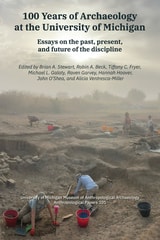
100 Years of Archaeology at the University of Michigan
Essays on the Past, Present, and Future of the DisciplineEdited by Brian A. Stewart, Robin A. Beck, Tiffany C. Fryer, Michael L. Galaty, Raven Garvey, Hannah Hoover, John O’Shea, and Alicia Ventresca-Miller
University of Michigan Press, 2025
The University of Michigan has been at the forefront of archaeological research for more than 100 years, since 1922, when the Museum of Anthropology (now the Museum of Anthropological Archaeology) was established on the Ann Arbor campus. The goal of its curators for many decades was to create a research and teaching program that emphasized methodological rigor in the analysis of archaeological materials, attempting to solve grand questions about human behavior through fieldwork, collections, and laboratory work. About fifty years ago, the Museum's emphasis shifted to developing archaeological theory when a new generation of curators with processualist leanings made Ann Arbor a testing ground for the so-called New Archaeology.
Now, archaeology stands at a crossroads. Some archaeologists refer to the death of archaeological theory. Others stake out opposed camps of generalists and particularists. At U-M, as at many other universities, the past decade has seen a new commitment to collaborative archaeology, working with descendant communities and acknowledging the discipline's roots in colonialism and extraction.
In 2022, to celebrate a century of existence, the University of Michigan Museum of Anthropological Archaeology (UMMAA) hosted an international conference to explore possibilities for a middle way: an archaeology for the next 100 years, combining humanistic and scientific approaches, which allows for both agents and systems, description and explanation, science and heritage. This volume is meant to be a snapshot of that conference and this moment in the development of the discipline. Included are most of the papers and posters presented, as well as photographs of the panels and the proceedings.
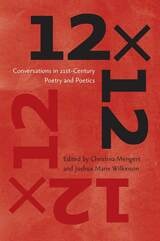
12 x 12
Conversations in 21st-Century Poetry and PoeticsChristina Mengert
University of Iowa Press, 2009
Christina Mengert and Joshua Marie Wilkinson have assembled an expansive and searching view of the world through the eyes of twenty-four of our most vital and engaging poets. Punctuated by poems from each contributor, 12 × 12 brings together an unparalleled range of poets and poetries, men and women from around the world, working poets for whom the form vitally matters.
Contributors
Jennifer K. Dick–Laura Mullen
Jon Woodward–Rae Armantrout
Sabrina Orah Mark–Claudia Rankine
Christina Hawkey–Tomaž Šalamun
Christine Hume–Rosemarie Waldrop
Srinkath Reddy–Mark Levine
Karen Volkman–Allen Grossman
Paul Fattaruso–Dara Wier
Mark Yakich–Mary Leader
Michelle Robinson–Paul Auster
Sawako Nakayasu–Carla Harryman
Ben Lerner–Aaron Kunin
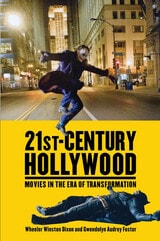
21st-Century Hollywood
Movies in the Era of TransformationDixon, Wheeler Winston
Rutgers University Press, 2011
They are shot on high-definition digital cameras—with computer-generated effects added in postproduction—and transmitted to theaters, websites, and video-on-demand networks worldwide. They are viewed on laptop, iPod, and cell phone screens. They are movies in the 21st century—the product of digital technologies that have revolutionized media production, content distribution, and the experience of moviegoing itself.
21st-Century Hollywood introduces readers to these global transformations and describes the decisive roles that Hollywood is playing in determining the digital future for world cinema. It offers clear, concise explanations of a major paradigm shift that continues to reshape our relationship to the moving image. Filled with numerous detailed examples, the book will both educate and entertain film students and movie fans alike.
2nd Chance
Daniel Becker
New Issues Poetry and Prose, 2020
5 Years of 4th Genre
Martha Bates
Michigan State University Press, 2006
In 1999, Michigan State University Press launched Fourth Genre: Explorations in Creative Nonfiction, a journal that began with and has maintained a devotion to publishing notable, innovative work in nonfiction. The title reflects an intent to give nonfiction its due as a literary genre—to give writers of the 'fourth genre' a showcase for their work and to give readers a place to find the liveliest and most creative works in the form.
Given the genre's flexibility and expansiveness, journal editors Michael Steinberg and David Cooper have welcomed a variety of works— ranging from personal essays and memoirs to literary journalism and personal criticism. The essays are lyrical, self-interrogative, meditative, and reflective, as well as expository, analytical, exploratory, or whimsical. In short, Fourth Genre encourages a writer- to-reader conversation, one that explores the markers and boundaries of literary/creative nonfiction.
Since its inaugural issue, contributors have earned many literary awards: 5 Notable Essays of the Year (Best American Essay); the Lowell Thomas Travel Journalism Award; Notable Essay of the Year (Best American Travel Writing); and 4 Pushcart Prizes. Five Years of 4th Genre is a celebration of this significant literary journal. Culling a selection of some of the most creative of Fourth Genre’s first five years—the Pushcart winners are here, as well as those essays that are unique, those that tell us something new, those that startle us, and those that touch our hearts —this volume presents a representative sampling.
911 A Public Emergency?, Volume 20
Ella Shohat, Brent Edwards, Stefano Harney, Randy Martin, Timothy Mitchell, and Fred Moten, eds.
Duke University Press, 0
Examining the strengths and shortcomings of area, race, and gender studies in the search for understanding, this issue considers cross-cultural feminism as a means of combating terrorism; racial profiling of Muslims in the context of other racist logics; and the homogenization of dissent. The issue includes poetry, photographic work, and an article by Judith Butler on the discursive space surrounding the attacks of September 11. This impressive range of contributions questions the meaning and implications of the events of September 11 and their aftermath.
Contributors. Muneer Ahmad, Meena Alexander, Lopamudra Basu, Judith Butler, Zillah Eisenstein, Stefano Harney, Randy Martin, Rosalind C. Morris, Fred Moten, Sandrine Nicoletta, Yigal Nizri, Jasbir K. Puar, Amit S. Rai, Ella Shohat, Ban Wang
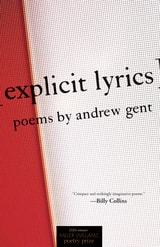
[explicit lyrics]
PoemsAndrew Gent
University of Arkansas Press, 2016
Winner, 2016 Miller Williams Poetry Prize, edited by Billy Collins
Randall Jarrell said that when you read a poem “you are entering a foreign country whose laws and language and life are a kind of translation of your own.” In [explicit lyrics], we are visitors to a world that is familiar as if the poems are occurring in our town, on the streets where we live. But the laws have changed, and what is normally important is no longer relevant. What was meaningless is now everything.
As the title indicates, these poems are lyrics—musings on the small decisions required by existence in the modern world. They contain the grand themes of art—life, love, and mortality—but not where you expect. The smallest and most mundane objects become the catalyst for reevaluating our roles in society and the world. This is not poetry as art. This is life as art, from a country where poetry is the only language.
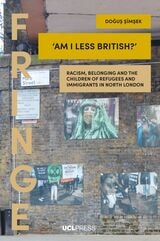
‘Am I Less British?’
Racism, Belonging, and the Children of Refugees and Immigrants in North LondonDogus Simsek
University College London, 2024
‘Am I Less British?’ focuses on the children of refugees and immigrants from Turkey in North London. Providing a rich ethnography of the lives of the children, the book studies their sense of identity and belonging, and their transnational experiences. It aims to understand how the children position themselves within a range of locations (London, North London, and Turkey), where they face class hierarchy, racism, and discrimination. Dogus Simsek explores how these children think about their sense of belonging within the contemporary political context in Britain and Turkey. De-identifying themselves from national identities and holding onto their oppressed identities appear as new forms of resistance in response to racism and exclusion.
The experiences of the young people reflect the complexity of their lives in changing political and social circumstances across the borders of nation-states, as well as the importance of other categories of identity, including local identities. Overall, the book argues that the intersections of local, national, and transnational approaches, the political context through which the lives of young people are framed, and their sophisticated engagement with ideas of race, class, ethnicity, and gender, are crucial to understanding their identity formation.
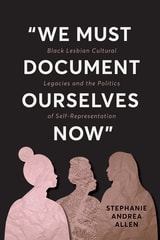
“We Must Document Ourselves Now”
Black Lesbian Cultural Legacies and the Politics of Self-RepresentationStephanie Andrea Allen
The Ohio State University Press, 2026
A long-overdue analysis of how Black lesbians have asserted their lived experience through creative practice, pushing back against heteropatriarchal systems that deny them visibility.
“We Must Document Ourselves Now” examines the essential but oft-ignored importance of Black lesbian literature and film in queer literary and film histories, arguing that Black lesbian cultural texts reflect creators’ lived experiences and resist the heteropatriarchal systems that deny Black lesbians visibility in popular culture. Stephanie Andrea Allen contends that these texts have three goals: to lay bare the experiences of Black lesbians in a raced, gendered, classed, and homophobic society; to challenge the notion that claiming Black lesbian identity is marginal or forbidden; and to take care of Black lesbians by bearing witness to their experiences through creative practice.
Insisting that Black feminist creative practice is an integral form of self and community care, Allen weaves analysis of cultural output spanning key sociocultural moments from 1974 to 2020 with interviews with Black lesbian cultural workers. “We Must Document Ourselves Now” examines the Black Arts / Black Power movement, the “boom” in lesbian and gay publishing, the so-called golden era of Black film, and twenty-first-century visual media to demonstrate how representations of Black lesbians, or lack thereof, were vital to constructing a cultural canon that focused on illuminating Black lesbian experiences in the United States.