Results by title
187 books match the query 'African American women' and 3 start with a non-letter
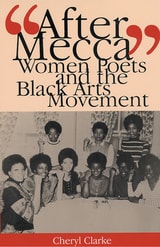
"After Mecca"
Women Poets and the Black Arts MovementClarke, Cheryl
Rutgers University Press, 2004
In "After Mecca," Cheryl Clarke explores the relationship between the Black Arts Movement and black women writers of the period. Poems by Gwendolyn Brooks, Ntozake Shange, Audre Lorde, Nikki Giovanni, Sonia Sanchez, Jayne Cortez, Alice Walker, and others chart the emergence of a new and distinct black poetry and its relationship to the black community's struggle for rights and liberation. Clarke also traces the contributions of these poets to the development of feminism and lesbian-feminism, and the legacy they left for others to build on.
She argues that whether black women poets of the time were writing from within the movement or writing against it, virtually all were responding to it. Using the trope of "Mecca," she explores the ways in which these writers were turning away from white, western society to create a new literacy of blackness.
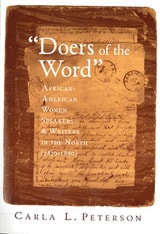
"Doers of the Word"
African-American Women Speakers and Writers in the North (1830-1880)Peterson, Carla L
Rutgers University Press, 1998
In situating these women within the emerging African-American urban communities of the free North, Doers of the Word provides an important counterweight to the vast scholarship on Southern slavery and argues that black "Civil Rights movements" cannot be seen as a purely modern phenomenon. In particular, the book examines the ways in which this Northern black population, despite its heterogeneity, came together and established social organizations that would facilitate community empowerment; yet Peterson's analysis also acknowledges, and seeks to explain, the highly complex relationship of black women to these institutions, a relationship that rendered their stance as public intellectuals all the more bold and defiant.
Peterson begins her study in the 1830s, when a substantial body of oratory and writing by black women first emerged, and traces the development of this writing through the shifting political climate up to the end of Reconstruction. She builds her analyses upon Foucault's interdisciplinary model of discourse with an explicitly feminist approach, drawing upon sermons, spiritual autobiographies, travel and slave narratives, journalism, essays, poetry, speeches, and fiction. From these, Peterson is able to answer several key questions. First, what empowered these women to act, to speak out, and to write? Why, and in what ways, were they marginalized within both the African-American and larger American communities? Where did they act, speak, and write from?
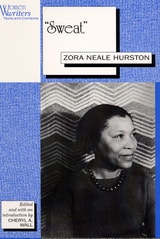
"Sweat"
Written by Zora Neale HurstonWall, Cheryl A
Rutgers University Press, 1997
Now frequently anthologized, Zora Neale Hurston's short story "Sweat" was first published in Firell, a legendary literary magazine of the Harlem Renaissance, whose sole issue appeared in November 1926. Among contributions by Gwendolyn Bennett, Countee Cullen, Langston Hughes, and Wallace Thurman, "Sweat" stood out both for its artistic accomplishment and its exploration of rural Southern black life. In "Sweat" Hurston claimed the voice that animates her mature fiction, notably the 1937 novel Their Eyes Were Watching God; the themes of marital conflict and the development of spiritual consciousness were introduced as well. "Sweat" exemplifies Hurston's lifelong concern with women's relation to language and the literary possibilities of black vernacular.
This casebook for the story includes an introduction by the editor, a chronology of the author's life, the authoritative text of "Sweat," and a second story, "The Gilded Six-Bits." Published in 1932, this second story was written after Hurston had spent years conducting fieldwork in the Southern United States. The volume also includes Hurston's groundbreaking 1934 essay, "Characteristics of Negro Expression," and excerpts from her autobiography, Dust Tracks on a Road. An article by folklorist Roger Abrahams provides additional cultural contexts for the story, as do selected blues and spirituals. Critical commentary comes from Alice Walker, who led the recovery of Hurston's work in the 1970s, Robert Hemenway, Henry Louis Gates, Gayl Jones, John Lowe, Kathryn Seidel, and Mary Helen Washington.