Results by title
4413 books match the query 'Anthropology' and 8 start with a non-letter

"A Truthful Impression of the Country"
British and American Travel Writing in China, 1880-1949Nicholas R. Clifford
University of Michigan Press, 2001
Nicholas R. Clifford argues that, for a variety of reasons, travel accounts during this time claimed a particular kind of veracity that distinguished them from the work of other writers--scholars, journalists, diplomats, policymakers, or memoir-writing expatriates--who also sought to represent an unfamiliar China to the West. Yet even as the genre claims to be a "truthful impression," it contains an implicit warning that the traveler's own sensibility enters into the account and into the representation of the unfamiliar and the exotic.
"A Truthful Impression of the Country" will appeal not only to those interested in the broad phenomenon of imperialism but also to those interested in cultural studies and post-colonialism. It will likewise prove accessible to the general reader exploring Sino-Western interactions or in travel writing as a particular genre.
Nicholas R. Clifford is College Professor Emeritus, Middlebury College. He is also the author of the novel The House of Memory and of the monographs Shanghai, 1925: Urban Nationalism and the Defense of Foreign Privilege and Spoilt Children of Empire: Westerners in Shanghai and the Chinese Revolution of 1925--1927.

"Stay Out of Politics"
A Philosopher Views South AfricaRonald Aronson
University of Chicago Press, 1990
Along with his visa, Aronson was given the following warning by a consular officer: "Stay out of politics!" Believing that philosophy not only has a role to play but that it can, and must, involve itself in the vital social and political issues of our time, Aronson equally discovered that in South Africa politics is everywhere and inescapable. The lectures Aronson delivered focused on the meaning of progress and hope, on the threat—and experience—of disaster today, and on our responsibility to join the struggle for a humane and rational world. Two of the most provocative lectures are included here, the first a discussion of the Holocaust that has direct and intentional applications to the current situation in South Africa. The second lecture, in memory of the assassinated political philosopher Richard Turner, is a sketch of Aronson's philosophy of hope as seen from within the South African context.
Despite the limitations of teaching under possible surveillance in a revolutionary situation, Aronson witnessed the social reality of apartheid and heard the voices of its victims. Aronson's love for the South African people motivated him to write this powerful account. He presents a lecturer's tour of South Africa: the experiences that both confirmed his belief in the urgent need for majority rule but also revealed the complexities of the society that seeks to continue apartheid through all reforms; and his philosopher's reflections upon returning to the United States on the irrationality of apartheid and the ambiguities of the struggle to end it.
"Stay Out of Politics" is not only a powerful encounter with South Africa today, it is a provocative statement about philosophy—its nature, its tasks, its duty to understand and change the world in which we live.
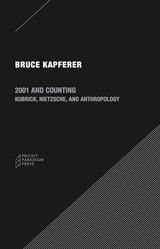
2001 and Counting
Kubrick, Nietzsche, and AnthropologyBruce Kapferer
Prickly Paradigm Press, 2014
In 2001 and Counting, renowned anthropologist Bruce Kapferer revisits 2001: A Space Odyssey, making a compelling case for its continued cultural relevance. While the film’s earliest audiences considered it to be a critical examination of European and American realities at the height of the Cold War, Kapferer shows that Kubrick’s masterwork speaks equally well to concerns of the contemporary world, including the Iraq War, the 2008 financial crisis, and the material and political effects of neoliberalism. Kapferer explores Kubrick’s central theme—the ever-changing relationship between humanity and technology—both with regard to current events and through the lens of Nietzsche’s Thus Spoke Zarathustra and the mythical concept of the eternal return.
A thought-provoking exploration of the cultural power of cinema, this volume by one of anthropology’s most insightful and imaginative thinkers will appeal to anthropologists and cineastes alike.
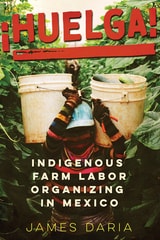
¡Huelga!
Indigenous Farm Labor Organizing in MexicoJames Daria
University of Arizona Press, 2026
On March 17, 2015, tens of thousands of Mexican farmworkers went on strike in San Quintin, Baja California, to protest horrible working conditions on the farms that produce most of the fresh fruits and vegetables you consume. Calling themselves the “slaves of the twenty-first century,” these mostly Indigenous men, women, and children rose up in defiance of the conditions of modern slavery, forced labor, sexual harassment, and “hunger wages.” This ethnography provides an in-depth look into how Indigenous farmworkers organize in the fields and their communities to improve wages and working conditions.
Since the strike, the farmworkers have organized a union to fight for justice in the fields. In this work, author James Daria accompanies these farmworkers as they struggle for dignity. Daria also charts the tensions inside the farmworker movement as women struggle to gain greater power in the home as well as at work. In an era of complex global integration, Daria shows us how what we eat is tied to the suffering of those who produce our food.
This book highlights and centers the Indigenous workers who struggle for justice in a global food system that connects us all.
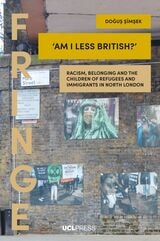
‘Am I Less British?’
Racism, Belonging, and the Children of Refugees and Immigrants in North LondonDogus Simsek
University College London, 2024
‘Am I Less British?’ focuses on the children of refugees and immigrants from Turkey in North London. Providing a rich ethnography of the lives of the children, the book studies their sense of identity and belonging, and their transnational experiences. It aims to understand how the children position themselves within a range of locations (London, North London, and Turkey), where they face class hierarchy, racism, and discrimination. Dogus Simsek explores how these children think about their sense of belonging within the contemporary political context in Britain and Turkey. De-identifying themselves from national identities and holding onto their oppressed identities appear as new forms of resistance in response to racism and exclusion.
The experiences of the young people reflect the complexity of their lives in changing political and social circumstances across the borders of nation-states, as well as the importance of other categories of identity, including local identities. Overall, the book argues that the intersections of local, national, and transnational approaches, the political context through which the lives of young people are framed, and their sophisticated engagement with ideas of race, class, ethnicity, and gender, are crucial to understanding their identity formation.

“Here, There and Everywhere”
The Foreign Politics of American Popular CultureEdited by Reinhold Wagnleitner and Elaine Tyler May
University Press of New England, 2000
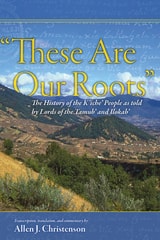
“These Are Our Roots”
The History of the K’iche’ People as Told by Lords of the Tamub’ and Ilokab’transcription, translation, and commentary by Allen J. Christenson
University Press of Colorado, 2026
In “These Are Our Roots”, Allen J. Christenson translates and analyzes historical documents composed by Tamub’ and Ilokab’ nobles of the K’iche’ Maya, who ruled much of the Guatemalan highlands until their lands were invaded by Spanish conquistadors in 1524. Complete original English translations of three Tamub’ texts and a new translation of the “Title of the Ilokab’” reveal how K’iche’ nobility strategically appropriated Christian elements from Dominican missionary texts while maintaining their Indigenous worldview. These documents served multiple purposes: legally establishing land rights, asserting nobility status, preserving cultural identity, and claiming religious legitimacy by positioning themselves as descendants of biblical figures—a sophisticated response to Spanish colonization that balanced accommodation and resistance through literacy, which had become a crucial tool for Indigenous elites navigating the colonial system.
The Tamub’ and Ilokab’ branches of the K’iche’ people have generally been overshadowed by their well-known Kaweq brethren, who wrote such literature masterpieces as the Popol Vuh and the Title of Totonicapán. But it is the voices relegated to the shadows of history that share views of events from different perspectives and whisper about what really happened behind the scenes—family jealousies, political rivalries, and delicious gossip about the great and the good who tend to focus on their own self-aggrandizing stories. “These Are Our Roots” is a valuable scholarly contribution to Maya studies and ethnohistory that makes these important primary sources more accessible to students and scholars.
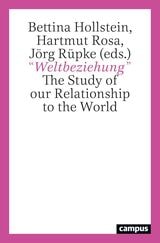
“Weltbeziehung”
The Study of our Relationship to the WorldEdited by Bettina Hollstein, Hartmut Rosa, and Jörg Rüpke
Campus Verlag, 2023
Human beings are always and essentially placed and situated in a world to which they relate, and it is this relationship that defines them. This book describes the historical and cultural variety of self-world-relations of this kind and revolves around aspects and dimensions of what Hartmut Rosa has gathered under the term “Weltbeziehung” (relationship to the world), expanding on his theory on resonance.
This book starts from this innovative approach to discuss socially relevant questions and conceptions of the present, like property, progress, or markets and then contrasts them with non-Western or non-modern forms of “Weltbeziehungen” like specific conceptions of virtue or fatalistic practices. In an effort to overcome Eurocentric biases, the book also includes studies about the decolonization of research in India and the role of markets in China. In addition, comparisons across time help to further refine our understanding of “Weltbeziehungen.” Finally, the volume’s contributions discuss a number of challenges and practical problems of the contemporary world such as the migration crises, sharing practices, or knowledge production in light of this conception.