Results by title
354 books match the query 'Authors, American' and 3 start with a non-letter
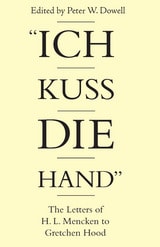
"Ich Kuss Die Hand"
The Letters of H. L. Mencken To Gretchen HoodH. L. Mencken
University of Alabama Press, 1986
“Ich Kuss Die Hand”: The Letters of H. L. Mencken to Gretchen Hood relates an episode in Mencken's life that has received only passing mention from his biographers. Gretchen Hood's acquaintance with the journalistic life of Washington formed a bond with Mencken, who thought of himself, first and foremost, as an inveterate newspaperman (they playfully entertained the idea of starting their own Washington newspaper), and she had a ready appreciation for his performances as a connoisseur of the Washington political spectacle. Mencken, the amateur musician and music buff, respected her talent and professional background.
His letters indicate that he found in her an intelligent, witty, and charming respondent to his characteristic traits of personality and style. She both flattered his ego and challenged him to exhibit his celebrated manner at its best. On her part, Hood was not simply awestruck by Mencken's attentions but met them with her independent verve. “Nothing scared me,” she later said of her attitude; “ready to take on all comers.” Mencken liked to refer to her as “a licensed outlaw,” a designation that captures his impression of her and describes as well the fashionable unconventionality, which fueled the Mencken vogue.
Mencken wrote Hood over two hundred letters, and she must have written him about the same number. For much of the time they corresponded, they exchanged several letters every month, sometimes as many as four or five a week. As their communications blossomed into a four-year friendship, personal meetings soon supplemented the flow of letters.
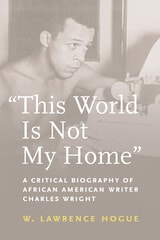
"This World Is Not My Home"
A Critical Biography of African American Writer Charles WrightW. Lawrence Hogue
University of Massachusetts Press, 2023
One of Book Authority's 8 New African-American and Black Biography Books Shaping 2025
In the 1960s, Charles Wright’s (1932–2008) star was on the rise. After dropping out of high school and serving in the Korean War, the young Black writer landed in New York, where he was mentored by Norman Mailer, signed a book deal with a leading publisher, and was celebrated by the likes of Langston Hughes and James Baldwin.
Over the decades to follow, Wright would lead a peripatetic and at times precarious life, moving between Tangier, Veracruz, Paris, and New York, penning a regular column for the Village Voice, living off the goodwill of his friends, and battling addiction and, later, mental health issues. As W. Lawrence Hogue shows, Wright’s innovative fiction stands apart, offering a different vision of outcast Black Americans in the postwar era and using satire to bring agency and humanity to working-class characters. This critical biography—the first devoted to Wright’s significant but largely forgotten story—brings new attention to the writer’s impressive body of work, in the context of a wild, but troubled, life.
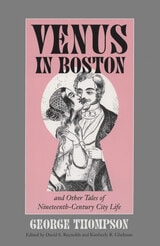
"Venus in Boston" and Other Tales of Nineteenth-Century City Life
George Thompson
University of Massachusetts Press, 2002
The three works in this volume offer a rich representative sample of Thompson's writing. The two novels—Venus in Boston and City Crimes—depict the American city as a place of dark mystery, bawdy humor, and near-universal corruption peopled with con artists and criminals of all kinds. In each novel, a complex narrative structure interweaves multiple stories of exploited labor, abuse of power, seduction, intrigue, and crime. Thompson's autobiography, My Life, presents the author's life in terms nearly as lively as his fiction.
Thompson's zestful, unconventional writings fly in the face of the stereotypical view of Victorian America as straitlaced and sentimental. Ideal for use as a classroom text, this new edition includes a scholarly introduction and an extensive bibliography.