Results by title
5159 books match the query 'Biography' and 25 start with a non-letter
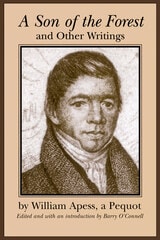
"A Son of the Forest" and Other Writings
William Apess
University of Massachusetts Press, 1997

"Almost a Man of Genius"
Clémence Royer, Feminism, and Nineteenth-Century ScienceHarvey, Joy
Rutgers University Press, 1997
A feminist who made lifelong enemies almost as readily as she made friends, Royer was never able to undertake formal, advanced education and was a product of her own self-study efforts. Only in her last few years was she formally recognized by several professional societies and awarded the French Legion of Honor. Harvey includes an overview of earlier biographical treatments, the text of an 1874 communication on "Women, Science, and the Birth Rate," and extensive notes.
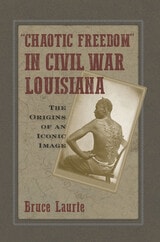
"Chaotic Freedom" in Civil War Louisiana
The Origins of an Iconic ImageBruce Laurie
University of Massachusetts Press, 2021
Bruce Laurie uncovers the people and events that created this seminal image, telling the tale of three men, two Yankee soldiers from western Massachusetts who were serving the Union Army in Louisiana and a man named Peter whose scarred back horrified all who saw it. The two soldiers were so shocked by what had been done to Peter, they sought to capture the image and document slavery's cruelty, the likes of which was all too common among those fleeing bondage in Louisiana. Meticulously researched and briskly told, this short volume unearths the story behind an iconic image.
"Fame Is Not Just for the Fellas"
Female Renown and the Childhood of Famous Americans SeriesGregory M. Pfitzer
University of Massachusetts Press, 2022
Finalist of the 2023 SHARP History of the Book Prize
Between 1932 and 1958, thousands of children read volumes in the book series Childhood of Famous Americans. With colorful cover art and compelling—and often highly fictionalized—narrative storylines, these biographies celebrated the national virtues and achievements of famous women like Betsy Ross, Louisa May Alcott, and Amelia Earhart. Employing deep archival research, Gregory M. Pfitzer examines the editorial and production choices of the publisher and considers the influence of the series on readers and American culture more broadly.
In telling the story of how female subjects were chosen and what went into writing these histories for young female readers of the time, Pfitzer illustrates how these books shaped children’s thinking and historical imaginations around girlhood using tales from the past. Utilizing documented conversations and disagreements among authors, editors, readers, reviewers, and sales agents at Bobbs-Merrill, “Fame Is Not Just for the Fellas” places the series in the context of national debates around fame, gender, historical memory, and portrayals of children and childhood for a young reading public—charged debates that continue to this day.
"Lincoln's Humor" and Other Essays
Benjamin P. Thomas. Edited by Michael Burlingame
University of Illinois Press, 2006
A skilled historian and a masterful storyteller himself, Thomas was widely regarded as the greatest Lincoln historian of his generation. With these essays, he combines historical depth with narrative grace in delineating Lincoln's qualities as a humorist, lawyer, and politician. From colorful tall tales to clever barbs aimed at political opponents, Lincoln clothed a shrewd wit in a homespun, backwoods vernacular. He used humor to defuse tension, illuminate a point, put others at ease--and sometimes for sheer fun. From an early reliance on broad humor and ridicule in speeches and on the stump, Lincoln's style shifted in 1854 to a more serious vein in which humor came primarily to elucidate an argument. "If I did not laugh occasionally I should die," he is said to have told his cabinet, "and you need this medicine as much as I do." Thomas brings his deep knowledge of Lincoln to essays on the great man's tumultuous career in Congress, his work as a lawyer, his experiences in the Courts, and his opinions of the South. A gracious survey of Lincoln's early biographers, particularly Ida Tarbell, stands alongside an appreciation of Harry Edward Pratt, a key figure in the early days of the Abraham Lincoln Association. Thomas also assesses Lincoln's use of language and the ongoing significance of the Gettysburg Address.
This diverse collection is enhanced by an introduction by Michael Burlingame, himself a leading biographer of Lincoln. Burlingame provides a balanced portrait of Thomas and his circuitous path toward writing history.

"Other Sheep I Have" The Autobiography of Father Paul M. Washington
Paul Washington
Temple University Press, 1994
Father Paul M. Washington rose to local and nation prominence as an unflagging supporter of civil and women's rights. One of a handful of black priests in a traditionally white church, he fought for understanding among all people, eventually serving twenty-five years as the Rector of the Episcopal Church of the Advocate in an inner-city Philadelphia neighborhood. Though his ideas about equality often went against the views of the Episcopal church leadership, he rejected threats of withdrawn funding or retaliation to follow his heart and his theology.
Father Washington's story is a window of insight into the struggles for justice and dignity in the latter half of the twentieth century. In the tumultuous 1960s he supported the Black Power movement, the Black Panther Party, and many other groups working for peace and justice, providing meeting places and guidance. He often found himself in the midst of racial disturbances—the riots on Susquehanna Avenue in 1963 and on Columbia Avenue in 1964, in front of the Board of Education where high school students protested the Eurocentric curriculum, and outside the walls of Girard College where citizens and civic leaders demonstrated against the school's exclusion of black children. In the 1980s, he helped Philadelphia city officials negotiate with MOVE members and was a vocal supporter of Ramona Africa, fighting for her release from prison. It was in his church on the corner of 18th and Diamond Streets that women were first ordained a priests in the Episcopal church. And it was one of his congregation, Barbara Harris, who became the first female Episcopal bishop.
In his evocative voice, Father Washington describes the pivotal events of his life and how each impacted upon his evolving ideas of the relationship between religion and justice. Spanning seven decades, his account is at once an insightful and unique historical account of political action, of the reformation of the church, of the changing urban landscape, and of a life graced by leadership and spiritual enlightenment.
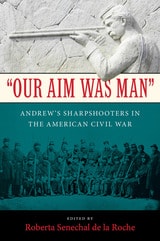
"Our Aim Was Man"
Andrew's Sharpshooters in the American Civil WarRoberta Senechal de la Roche
University of Massachusetts Press, 2016
One was a father who worried about his fellow soldiers' swearing. Another hoped to enter Harvard College. The third was a farmer whose letters home depict the later stages of the war. The fourth had turned to boot making when he did not inherit land. Based on the letters, diaries, and memoirs of four members of the First Company Massachusetts Sharpshooters, known as Andrew's Sharpshooters, this book provides a rare glimpse into the experiences of Union Army snipers. The company was one of the first units in American military history to be equipped with telescope-sighted rifles to enable long-distance targeting. Despite complaints that snipers violated codes of honorable combat, the members of Andrew's Sharpshooters generally expressed quiet pride in being an elite unit of highly skilled soldiers—"cool blooded sharpshooters," as one of them said.
Introduced and edited by Roberta Senechal de la Roche, these primary accounts include new details about the equipment, training, and deployment of snipers in the Army of the Potomac. They also reveal the challenges of covert warfare and include rich detail on the everyday problems of Civil War soldiers, including bad food, disease, punishing marches, and homesickness. The collected documents also convey the trials of those left on the home front.

"The Most Dangerous Communist in the United States"
A Biography of Herbert ApthekerMurrell Gary
University of Massachusetts Press, 2015
"The Skeleton in Grandpa's Barn"
And Other Stories of Growing Up in UtahStanford J. Layton
Signature Books, 2008
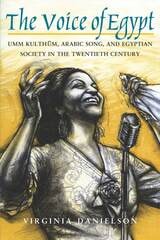
"The Voice of Egypt"
Umm Kulthum, Arabic Song, and Egyptian Society in the Twentieth CenturyVirginia Danielson
University of Chicago Press, 1997
Danielson examines the careful construction of Umm Kulthum's phenomenal popularity and success in a society that discouraged women from public performance. From childhood, her mentors honed her exceptional abilities to accord with Arab and Muslim practice, and as her stature grew, she remained attentive to her audience and the public reception of her work. Ultimately, she created from local precendents and traditions her own unique idiom and developed original song styles from both populist and neo-classical inspirations. These were enthusiastically received, heralded as crowning examples of a new, yet authentically Arab-Egyptian, culture. Danielson shows how Umm Kulthum's music and public personality helped form popular culture and contributed to the broader artistic, societal, and political forces that surrounded her.
This richly descriptive account joins biography with social theory to explore the impact of the individual virtuoso on both music and society at large while telling the compelling story of one of the most famous musicians of all time.
"She is born again every morning in the heart of 120 million beings. In the East a day without Umm Kulthum would have no color."—Omar Sharif
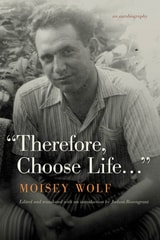
"Therefore, Choose Life..."
An AutobiographyMoisey Wolf
Oregon State University Press, 2014
Wolf describes his Jewish childhood and youth in pre-war Poland, his escape from the Holocaust and subsequent medical service in the Soviet Army during World War II and the following decade, his distinguished career in psychiatry in post-Stalinist Soviet Russia, and his final years in Portland, Oregon, after his departure from the Soviet Union in 1992.
Wolf’s narrative skill and evocative personal insights, combined with Judson Rosengrant’s judicious editing and annotation and elegant translation, provide the reader with direct access to a world that has seemingly ceased to exist, yet continues to resonate and inform our own lives in powerful ways.
“Therefore, Choose Life…” will appeal to readers interested in the history of the East-European twentieth century, pre-Holocaust Jewish family life in Poland, and in the survival of a man of deep religious faith and cultivation in the face of the catastrophes and vicissitudes of his time and place.
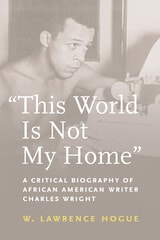
"This World Is Not My Home"
A Critical Biography of African American Writer Charles WrightW. Lawrence Hogue
University of Massachusetts Press, 2023
One of Book Authority's 8 New African-American and Black Biography Books Shaping 2025
In the 1960s, Charles Wright’s (1932–2008) star was on the rise. After dropping out of high school and serving in the Korean War, the young Black writer landed in New York, where he was mentored by Norman Mailer, signed a book deal with a leading publisher, and was celebrated by the likes of Langston Hughes and James Baldwin.
Over the decades to follow, Wright would lead a peripatetic and at times precarious life, moving between Tangier, Veracruz, Paris, and New York, penning a regular column for the Village Voice, living off the goodwill of his friends, and battling addiction and, later, mental health issues. As W. Lawrence Hogue shows, Wright’s innovative fiction stands apart, offering a different vision of outcast Black Americans in the postwar era and using satire to bring agency and humanity to working-class characters. This critical biography—the first devoted to Wright’s significant but largely forgotten story—brings new attention to the writer’s impressive body of work, in the context of a wild, but troubled, life.
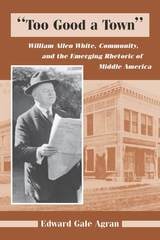
"Too Good a Town"
William Allen White, Community, and the Emerging Rhetoric of Middle AmericaEdward G. Agran
University of Arkansas Press, 1999
For fifty years, William Allen White, first as a reporter and later as the long-time editor of the Emporia Gazette, wrote of his small town and its Mid-American values. By tailoring his writing to the emerging urban middle class of the early twentieth century, he won his “gospel of Emporia” a nationwide audience and left a lasting impact on he way America defines itself.
Investigating White’s life and his extensive writings, Edward Gale Agran explores the dynamic thought of one of America’s best-read and most-respected social commentators. Agran shows clearly how White honed his style and transformed the myth of conquering the western frontier into what became the twentieth-century ideal of community building.
Once a confidante of and advisor to Theodore Roosevelt, White addressed, and reflected in his work, all the great social and political oscillations of his time—urbanization and industrialism, populism, and progressivism, isolationism internationalism, Prohibition, and New Deal reform. Again and again, he asked the question “What’s the matter?” about his times and townspeople, then found the middle ground. With great care and discernment, Agran gathers the man strains of White’s messages, demonstrating one writer’s pivotal contribution to our idea of what it means to be an American.
"Venus in Boston" and Other Tales of Nineteenth-Century City Life
George Thompson
University of Massachusetts Press, 2002
The three works in this volume offer a rich representative sample of Thompson's writing. The two novels—Venus in Boston and City Crimes—depict the American city as a place of dark mystery, bawdy humor, and near-universal corruption peopled with con artists and criminals of all kinds. In each novel, a complex narrative structure interweaves multiple stories of exploited labor, abuse of power, seduction, intrigue, and crime. Thompson's autobiography, My Life, presents the author's life in terms nearly as lively as his fiction.
Thompson's zestful, unconventional writings fly in the face of the stereotypical view of Victorian America as straitlaced and sentimental. Ideal for use as a classroom text, this new edition includes a scholarly introduction and an extensive bibliography.
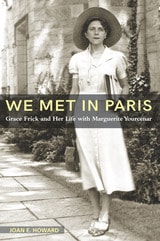
"We Met in Paris"
Grace Frick and Her Life with Marguerite YourcenarJoan E. Howard
University of Missouri Press, 2020
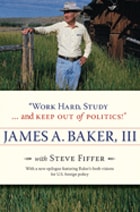
"Work Hard, Study . . . and Keep Out of Politics!"
James A. Baker III with Steve Fiffer
Northwestern University Press, 2008
Beginning in 1975 with the Ford administration, in a job procured for him by friend and tennis partner George H. W. Bush, Baker was in the thick of American politics. He recounts the inside story of Ford’s rejection of Reagan as a running mate in 1976 with the same insight he has into Reagan’s rejection of Ford four years later. When the White House was plunged into turmoil after the Reagan assassination attempt, he was there, and his stories take readers deeper into those chaotic days. Baker was on hand for the George H. W. Bush campaign’s battle over running mate Dan Quayle and, more recently, he was again on the front row as George W. Bush fought it out in Florida. Spellbinding and frank, his stories are the ones between the lines of our history books.
In this new edition, Baker also responds for the first time in print to the George W. Bush administration’s reaction to the Iraq Study Group Report, written with his input. Baker is very qualified to comment on the political operation of the current administration, and his new writing for this paperback brings the full weight of his experience to bear.
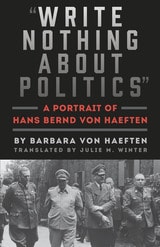
"Write Nothing about Politics"
A Portrait of Hans Bernd von HaeftenBarbara von Haeften
Michigan State University Press, 2018
... And Heaven Shed No Tears
Henry Armin Herzog
University of Wisconsin Press, 2005
1995 paperback, Saga Publishers / Folio Private

1001 Beds
Performances, Essays, and TravelsTim Miller; Edited by Glen Johnson
University of Wisconsin Press, 2006
Here we have the most complete Miller yet—a raucous collection of his performance scripts, essays, interviews, journal entries, and photographs, as well as his most recent stage piece Us. This volume brings together the personal, communal, and national political strands that interweave through his work from its beginnings and ultimately define Miller's place as a contemporary artist, activist, and gay man.
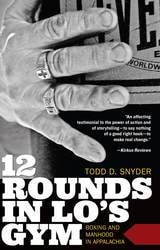
12 Rounds in Lo's Gym
Boxing and Manhood in AppalachiaTodd D. Snyder
West Virginia University Press, 2018
Part love letter to Appalachia, part rigorous social critique, readers may find 12 Rounds in Lo’s Gym—and its narrative of individual and community strength in the face of globalism’s headwinds—a welcome corrective to popular narratives that blame those in the region for their troubles.

23 Woodcock in 22 Years
Reflections on Hunting, the Night Sky, and Our Place in the UniverseJeff Wilkerson
University of Iowa Press, 2024
As Wilkerson’s thoughts soar to the stars that produced the chemical elements that form us and all the land and its creatures, simple reflections on going afield to harvest a woodcock for a special holiday meal ground him. What emerges is a love story about a bird, the land, and all of creation from atomic nuclei to the farthest reaches of the universe, and a reminder to acknowledge the gentle flow of time while cherishing the everyday existence around us.
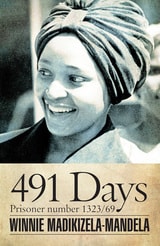
491 Days
Prisoner Number 1323/69Winnie Madikizela-Mandela
Ohio University Press, 2014
On a freezing winter’s night, a few hours before dawn on May 12, 1969, South African security police stormed the Soweto home of Winnie Madikizela-Mandela, activist and wife of the imprisoned Nelson Mandela, and arrested her in the presence of her two young daughters, then aged nine and ten.
Rounded up in a group of other antiapartheid activists under Section 6 of the Terrorism Act, designed for the security police to hold and interrogate people for as long as they wanted, she was taken away. She had no idea where they were taking her or what would happen to her children. For Winnie Mandela, this was the start of 491 days of detention and two trials.
Forty-one years after Winnie Mandela’s release on September 14, 1970, Greta Soggot, the widow of one of the defense attorneys from the 1969–70 trials, handed her a stack of papers that included a journal and notes she had written while in detention, most of the time in solitary confinement. Their reappearance brought back to Winnie vivid and horrifying memories and uncovered for the rest of us a unique and personal slice of South Africa’s history.
491 Days: Prisoner Number 1323/69 shares with the world Winnie Mandela’s moving and compelling journal along with some of the letters written between several affected parties at the time, including Winnie and Nelson Mandela, himself then a prisoner on Robben Island for nearly seven years.
Readers will gain insight into the brutality she experienced and her depths of despair, as well as her resilience and defiance under extreme pressure. This young wife and mother emerged after 491 days in detention unbowed and determined to continue the struggle for freedom.

Águila
The Vision, Life, Death, and Rebirth of a Two-Spirit Shaman in the Ozark MountainsMaría Cristina Moroles
University of Arkansas Press, 2024

“A Good Poor Man’s Wife”
Being a Chronicle of Harriet Hanson Robinson and Her Family in Nineteenth-Century New EnglandClaudia L. Bushman
University Press of New England, 1998
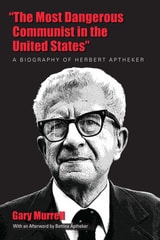
“The Most Dangerous Communist in the United States”
A Biography of Herbert ApthekerGary Murrell
University of Massachusetts Press, 2015
When J. Edgar Hoover declared Herbert Aptheker “the most dangerous Communist in the United States,” the notorious FBI director misconstrued his true significance. In this first book-length biography of Aptheker (1915–2003), Gary Murrell provides a balanced yet unflinching assessment of the controversial figure who was at once a leading historian of African America, radical political activist, literary executor of W. E. B. Du Bois, and lifelong member of the American Communist Party. Although blacklisted at U.S. universities, Aptheker published dozens of books, including the groundbreaking American Negro Slave Revolts (1943) and the monumental seven-volume Documentary History of the Negro People (1951–1994). He also edited four volumes of the correspondence and unpublished writings of Du Bois, an achievement that Eric Foner, writing in the New York Times Book Review, called “a milestone in the coming of age of Afro-American history.”
As Murrell shows, Aptheker the historian was inseparable from Aptheker the leading Communist Party intellectual, polemicist, and agitator. During the 1960s, his ability to rouse and inspire both black and white student radicals made him one of the few Old Leftists accepted by the New Left. Aptheker had joined the CPUSA during its heyday in the 1930s, convinced that only through the party's leadership could fascism be defeated and true liberation be achieved: he ended his affiliation five decades later in 1991 after the collapse of socialism in the Soviet Union and Eastern Europe.
In an afterword, Bettina Aptheker adds to Murrell's narrative by illuminating her mother Fay's vital contributions to her father's work and by affirming the particularly devastating challenges of life in a family dedicated to radical political and social change.