Results by title
303 books match the query 'Church history' and 3 start with a non-letter
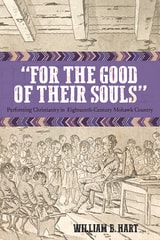
"For the Good of Their Souls"
Performing Christianity in Eighteenth-Century Mohawk CountryWilliam B. Hart
University of Massachusetts Press, 2020
Using the lens of performance theory to explain the ways in which the Mohawks considered converting and participating in Christian rituals, historian William B. Hart contends that Mohawks who prayed, sang hymns, submitted to baptism, took communion, and acquired literacy did so to protect their nation's sovereignty, fulfill their responsibility of reciprocity, serve their communities, and reinvent themselves. Performing Christianity was a means of "survivance," a strategy for sustaining Mohawk life and culture on their terms in a changing world.

"Other Sheep I Have" The Autobiography of Father Paul M. Washington
Paul Washington
Temple University Press, 1994
Father Paul M. Washington rose to local and nation prominence as an unflagging supporter of civil and women's rights. One of a handful of black priests in a traditionally white church, he fought for understanding among all people, eventually serving twenty-five years as the Rector of the Episcopal Church of the Advocate in an inner-city Philadelphia neighborhood. Though his ideas about equality often went against the views of the Episcopal church leadership, he rejected threats of withdrawn funding or retaliation to follow his heart and his theology.
Father Washington's story is a window of insight into the struggles for justice and dignity in the latter half of the twentieth century. In the tumultuous 1960s he supported the Black Power movement, the Black Panther Party, and many other groups working for peace and justice, providing meeting places and guidance. He often found himself in the midst of racial disturbances—the riots on Susquehanna Avenue in 1963 and on Columbia Avenue in 1964, in front of the Board of Education where high school students protested the Eurocentric curriculum, and outside the walls of Girard College where citizens and civic leaders demonstrated against the school's exclusion of black children. In the 1980s, he helped Philadelphia city officials negotiate with MOVE members and was a vocal supporter of Ramona Africa, fighting for her release from prison. It was in his church on the corner of 18th and Diamond Streets that women were first ordained a priests in the Episcopal church. And it was one of his congregation, Barbara Harris, who became the first female Episcopal bishop.
In his evocative voice, Father Washington describes the pivotal events of his life and how each impacted upon his evolving ideas of the relationship between religion and justice. Spanning seven decades, his account is at once an insightful and unique historical account of political action, of the reformation of the church, of the changing urban landscape, and of a life graced by leadership and spiritual enlightenment.
1 Clement
A Reader's EditionTheodore A. Bergren
Catholic University of America Press, 2020