Results by title
129 books match the query 'City and town life' and 3 start with a non-letter
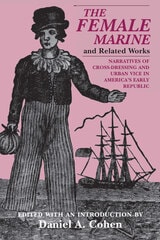
"The Female Marine" and Related Works
Narratives of Cross-Dressing and Urban Vice in America's Early RepublicDaniel A. Cohen
University of Massachusetts Press, 1997
This is the first complete modern edition of The Female Marine, a fictional cross-dressing trilogy originally published between 1815 and 1818. Enormously popular among New England readers, the tale in various versions appeared in no fewer than nineteen editions over that brief four-year span. This new edition appends three other contemporary accounts of cross-dressing and urban vice which, together with The Female Marine, provide a unique portrayal of prostitution and interracial city life in early-nineteenth-century America.
The alternately racy and moralistic narrative recounts the adventures of a young woman from rural Massachusetts who is seduced by a false-hearted lover, flees to Boston, and is entrapped in a brothel. She eventually escapes by disguising herself as a man and serves with distinction on board the U.S. frigate Constitution during the War of 1812. After subsequent onshore adventures in and out of male dress, she is happily married to a wealthy New York gentleman.
In his introduction, Daniel A. Cohen situates the story in both its literary and historical contexts. He explains how the tale draws upon a number of popular Anglo-American literary genres, including the female warrior narrative, the sentimental novel, and the urban exposé. He then explores how The Female Marine reflects early-nineteenth-century anxieties concerning changing gender norms, the expansion of urban prostitution, the growth of Boston's African American community, and feelings of guilt aroused by New England's notoriously unpatriotic activities during the War of 1812.
[more]
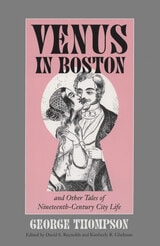
"Venus in Boston" and Other Tales of Nineteenth-Century City Life
George Thompson
University of Massachusetts Press, 2002
This book reprints for the first time since the 1850s three short works by George Thompson (1823–c. 1873), one of antebellum America's most successful and prolific authors of sensational fiction. Beginning in the 1840s, he wrote stories for sporting papers like Life in Boston and New York, edited the humorous New York weekly The Broadway Belle, and contributed regularly to the sexually explicit Venus' Miscellany. He also published dozens of novels, most of which were set in Northeastern cities. His writing blends entertainment and social protest, combining commentary on such issues as urbanization, poverty, race, and class with some of the era's most shocking depictions of sex and violence.
The three works in this volume offer a rich representative sample of Thompson's writing. The two novels—Venus in Boston and City Crimes—depict the American city as a place of dark mystery, bawdy humor, and near-universal corruption peopled with con artists and criminals of all kinds. In each novel, a complex narrative structure interweaves multiple stories of exploited labor, abuse of power, seduction, intrigue, and crime. Thompson's autobiography, My Life, presents the author's life in terms nearly as lively as his fiction.
Thompson's zestful, unconventional writings fly in the face of the stereotypical view of Victorian America as straitlaced and sentimental. Ideal for use as a classroom text, this new edition includes a scholarly introduction and an extensive bibliography.
[more]
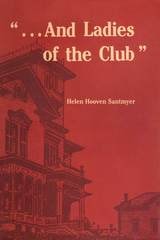
“. . . And the Ladies of the Club”
Helen Hooven Santmyer
The Ohio State University Press, 1980
This New York Times best seller by Helen Hooven Santmyer recounts the lives of a group of women who start a study club in a small town in southwestern Ohio in 1868. Over the years, the club evolves into an influential community service organization in the town. Numerous characters are introduced in the course of the novel but primary are Anne Gordon and Sally Rausch who, as the book begins, are new graduates of the Waynesboro Female Seminary. The novel covers decades of their lives—chronicling the two women’s marriages and those of their children and grandchildren. Santmyer focuses not just on the lives of the women in the club, but also their families and friends and the politics and developments in their small town and the larger world.
In this longest and most ambitious of Santmyer’s books, there is—as with all of her previous work—a poignant sense of a past made present again through an acute sensibility, of human life and experience as somehow cumulative, and of lives and events, largely fugitive and forgotten, as captured and transformed as the stuff of her poetry.
In this longest and most ambitious of Santmyer’s books, there is—as with all of her previous work—a poignant sense of a past made present again through an acute sensibility, of human life and experience as somehow cumulative, and of lives and events, largely fugitive and forgotten, as captured and transformed as the stuff of her poetry.
[more]