Results by title
138 books match the query 'Civil War' and 3 start with a non-letter
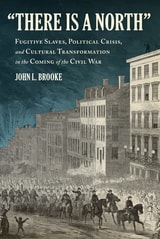
"There Is a North"
Fugitive Slaves, Political Crisis, and Cultural Transformation in the Coming of the Civil WarJohn L. Brooke
University of Massachusetts Press, 2019
How does political change take hold? In the 1850s, politicians and abolitionists despaired, complaining that the "North, the poor timid, mercenary, driveling North" offered no forceful opposition to the power of the slaveholding South. And yet, as John L. Brooke proves, the North did change. Inspired by brave fugitives who escaped slavery and the cultural craze that was Uncle Tom's Cabin, the North rose up to battle slavery, ultimately waging the bloody Civil War.
While Lincoln's alleged quip about the little woman who started the big war has been oft-repeated, scholars have not fully explained the dynamics between politics and culture in the decades leading up to 1861. Rather than simply viewing the events of the 1850s through the lens of party politics, “There Is a North” is the first book to explore how cultural action—including minstrelsy, theater, and popular literature—transformed public opinion and political structures. Taking the North's rallying cry as his title, Brooke shows how the course of history was forever changed.
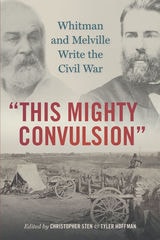
"This Mighty Convulsion"
Whitman and Melville Write the Civil WarChristopher Sten and Tyler Hoffman
University of Iowa Press, 2019
This is the first book exclusively devoted to the Civil War writings of Walt Whitman and Herman Melville, arguably the most important poets of the war. The essays brought together in this volume add significantly to recent critical appreciation of the skill and sophistication of these poets; growing recognition of the complexity of their views of the war; and heightened appreciation for the anxieties they harbored about its aftermath. Both in the ways they come together and seem mutually influenced, and in the ways they disagree, Whitman and Melville grapple with the casualties, complications, and anxieties of the war while highlighting its irresolution. This collection makes clear that rather than simply and straightforwardly memorializing the events of the war, the poetry of Whitman and Melville weighs carefully all sorts of vexing questions and considerations, even as it engages a cultural politics that is never pat.
Contributors: Kyle Barton, Peter Bellis, Adam Bradford, Jonathan A. Cook, Ian Faith, Ed Folsom, Timothy Marr, Cody Marrs, Christopher Ohge, Vanessa Steinroetter, Sarah L. Thwaites, Brian Yothers
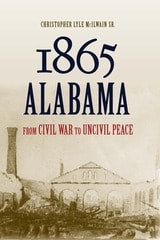
1865 Alabama
From Civil War to Uncivil PeaceChristopher Lyle McIlwain Sr.
University of Alabama Press, 2017
Unraveling the twelve months that forged modern Alabama.
To understand Alabama today, it's necessary to understand what happened in 1865. In 1865 Alabama: From Civil War to Uncivil Peace Christopher McIlwain examines the end of the Civil War and the early days of Reconstruction, tracing how the action—and inaction—of leaders in the state during those twelve months shaped the decades that followed as well as state politics today. McIlwain focuses on four factors: the immediate and unconditional emancipation of enslaved people, the destruction of Alabama’s industrial economy, significant broadening of northern support for suffrage rights for freedmen, and a long scarcity of investment capital. Each element proves important to understanding aspects of Alabama today.
Relevant events outside Alabama are woven into the narrative, including McIlwain’s controversial argument regarding the effect of Lincoln’s assassination. Most historians assume that Lincoln favored black suffrage and that he would have led the fight to impose that on the South. But he made it clear to his cabinet members that granting suffrage rights was a matter to be decided by the southern states, not the federal government. Thus, according to McIlwain, if Lincoln had lived, black suffrage would not have been the issue it became in Alabama.
In his fresh analysis of what really happened in Alabama in 1865 and why—McIlwain illuminates that Alabama's challenges were neither entirely the fault of northern or southern policies but rather the complex interaction between the two.