Results by title
191 books match the query 'Critical theory' and 3 start with a non-letter
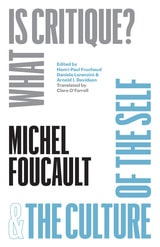
"What Is Critique?" and "The Culture of the Self"
Michel Foucault
University of Chicago Press, 2024
Newly published lectures by Foucault on critique, Enlightenment, and the care of the self—now in paperback.
On May 27, 1978, Michel Foucault gave a lecture to the French Society of Philosophy where he redefined his entire philosophical project in light of Immanuel Kant’s 1784 text “What Is Enlightenment?” Foucault strikingly characterizes critique as the political and moral attitude consisting in the “art of not being governed like this,” one that performs the function of destabilizing power relations and creating the space for a new formation of the self within the “politics of truth.”
This volume presents the first critical edition of this crucial lecture alongside a previously unpublished lecture about the culture of the self and three public debates with Foucault at the University of California, Berkeley, in April 1983. There, for the first time, Foucault establishes a direct connection between his reflections on the Enlightenment and his analyses of Greco-Roman antiquity. However, far from suggesting a return to the ancient culture of the self, Foucault invites his audience to build a “new ethics” that bypasses the traditional references to religion, law, and science.

#Triggered
Social Media, Subjectivity, and the Struggle for Safe SpaceSean Johnson Andrews
University of Michigan Press, 2027
In this time of social crisis and revolutionary change, words have become one of the key sites of social struggle. Using a framework informed by trans studies, critical race theory, and digital media studies, #Triggered looks at the peak period of progressive social media activism in the U.S. and argues that it is primarily a struggle over whether it is safe for each of us to be ourselves, openly, publicly, proudly, and without permission from the dominant culture.
The term “triggered” and the concept of the trigger warning are just two of many emergent sites of struggle. This book provides a contextual, theoretical history to consider them alongside movements like #BlackLivesMatter, #MeToo, and #TimesUp and concepts like cultural appropriation, “cancel culture,” and safe spaces. These on- and offline struggles have transformed the way we talk, the words we use, and the dominant cultural conversation of race, gender, sexuality, police violence, trauma, and equity. And yet the status quo is still one where marginalized individuals are made to fear for their lives if they do not exhibit the appropriate care and deference. #Triggered invites readers to consider the legitimate complaints about oppressive systems underlying this social crisis, the hierarchy of traumas and subjectivity these movements are opposing, and the opportunity to develop a more open and less repressive society and culture.
9/11
The Culture of CommemorationDavid Simpson
University of Chicago Press, 2006
In 9/11, Simpson argues that elements of the conventional culture of mourning and remembrance—grieving the dead, summarizing their lives in obituaries, and erecting monuments in their memory—have been co-opted for political advantage. He also confronts those who labeled the event an “apocalypse,” condemning their exploitation of 9/11 for the defense of torture and war.
In four elegant chapters—two of which expand on essays originally published in the London Review of Books to great acclaim—Simpson analyzes the response to 9/11: the nationally syndicated “Portraits of Grief” obituaries in the New York Times; the debates over the rebuilding of the World Trade Center towers and the memorial design; the representation of American and Iraqi dead after the invasion of March 2003, along with the worldwide circulation of the Abu Ghraib torture photographs; and the urgent and largely ignored critique of homeland rhetoric from the domain of critical theory.
Calling for a sustained cultural and theoretical analysis, 9/11 is the first book of its kind to consider the events of that tragic day with a perspective so firmly grounded in the humanities and so persuasive about the contribution they can make to our understanding of its consequences.