Results by title
2728 books match the query 'Education' and 16 start with a non-letter
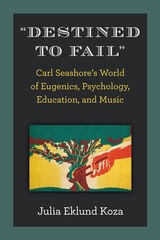
"Destined to Fail"
Carl Seashore’s World of Eugenics, Psychology, Education, and MusicJulia Eklund Koza
University of Michigan Press, 2021
A little-known fact about the prominent US psychologist and educator Carl E. Seashore (1866–1949) is that he was deeply involved in the American eugenics movement. He was among the US academics to support eugenics long before German Nazis embraced it. A titan in a host of disciplines and a proponent of radical education reform, Seashore used his positional power to promote a constellation of education reforms consistent with central precepts of eugenics. Many of these reforms, including tracking, gifted and talented programs, and high-stakes standardized testing, were adopted and remain standard practice in the United States today. He promulgated the idea that musical talent is biologically inheritable, and he developed the first standardized tests of musical talent; these tests were used by early-twentieth-century researchers in their attempts to determine whether there are race differences in musical talent. Seashore’s ideas and work profoundly shaped music education’s research trajectory, as well as enduring “commonsense” beliefs about musical ability. An intersectional analysis, “Destined to Fail” focuses on the relationship between eugenics and Seashore’s views on ability, race, and gender. Koza concludes that Seashore promoted eugenics and its companion, euthenics, because he was a true believer. She also discusses the longstanding silences surrounding Seashore’s participation in eugenics. As a diagnosis and critique of the present, “Destined to Fail” identifies resemblances and connections between past and present that illustrate the continuing influence of eugenics—and the systems of reasoning that made early-twentieth-century eugenics imaginable and seem reasonable—on education discourse and practice today. It maps out discursive, citational, and funding connections between eugenicists of the early twentieth-century and contemporary White supremacists; this mapping leads to some of Donald Trump’s supporters and appointees.
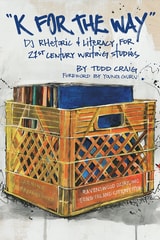
"K for the Way"
DJ Rhetoric and Literacy for 21st Century Writing StudiesTodd Craig
Utah State University Press, 2023
Using material from a larger qualitative research study that illustrates the Hip Hop DJ as a twenty-first-century new media reader, writer, and literary critic, Craig blends interviews from prominent and influential DJs in the Hip Hop community with narrative and interdisciplinary scholarship from writing studies, Hip Hop studies, African American studies, urban education, and ethnomusicology. The voices of DJs sit front and center, presenting a revolutionary conversation about writing and communication in the twenty-first century.
Weaving Craig’s life experiences with important discussions of racial literacies, “K for the Way” is a layered and utterly singular exploration of culture, identity, and literacy in America.
"K for the Way"
DJ Rhetoric and Literacy for 21st Century Writing StudiesTodd Craig
Utah State University Press, 2023
Using material from a larger qualitative research study that illustrates the Hip Hop DJ as a twenty-first-century new media reader, writer, and literary critic, Craig blends interviews from prominent and influential DJs in the Hip Hop community with narrative and interdisciplinary scholarship from writing studies, Hip Hop studies, African American studies, urban education, and ethnomusicology. The voices of DJs sit front and center, presenting a revolutionary conversation about writing and communication in the twenty-first century.
Weaving Craig’s life experiences with important discussions of racial literacies, “K for the Way” is a layered and utterly singular exploration of culture, identity, and literacy in America.
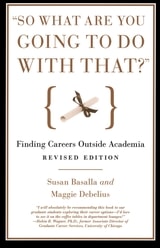
"So What Are You Going to Do with That?"
Finding Careers Outside AcademiaSusan Basalla and Maggie Debelius
University of Chicago Press, 2007
With “So What Are You Going to Do with That?” Susan Basalla and Maggie Debelius—Ph.D.’s themselves—answer all those questions with a resounding “Yes!” A witty, accessible guide full of concrete advice for anyone contemplating the jump from scholarship to the outside world, “So What Are You Going to Do with That?” covers topics ranging from career counseling to interview etiquette to translating skills learned in the academy into terms an employer can understand and appreciate. Packed with examples and stories from real people who have successfully made this daunting—but potentially rewarding— transition, and written with a deep understanding of both the joys and difficulties of the academic life, this fully revised and up-to-date edition will be indispensable for any graduate student or professor who has ever glanced at her CV, flipped through the want ads, and wondered, “What if?”
“I will absolutely be recommending this book to our graduate students exploring their career options—I’d love to see it on the coffee tables in department lounges!”—Robin B. Wagner, former associate director for graduate career services, University of Chicago
"So What Are You Going to Do with That?"
Finding Careers Outside Academia, Third EditionSusan Basalla and Maggie Debelius
University of Chicago Press, 2014
In this third edition of “So What Are You Going to Do with That?”, thoroughly revised with new advice for students in the sciences, Susan Basalla and Maggie Debelius—PhDs themselves—answer all those questions with a resounding “Yes!” A witty, accessible guide full of concrete advice for anyone contemplating the jump from scholarship to the outside world, “So What Are You Going to Do with That?” covers topics ranging from career counseling to interview etiquette to how to translate skills learned in the academy into terms an employer can understand and appreciate. Packed with examples and stories from real people who have successfully made this daunting—but potentially rewarding—transition, and written with a deep understanding of both the joys and difficulties of the academic life, this fully updated guide will be indispensable for any graduate student or professor who has ever glanced at his or her CV, flipped through the want ads, and wondered, “What if?”
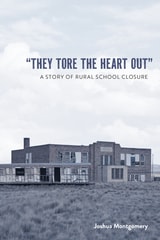
"They Tore the Heart Out"
A Story of Rural School ClosureJoshua Montgomery
University of Wyoming Press, 2027
What does a school mean in rural space? What happens when, despite the protests of a community, a school is closed? How does school closure uncover the cracks in the stories we tell about ourselves and our world? In “They Tore the Heart Out” Joshua Montgomery describes the impact of multiple rounds of school closure and school consolidation in the rural Wyoming community of Medicine Bow, reconstructing the story of the closure and the forces behind it through meeting minutes and other primary sources as well as interviews with past and present residents.
High schools in many small communities act as a surrogate identity and signifier of community success. The school building and the complex community it engenders play roles both prosaic, through school lunches, curriculum, and nurses, and productive, as an economic, political, social, and cultural engine. Montgomery illustrates the long-term impacts of school closure on Medicine Bow and tracks the existential tensions that persist to this day. The story that emerges exists in a rapidly changing cultural context that complicates not only the telling but also the interpreting. School closure, and its aftermath, forced community members to confront issues related to their ability to preserve and control their own destinies.
Told with a strong narrative flair that brings the story to life through dramatic events driven by colorful local characters, “They Tore the Heart Out” allows for a better understanding of the rural educational experience, leads to fundamental questions about who and what we are as a culture, and underscores the importance of maintaining rural space.
"To Serve a Larger Purpose"
Engagement for Democracy and the Transformation of Higher EducationEdited by John Saltmarsh and Matthew Hartley
Temple University Press, 2012
"To Serve a Larger Purpose" calls for the reclamation of the original democratic purposes of civic engagement and examines the requisite transformation of higher education required to achieve it. The contributors to this timely and relevant volume effectively highlight the current practice of civic engagement and point to the institutional change needed to realize its democratic ideals.
Using multiple perspectives, "To Serve a Larger Purpose" explores the democratic processes and purposes that reorient civic engagement to what the editors call "democratic engagement." The norms of democratic engagement are determined by values such as inclusiveness, collaboration, participation, task sharing, and reciprocity in public problem solving and an equality of respect for the knowledge and experience that everyone contributes to education, knowledge generation, and community building. This book shrewdly rethinks the culture of higher education.
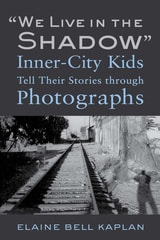
"We Live in the Shadow"
Inner-City Kids Tell Their Stories through PhotographsElaine Bell Kaplan
Temple University Press, 2013
Looking at their photo of railroad tracks, a group of preteen students in South Central Los Angeles see either "a way out of the ghetto," or a "dirty, bad environment." Such are the impressions expressed in the poignant "We Live in the Shadow": Inner-City Kids Tell Their Stories through Photographs.
In Elaine Bell Kaplan's perceptive book, at-risk youth were given five-dollar cameras to tell stories about their world. Their photos and stories show us their response to negative inner-city teen images. We follow them into their schools, and we hear about their creative coping strategies. While these kids see South Central as dangerous, they also see themselves as confident enough to not let the inner city take them down. They refuse to be labeled as "ghetto thugs," as outsiders sometimes do. These outsiders include police, teachers, and other groups representing the institutional voices governing their daily lives.
The kids in "We Live in the Shadow": Inner-City Kids Tell Their Stories through Photographs have developed a multilayered view of society. This impressive book gives voice to their resilience.
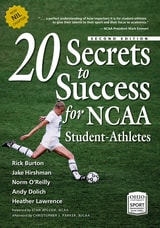
20 Secrets to Success for NCAA Student-Athletes
Rick Burton
Ohio University Press, 2021
The premier NCAA student-athlete handbook, now in a second, updated edition designed for today’s competitive market and with a new chapter on name, image, and likeness (NIL) rights.
Few student-athletes dreaming of athletic stardom ever make it to the pros. Yet, the discipline and skills they’ve developed while balancing a sport and academics make them ideally suited for satisfying careers elsewhere.
The book’s authors draw on personal experience, interviews, expert opinion, and industry data to provide a game plan for student-athletes to help them transition from high school to college, navigate evolving rules about NIL rights, and find success in life after college.
Modeled after Stephen Covey’s The 7 Habits of Highly Effective People, this expanded and updated guide provides a much-needed strategy for student-athletes as they prepare for postcollege careers, while serving as a valuable resource for their parents, coaches, and sports administrators across the country.
20 Secrets to Success for NCAA Student-Athletes Who Won’t Go Pro
Rick Burton
Ohio University Press, 2017
The vast majority of student-athletes dreaming of athletic stardom won’t make it to the pros. Yet, the discipline and skills they’ve developed while balancing a sport and academics make them ideally suited for satisfying careers elsewhere.
In 20 Secrets to Success for NCAA Student-Athletes Who Won’t Go Pro, the authors draw on personal experience, interviews, expert opinion, and industry data to provide a game plan for student-athletes through key transitions at each stage of their careers, from high school through college and beyond.
Modeled on Stephen Covey’s The 7 Habits of Highly Effective People, this book provides a much-needed strategy for achieving career success. Readable and concise, it will be a valuable tool for students, parents, and sports administrators.
33 Simple Strategies for Faculty
A Week-by-Week Resource for Teaching First-Year and First-Generation StudentsNunn, Lisa M
Rutgers University Press, 2019
Many students struggle with the transition from high school to university life. This is especially true of first-generation college students, who are often unfamiliar with the norms and expectations of academia. College professors usually want to help, but many feel overwhelmed by the prospect of making extra time in their already hectic schedules to meet with these struggling students.
33 Simple Strategies for Faculty is a guidebook filled with practical solutions to this problem. It gives college faculty concrete exercises and tools they can use both inside and outside of the classroom to effectively bolster the academic success and wellbeing of their students. To devise these strategies, educational sociologist Lisa M. Nunn talked with a variety of first-year college students, learning what they find baffling and frustrating about their classes, as well as what they love about their professors’ teaching.
Combining student perspectives with the latest research on bridging the academic achievement gap, she shows how professors can make a difference by spending as little as fifteen minutes a week helping their students acculturate to college life. Whether you are a new faculty member or a tenured professor, you are sure to find 33 Simple Strategies for Faculty to be an invaluable resource.
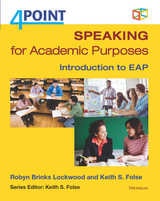
4 Point Speaking for Academic Purposes
Introduction to EAPRobyn Brinks Lockwood and Keith S. Folse
University of Michigan Press, 2017
The 4 Point series is designed for English language learners whose primary goal is to succeed in an academic setting. Academic English learners need skills-based books that focus on reading, listening, and speaking, as well as the two primary language bases of vocabulary and grammar. The ultimate goal is to help your students improve these skills and earn a 4.0 (GPA).
The Introduction to English for Academic Purposes (EAP) level is designed for students in academic programs who need a more general introduction to authentic academic content. The discrete skills volumes are designed for programs and courses that want to more intensively focus on key strategies and authentic academic content in one skill area.
Each 4 Point volume covers academic skills while providing reinforcement and systematic recycling of key vocabulary issues and further exposure to grammar issues. These volumes focus very heavily on vocabulary because language learners know that they are way behind their native-speaker counterparts when it comes to vocabulary. Each book highlights key vocabulary items, including individual words, compound words, phrasal verbs, short phrases, idioms, metaphors, collocations and longer set lexical phrases.
Speaking for Academic Purposes is an introductory textbook containing English for Academic Purposes content. Each unit includes activities to strengthen a range of speaking skills, notably: understanding classroom discourse, using academic language functions, recognizing signal words and phrases, and synthesizing information. These activities are presented within the context of one field of academic study (Architecture, Marketing, Earth Science, U.S. History, Chemistry, and Fine Arts) per unit.
Unique to this speaking text are six videos showing common student interactions. Access to the videos is free.
Each unit includes three academic speaking strategies (including one specific to making presentations) and tasks that involve participating in group discussions, interacting with native speakers, and making a presentation. The goal is to provide students with a variety of strategies/tools to master academic situations in which they need to participate.
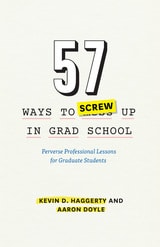
57 Ways to Screw Up in Grad School
Perverse Professional Lessons for Graduate StudentsKevin D. Haggerty and Aaron Doyle
University of Chicago Press, 2015
When it comes to a masters or PhD program, most graduate students don’t deliberately set out to fail. Yet, of the nearly 500,000 people who start a graduate program each year, up to half will never complete their degree. Books abound on acing the admissions process, but there is little on what to do once the acceptance letter arrives. Veteran graduate directors Kevin D. Haggerty and Aaron Doyle have set out to demystify the world of advanced education. Taking a wry, frank approach, they explain the common mistakes that can trip up a new graduate student and lay out practical advice about how to avoid the pitfalls. Along the way they relate stories from their decades of mentorship and even share some slip-ups from their own grad experiences.
The litany of foul-ups is organized by theme and covers the grad school experience from beginning to end: selecting the university and program, interacting with advisors and fellow students, balancing personal and scholarly lives, navigating a thesis, and creating a life after academia. Although the tone is engagingly tongue-in-cheek, the lessons are crucial to anyone attending or contemplating grad school. 57 Ways to Screw Up in Grad School allows you to learn from others’ mistakes rather than making them yourself.
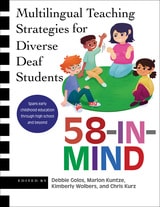
58-IN-MIND
Multilingual Teaching Strategies for Diverse Deaf StudentsDebbie Golos
Gallaudet University Press, 2024
Each chapter is written by a team of researchers and P–12 teachers with at least one Deaf coauthor. With seventy-five percent of the authors being Deaf, this is the first teaching methods book to harness the expertise of Deaf professionals at this level, highlighting their vital role in Deaf education and in shaping inclusive and effective learning environments. This book meets the need for a resource that recognizes the diversity of Deaf students by creating space in the classroom to honor their home/heritage languages, cultures, races, genders, abilities, hearing levels, and other multiple and intersecting identities. Written in a conversational tone, the book includes core recommendations for instruction of the targeted subject area, examples of key strategies, lessons and real stories from those working in the field, suggestions for practice, and recommended resources.
“58-IN-MIND” in the title refers to the version of the ASL sign "stick" that is made on the forehead, which is equivalent to the English idiom “to stick in one's mind.” As in, when students learn in a culturally responsive manner, the learning is likely to stick. The title also alludes indirectly to the collective aspirations of the chapter authors that the practices discussed in the book will also stick in the readers’ minds, and thus have a transformative impact on the way Deaf students are taught.
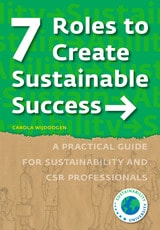
7 Roles to Create Sustainable Success
A Practical Guide for Sustainability and CSR ProfessionalsCarola Wijdoogen
Amsterdam University Press, 2020
The innovative science-based 7 Roles approach is explained using an excellent collection of practices and anecdotes from (among others) Kate Raworth ('Doughnut Economy') and CSOs of companies like Ingka Group, Levi Strauss & Co., Starbucks Coffee Company, Unilever Benelux, Microsoft, Kellogg Company, Interface Europe, KPN, Philips International B.V, DSM, AkzoNobel, Google, Tommy Hilfiger Global/PVH Europe, etc.

9XM Talking
WHA Radio and the Wisconsin IdeaRandall Davidson
University of Wisconsin Press, 2017