Results by title
153 books match the query 'Egypt' and 2 start with a non-letter
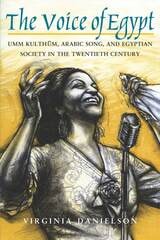
"The Voice of Egypt"
Umm Kulthum, Arabic Song, and Egyptian Society in the Twentieth CenturyVirginia Danielson
University of Chicago Press, 1997
Danielson examines the careful construction of Umm Kulthum's phenomenal popularity and success in a society that discouraged women from public performance. From childhood, her mentors honed her exceptional abilities to accord with Arab and Muslim practice, and as her stature grew, she remained attentive to her audience and the public reception of her work. Ultimately, she created from local precendents and traditions her own unique idiom and developed original song styles from both populist and neo-classical inspirations. These were enthusiastically received, heralded as crowning examples of a new, yet authentically Arab-Egyptian, culture. Danielson shows how Umm Kulthum's music and public personality helped form popular culture and contributed to the broader artistic, societal, and political forces that surrounded her.
This richly descriptive account joins biography with social theory to explore the impact of the individual virtuoso on both music and society at large while telling the compelling story of one of the most famous musicians of all time.
"She is born again every morning in the heart of 120 million beings. In the East a day without Umm Kulthum would have no color."—Omar Sharif
' Ulama', Politics, and the Public Sphere
An Egyptian PerspectiveMeir Hatina
University of Utah Press, 2010
The status of the Sunni Ulama (religious scholars) in modern times has attracted renewed academic interest, in light of their assertiveness regarding moral and sociopolitical issues on the Arab-Muslim agenda. This has led to a reassessment of the narrative of historians and social scientists, who usually depicted the Ulama as marginal players in comparison with the new lay Islamists, and certainly with the Shia Ulama. The Sunni 'Ulama'’s vitality is undoubtedly related to the continuing Islamic resurgence, which since the 1970s has forced the political elites to rely increasingly on the religious establishment in order to neutralize the Islamist challenge, thus allowing the Ulama greater freedom of activity.
Hatina’s study returns to an earlier period and shows that such vitality has its roots in the second half of the nineteenth and the early twentieth centuries. Hatina traces the diverse Ulama reactions to this period of accelerated state building and national cohesion.