Results by title
1832 books match the query 'Essays' and 8 start with a non-letter
"A Fully Accredited Ocean"
Essays on the Great LakesVictoria Brehm, Editor
University of Michigan Press, 1998
"Maximum Clarity" and Other Writings on Music
Ben Johnston. Edited by Bob Gilmore
University of Illinois Press, 2022
This collection spans forty years and brings together forty-one of Johnston's most important writings, including many rare and several previously unpublished selections. They include position papers, theoretical treatises, program notes, historical reflections, lectures, excerpts from interviews, and letters, and they cover a broad spectrum of concerns--from the technical exegesis of microtonality to the personal and the broadly humanistic. A discography of commercially available recordings of Johnston's music closes out the collection.
"The Girl in the Window" and Other True Tales
An Anthology with Tips for Finding, Reporting, and Writing Nonfiction NarrativesLane DeGregory
University of Chicago Press, 2023
This book—part anthology, part craft guide—provides a forensic reading of twenty-four of DeGregory’s singular stories, illustrating her tips for writers alongside pieces that put those elements under the microscope. Each of the pieces gathered here—including the Pulitzer Prize–winning title story—is accompanied by notes on how she built the story, plus tips on how nonfiction writers at all levels can do the same. Featuring a foreword by Beth Macy, author of the acclaimed Dopesick, this book is sure to delight fans of DeGregory’s writing, as well as introduce her to readers and writers who have not yet discovered her inspiring body of work.
"The One Who Sows Bountifully"
Essays in Honor of Stanley K. StowersCaroline Johnson Hodge
SBL Press, 2014
This festschrift honors the work of Stanley K. Stowers, a renowned specialist in the field of Pauline studies and early Christianity, on the occasion of his sixty-fifth birthday and retirement from Brown University. The collection includes twenty-eight essays on theory and history of interpretation, Israelite religion and ancient Judaism, the Greco-Roman world, and early Christinity, a preface honoring Stowers, and a select bibliography of his publications.
Contributors include: Adriana Destro, John T. Fitzgerald, John G. Gager, Caroline Johnson Hodge, Ross S. Kraemer, Saul M. Olyan, Mauro Pesce, Daniel Ullucci, Debra Scoggins Ballentine, William K. Gilders, David Konstan, Nathaniel B. Levtow, Jordan D. Rosenblum, Michael L. Satlow, Karen B. Stern, Emma Wasserman, Nathaniel DesRosiers, John S. Kloppenborg, Luther H. Martin, Arthur P. Urbano, L. Michael White, William Arnal, Pamela Eisenbaum, Troels Engberg-Pedersen, Karen L. King, Christopher R. Matthews, Erin Roberts, and Richard Wright.
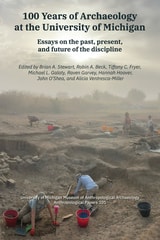
100 Years of Archaeology at the University of Michigan
Essays on the Past, Present, and Future of the DisciplineEdited by Brian A. Stewart, Robin A. Beck, Tiffany C. Fryer, Michael L. Galaty, Raven Garvey, Hannah Hoover, John O’Shea, and Alicia Ventresca-Miller
University of Michigan Press, 2025
The University of Michigan has been at the forefront of archaeological research for more than 100 years, since 1922, when the Museum of Anthropology (now the Museum of Anthropological Archaeology) was established on the Ann Arbor campus. The goal of its curators for many decades was to create a research and teaching program that emphasized methodological rigor in the analysis of archaeological materials, attempting to solve grand questions about human behavior through fieldwork, collections, and laboratory work. About fifty years ago, the Museum's emphasis shifted to developing archaeological theory when a new generation of curators with processualist leanings made Ann Arbor a testing ground for the so-called New Archaeology.
Now, archaeology stands at a crossroads. Some archaeologists refer to the death of archaeological theory. Others stake out opposed camps of generalists and particularists. At U-M, as at many other universities, the past decade has seen a new commitment to collaborative archaeology, working with descendant communities and acknowledging the discipline's roots in colonialism and extraction.
In 2022, to celebrate a century of existence, the University of Michigan Museum of Anthropological Archaeology (UMMAA) hosted an international conference to explore possibilities for a middle way: an archaeology for the next 100 years, combining humanistic and scientific approaches, which allows for both agents and systems, description and explanation, science and heritage. This volume is meant to be a snapshot of that conference and this moment in the development of the discipline. Included are most of the papers and posters presented, as well as photographs of the panels and the proceedings.
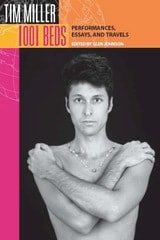
1001 Beds
Performances, Essays, and TravelsTim Miller; Edited by Glen Johnson
University of Wisconsin Press, 2006
Here we have the most complete Miller yet—a raucous collection of his performance scripts, essays, interviews, journal entries, and photographs, as well as his most recent stage piece Us. This volume brings together the personal, communal, and national political strands that interweave through his work from its beginnings and ultimately define Miller's place as a contemporary artist, activist, and gay man.
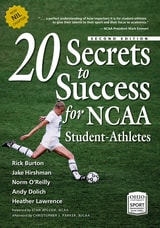
20 Secrets to Success for NCAA Student-Athletes
Rick Burton
Ohio University Press, 2021
The premier NCAA student-athlete handbook, now in a second, updated edition designed for today’s competitive market and with a new chapter on name, image, and likeness (NIL) rights.
Few student-athletes dreaming of athletic stardom ever make it to the pros. Yet, the discipline and skills they’ve developed while balancing a sport and academics make them ideally suited for satisfying careers elsewhere.
The book’s authors draw on personal experience, interviews, expert opinion, and industry data to provide a game plan for student-athletes to help them transition from high school to college, navigate evolving rules about NIL rights, and find success in life after college.
Modeled after Stephen Covey’s The 7 Habits of Highly Effective People, this expanded and updated guide provides a much-needed strategy for student-athletes as they prepare for postcollege careers, while serving as a valuable resource for their parents, coaches, and sports administrators across the country.
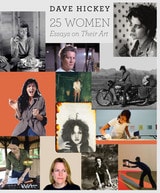
25 Women
Essays on Their ArtDave Hickey
University of Chicago Press, 2015
25 Women will not disappoint. The book collects Hickey’s best and most important writing about female artists from the past twenty years. But this is far more than a compilation: Hickey has revised each essay, bringing them up to date and drawing out common themes. Written in Hickey’s trademark style—accessible, witty, and powerfully illuminating—25 Women analyzes the work of Joan Mitchell, Bridget Riley, Fiona Rae, Lynda Benglis, Karen Carson, and many others. Hickey discusses their work as work, bringing politics and gender into the discussion only where it seems warranted by the art itself. The resulting book is not only a deep engagement with some of the most influential and innovative contemporary artists, but also a reflection on the life and role of the critic: the decisions, judgments, politics, and ethics that critics negotiate throughout their careers in the art world.
Always engaging, often controversial, and never dull, Dave Hickey is a writer who gets people excited—and talking—about art. 25 Women will thrill his many fans, and make him plenty of new ones.