Results by title
2706 books match the query 'European' and 12 start with a non-letter
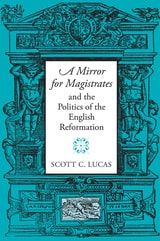
"A Mirror for Magistrates" and the Politics of the English Reformation
Scott Lucas
University of Massachusetts Press, 2009
In a striking departure from previous scholarship, Scott Lucas shows that modern critics have misconstrued the purpose of the tragic verse narratives of the Mirror, approaching them primarily as uncontroversial meditations on abstract political and philosophical doctrines. Lucas revises this view, revealing many of the Mirror tragedies to be works topically applicable in form and politically contentious in nature.
Lucas returns the earliest poems of A Mirror for Magistrates to the troubled context of their production, the tumultuous reign of the Catholic Queen Mary (1553–1558). As Protestants suffering from the traumatic collapse of King Edward VI's "godly" rule (1547–1553) and from the current policies of Mary's government, the Mirror authors radically reshaped their poems' historical sources in order to craft emotionally moving narratives designed to provide models for interpreting the political failures of Edward VI's reign and to offer urgent warnings to Marian magistrates.
Lucas's study also reveals how, in later poems, the Mirror authors issued oblique appeals to Queen Elizabeth's officers, boldly demanding that they allow the realm of "the literary" to stand as an unfettered discursive arena of public controversy. Lucas thus provides a provocative new approach to this seminal but long-misunderstood collection, one that restores the Mirror to its rightful place as one of the greatest works of sixteenth-century English political literature.

"A Truthful Impression of the Country"
British and American Travel Writing in China, 1880-1949Nicholas R. Clifford
University of Michigan Press, 2001
Nicholas R. Clifford argues that, for a variety of reasons, travel accounts during this time claimed a particular kind of veracity that distinguished them from the work of other writers--scholars, journalists, diplomats, policymakers, or memoir-writing expatriates--who also sought to represent an unfamiliar China to the West. Yet even as the genre claims to be a "truthful impression," it contains an implicit warning that the traveler's own sensibility enters into the account and into the representation of the unfamiliar and the exotic.
"A Truthful Impression of the Country" will appeal not only to those interested in the broad phenomenon of imperialism but also to those interested in cultural studies and post-colonialism. It will likewise prove accessible to the general reader exploring Sino-Western interactions or in travel writing as a particular genre.
Nicholas R. Clifford is College Professor Emeritus, Middlebury College. He is also the author of the novel The House of Memory and of the monographs Shanghai, 1925: Urban Nationalism and the Defense of Foreign Privilege and Spoilt Children of Empire: Westerners in Shanghai and the Chinese Revolution of 1925--1927.
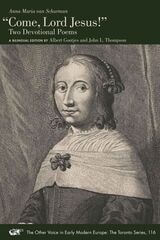
"Come, Lord Jesus!"
Two Devotional Poems. A Bilingual EditionAnna Maria van Schurman
Iter Press, 2026
The life and reputation of Anna Maria van Schurman (1607–78) swung dramatically from her early fame as a prodigy and femme savante to the infamy she bore in the wake of her late affiliation with Jean de Labadie. From her late adolescence on, van Schurman was widely known for her intellectual gifts, her mastery of languages, and her skillful portraiture and embroidery. Described by some as a femme savante and “the Star of Utrecht,” she gained an international reputation with the publication of her defense of women’s education. Her later years, however, were marked by a growing disillusionment with her own fame and intellectual achievements, and her reputation was dramatically marred in the eyes of her contemporaries when, in her final decade, she repudiated the Dutch Reformed Church to affiliate with Jean de Labadie. With him and his spiritual community, she lived out her last years in peace while also composing a two-volume defense of her actions and convictions, entitled Eukleria or The Better Choice.
The years between her withdrawal from public life and her supposedly scandalous return are not easily mapped. Drawing on two long devotional poems that she wrote during this period (and that remained unpublished during her lifetime), this bilingual edition introduces readers to van Schurman’s private piety, as well as to her theological acumen, her artistry as a vernacular poet, and her participation in the leadership of a conventicle of like-minded friends and acquaintances. The English translation closely approximates the rhyme, meter, and cadence of the Dutch original and thus facilitates an appreciation not only of the poet’s meaning but also of the auditory aesthetics of each text.
"La Clarté Notre-Dame" and "The Last Book of the Madrigals"
Philippe Jaccottet
Seagull Books, 2022
In his 96th and final year, and with the help of the poet José-Flore Tappy, celebrated Swiss poet Philippe Jaccottet finished two manuscripts-in-progress, one in prose and one in poetry, both of which are presented in this volume in John Taylor’s sensitive translation.
The first work, “La Clarté Notre-Dame,” takes off from the “pure, weightless, fragile, yet crystal-clear tinkling” of a monastery bell heard during a walk with friends. With this thought-provoking sound as a leitmotiv, Jaccottet looks back on a life of writing, reading, and scrutinizing humankind’s existential and spiritual aspirations. He sets these concerns against his equally lifelong preoccupation with “the rise of evil in today’s world,” notably in Syria. Composed in a baroque style, the verse poems collected in “The Last Book of Madrigals” explore love. Jaccottet returns in spirit to Italy, the country which for him symbolizes happiness and sensuality. As he evokes amorous attraction, he conjures up Monteverdi’s madrigals, one of Dante’s little-known rhymes, and Giuseppe Ungaretti’s last poem. Reinventing and commenting on these works, Jaccottet meditates on old age, approaching death, despair, and the persistence of love.
Together, both works grapple with devastating darkness, but as Tappy observes in her afterword, however, Jaccottet’s “greatest force” was “his perpetually renewed desire, during the most terrifying night, to head for the light.”
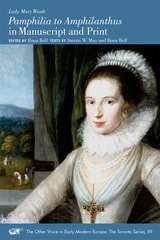
"Pamphilia to Amphilanthus" in Manuscript and Print
Lady Mary Wroth
Iter Press, 2017
"Songes of Rechelesnesse"
Langland and the FranciscansLawrence M. Clopper
University of Michigan Press, 1997
In the late Middle Ages, Franciscan friars had a significant impact on all levels of society.
But because of the apparent discrepancy between the poverty the Franciscans claimed and the life they lived, a large body of antifraternal literature arose, including, supposedly, Piers Plowman. Since the sixteenth century, when it was first put into print, Piers Plowman has been understood to be a proto-Protestant work that revealed the failures of the medieval clergy, but especially of the mendicant orders. In "Songes of Rechelesnesse," Clopper establishes the presence of a Franciscan reformist position in Piers Plowman.
Clopper maintains that the poem articulates a reformist agenda, presenting the internal Franciscan debate, in a bid to return the order to its initial foundation. Clopper believes that Langland is deeply imbued with a Franciscan mentality that reaches deep into the structure of the poem. It manifests itself at the level of the alliterative long line in his exemplarist poetics and is the source of his imagery and politics. In short Clopper identifies Franciscanism as holding the poem together.
"Songes of Rechelesnesse" is a historical, political, and religious history of late fourteenth-century England. It will be of interest to literary scholars, historians of the late Middle Ages, and scholars in religious studies.
Lawrence M. Clopper is Director, Medieval Studies Institute, and Professor of English, Indiana University.
"The Stage's Glory"
John Rich (1692–1761)Berta Joncus
University of Delaware Press, 2011
Published by University of Delaware Press. Distributed worldwide by Rutgers University Press.
"This Book of Starres"
Learning to Read George HerbertJames Boyd White
University of Michigan Press, 1995
"This Book of Starres" is one of those all-too-rare books in which an author's love of someone's work--in this case, the seventeenth-century English poet George Herbert--leads to a journey of exploration.
Herbert's poetry presents a special set of challenges: It is to the modern ear archaic, difficult in thought and structure, and entirely theological in character. Yet no poet is more deeply admired by those who know him well. "This Book of Starres" is meant to engage the reader in a process of reading by which this verse can be seen to be vivid and alive. It is the record of one person's life-changing involvement with the poetry of George Herbert; in this it is about not only how, but why we read great poetry.
"It is a joy to experience Herbert's poetry in the company of James Boyd White, whose affinity for the work is always convincing and seems at times preternatural. 'This Book of Starres' is a necessary pleasure: all readers of poetry, whether expert or inexpert, will find it enriching." --Alice Fulton
". . . both a delight to read, and one of the most instructive exercises in literature and theology I have read for a long time. . . . Herbert emerges as one of the greatest, a writer to test and change the imagination, the very way in which we think about the world and that which is beyond it." --Literature and Theology
James Boyd White is Hart Wright Professor of Law, Professor of English, and Adjunct Professor of Classical Studies, University of Michigan.

20th-Century Italian Women Writers
The Feminine ExperienceAlba Amoia
Southern Illinois University Press, 1996
As an international scholar and resident of Italy who has observed and shared the experiences of Italian women for the past twenty years, Alba Amoia has positioned herself perfectly to report to English-speaking audiences the great range and variety of writing produced by twentieth-century Italian women. Her personal contact with many of the authors she discusses lends further immediacy to her study.
Rather than focusing exclusively on contemporary living authors, Amoia discusses writers from the early part of the twentieth century as well, linking them with later writers spanning twentieth-century Italy’s literary movements and political, social, and economic developments. Yet the connections and contradictions that bind and divide these women are only beginning to be established because Italy is still a splintered country in which perceptions of Italian women as a historical group have only begun to crystallize. While feminine voices resound on the Italian literary scene, only recently has feminine authority made itself felt in the professional and institutional worlds.
The eleven writers in this volume criticize the female role in Italian society, externalize women’s unconscious needs, and offer unusual examples of feminine creativity. Amoia provides a critical treatment of each author, incorporating the accepted opinion of Italian and other critics. She isolates recurrent and fundamental themes in each author’s literary career: linguistic repression by males, personal frustration in the realm of "householditude," and disorientation within Italy’s unbalanced institutions and hierarchies still strongly anchored in archaic structures.
Amoia begins her discussion with two illustrious predecessors of Italy’s contemporary women writers: the 1926 Nobel Prize winner Grazia Deledda and the premier literary feminist Sibilla Aleramo. Continuing in chronological order, Amoia discusses Gianna Manzini, Lalla Romano, Elsa Morante, Natalia Ginzburg, Rosetta Loy, and Dacia Maraini. Amoia concludes her exploration of Italian women writers with three journalists: Matilde Serao, Oriana Fallaci, and Camilla Cederna.
Essentially, Amoia has provided a collection of succinct and accessible monographs featuring pertinent biographical information and extensive bibliographies. She discusses each author’s most representative works, seeking to give readers both a sense of these women as writers and an understanding of their significance in the male-dominated literary scene.
‘We Didn’t Do Very Well’
The CorrespondenceIngeborg Bachmann and Max Frisch
Seagull Books, 2026
The fraught and generative relationship between two postwar literary giants—revealed through a series of letters published for the first time in English.
Ingeborg Bachmann (1926–1973) stands among the most vital voices of postwar German literature—an acclaimed poet and prose writer who also reshaped radio drama and opera. In 1958, a letter of admiration from the Swiss novelist Max Frisch (1911–1991), written after hearing Bachmann’s radio play The Good God of Manhattan, led to a meeting in Paris and the beginning of an intense, volatile love affair that would forever leave a mark on both their lives and work. Presented here for the first time in English, 299 letters written between 1958 and 1973 trace the arc of that relationship: long separations, the strain of two writers attempting to share a life, creative rivalry, sexual jealousy, and gendered tensions sharpened by a fifteen-year age gap. The correspondence ranges from everyday logistics to raw psychological insight, from passion and longing to bitterness, silence, and regret. The later letters, written as Bachmann’s health declined, expand to include friends, relatives, and key literary figures. First published in German in 2022, this correspondence overturned long-held myths about the two writers, revealing mutual influence, negotiated freedom, and a struggle to reconcile incompatible needs. Intimate and revelatory, these letters illuminate the fragile intersection of love, power, and creativity.
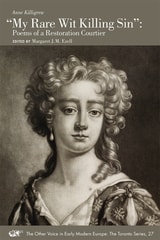
“My Rare Wit Killing Sin”
Poems of a Restoration CourtierAnne Killigrew
Iter Press, 2013
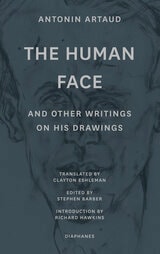
“The Human Face” and Other Writings on His Drawings
Antonin Artaud
Diaphanes, 2021
The many major exhibitions of Antonin Artaud’s drawings and drawn notebook pages in recent years—at New York’s Museum of Modern Art, Vienna’s Museum Moderner Kunst, and Paris’s Centre Georges Pompidou—have entirely transformed our perception of his work, reorienting it toward the artworks of his final years. This volume collects all three of Artaud’s major writings on his artworks. “The Human Face” (1947) was written as the catalog text for Artaud’s only gallery exhibition of his drawings during his lifetime, focusing on his approach to making portraits of his friends at the decrepit pavilion in the Paris suburbs where he spent the final year of his life. “Ten years that language is gone” (1947) examines the drawings Artaud made in his notebooks—his main creative medium at the end of his life—and their capacity to electrify his creativity when language failed him. “50 Drawings to assassinate magic” (1948), the residue of an abandoned book of Artaud’s drawings, approaches the act of drawing as part of the weaponry deployed by Artaud at the very end of his life to combat malevolent assaults and attempted acts of assassination. Together, these three extraordinary texts—pitched between writing and image—project Artaud’s ferocious engagement with the act of drawing.