Results by title
147 books match the query 'Freedom' and 3 start with a non-letter
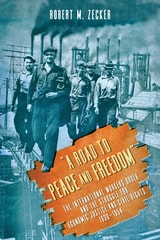
"A Road to Peace and Freedom"
The International Workers Order and the Struggle for Economic Justice and Civil Rights, 1930-1954Robert M. Zecker
Temple University Press, 2017
The International Workers Order was an American consortium of ethnic mutual self-insurance societies that advocated for unemployment insurance, Social Security and vibrant industrial unions. This interracial leftist organization guaranteed the healthcare of its 180,000 white, black, Hispanic and Arabic working-class members. But what accounted for the popularity—and eventual notoriety—of this Order?
Mining extensive primary sources, Robert Zecker gives voice to the workers in “A Road to Peace and Freedom.” He describes the group's economic goals, commitment to racial justice, and activism, from lobbying to end segregation and lynching in America to defeating fascism abroad. Zecker also illustrates the panoply of entertainment, sports, and educational activities designed to cultivate the minds and bodies of members.
However, the IWO was led by Communists, and the Order was targeted for red-baiting during the Cold War, subject to government surveillance, and ultimately "liquidated." Zecker explains how the dismantling of the IWO and the general suppression of left-wing dissenting views on economic egalitarianism and racial equality had deleterious effects for the entire country. Moreover, Zecker shows why the sobering lesson of the IWO remains prescient today.
[more]
"The Disenthralled Hosts of Freedom"
Party Prophecy in the Antebellum Editions of Leaves of GrassDavid Grant
University of Iowa Press, 2021
Walt Whitman wrote three distinct editions of Leaves of Grass before the Civil War. During those years he was passionately committed to party anti-slavery, and his unpublished tract The Eighteenth Presidency shows that he was fully attuned to the kind of rhetoric coming out of the new Republican party. This study explores how the prophecies of the pre–war Leaves of Grass relate to the prophecy of this new party. It seeks not only to ground Whitman’s work in this context but also to bring out features of party discourse that make it relevant to literary and cultural studies.
Anti-slavery party discourse set itself the task of curing an ailing people who had grown compliant, inert, and numb; it fashioned a complete fictional world where the people could be reactivated into assuming their true role in the republic. Both as a cause and a result of this rejuvenation, they would come into their own and spread their energies over the land and over the body politic, thereby rescuing their country at the last minute from what would otherwise be the permanent dominion of slavery. Party discourse had long hinged its success on such magical transformations of the people individually and collectively, and Whitman’s celebrations of his nation’s potential need to be seen in this context: like his party, Whitman calls on the people to reject their own subordination and take command of the future, and redeem themselves as they also redeem the nation.
Anti-slavery party discourse set itself the task of curing an ailing people who had grown compliant, inert, and numb; it fashioned a complete fictional world where the people could be reactivated into assuming their true role in the republic. Both as a cause and a result of this rejuvenation, they would come into their own and spread their energies over the land and over the body politic, thereby rescuing their country at the last minute from what would otherwise be the permanent dominion of slavery. Party discourse had long hinged its success on such magical transformations of the people individually and collectively, and Whitman’s celebrations of his nation’s potential need to be seen in this context: like his party, Whitman calls on the people to reject their own subordination and take command of the future, and redeem themselves as they also redeem the nation.
[more]
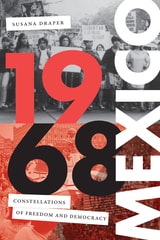
1968 Mexico
Constellations of Freedom and DemocracySusana Draper
Duke University Press, 2018
Recognizing the fiftieth anniversary of the protests, strikes, and violent struggles that formed the political and cultural backdrop of 1968 across Europe, the United States, and Latin America, Susana Draper offers a nuanced perspective of the 1968 movement in Mexico. She challenges the dominant cultural narrative of the movement that has emphasized the importance of the October 2nd Tlatelolco Massacre and the responses of male student leaders. From marginal cinema collectives to women’s cooperative experiments, Draper reveals new archives of revolutionary participation that provide insight into how 1968 and its many afterlives are understood in Mexico and beyond. By giving voice to Mexican Marxist philosophers, political prisoners, and women who participated in the movement, Draper counters the canonical memorialization of 1968 by illustrating how many diverse voices inspired alternative forms of political participation. Given the current rise of social movements around the globe, in 1968 Mexico Draper provides a new framework to understand the events of 1968 in order to rethink the everyday existential, political, and philosophical problems of the present.
[more]