Results by title
932 books match the query 'Genres & Styles' and 8 start with a non-letter
"Do You Know...?"
The Jazz Repertoire in ActionRobert R. Faulkner and Howard S. Becker
University of Chicago Press, 2009
Every night, somewhere in the world, three or four musicians will climb on stage together. Whether the gig is at a jazz club, a bar, or a bar mitzvah, the performance never begins with a note, but with a question. The trumpet player might turn to the bassist and ask, “Do you know ‘Body and Soul’?”—and from there the subtle craft of playing the jazz repertoire is tested in front of a live audience. These ordinary musicians may never have played together—they may never have met—so how do they smoothly put on a show without getting booed offstage.
In “Do You Know . . . ?” Robert R. Faulkner and Howard S. Becker—both jazz musicians with decades of experience performing—present the view from the bandstand, revealing the array of skills necessary for working musicians to do their jobs. While learning songs from sheet music or by ear helps, the jobbing musician’s lexicon is dauntingly massive: hundreds of thousands of tunes from jazz classics and pop standards to more exotic fare. Since it is impossible for anyone to memorize all of these songs, Faulkner and Becker show that musicians collectively negotiate and improvise their way to a successful performance. Players must explore each others’ areas of expertise, develop an ability to fake their way through unfamiliar territory, and respond to the unpredictable demands of their audience—whether an unexpected gang of polka fanatics or a tipsy father of the bride with an obscure favorite song.
“Do You Know . . . ?” dishes out entertaining stories and sharp insights drawn from the authors’ own experiences and observations as well as interviews with a range of musicians. Faulkner and Becker’s vivid, detailed portrait of the musician at work holds valuable lessons for anyone who has to think on the spot or under a spotlight.
"Don Giovanni" Captured
Performance, Media, MythRichard Will
University of Chicago Press, 2022
Mozart’s opera Don Giovanni has long inspired myths about eros and masculinity. Over time, its performance history has revealed a growing trend toward critique—an increasing effort on the part of performers and directors to highlight the violence and predatoriness of the libertine central character, alongside the suffering and resilience of his female victims.
In “Don Giovanni” Captured, Richard Will sets out to analyze more than a century’s worth of recorded performances of the opera, tracing the ways it has changed from one performance to another and from one generation to the next. Will consults audio recordings, starting with wax cylinders and 78s, as well as video recordings, including DVDs, films, and streaming videos. As Will argues, recordings and other media shape our experience of opera as much as live performance does. Seen as a historical record, opera recordings are also a potent reminder of the refusal of works such as Don Giovanni to sit still. By choosing a work with such a rich and complex tradition of interpretation, Will helps us see Don Giovanni as a standard-bearer for evolving ideas about desire and power, both on and off the stage.
"I Hear America Singing"
Folk Music and National IdentityRachel Clare Donaldson
Temple University Press, 2014
In "I Hear America Singing," Rachel Donaldson traces the vibrant history of the twentieth-century folk music revival from its origins in the 1930s through its end in the late 1960s. She investigates the relationship between the revival and concepts of nationalism, showing how key figures in the revival--including Pete Seeger , Alan Lomax, Moses Asch, and Ralph Rinzler--used songs to influence the ways in which Americans understood the values, the culture, and the people of their own nation.
As Donaldson chronicles how cultural norms were shaped over the course of the mid-twentieth century, she underscores how various groups within the revival and their views shifted over time. "I Hear America Singing" provides a stirring account of how and why the revivalists sustained their culturally pluralist and politically democratic Americanism over this tumultuous period in American history.
"K for the Way"
DJ Rhetoric and Literacy for 21st Century Writing StudiesTodd Craig
Utah State University Press, 2023
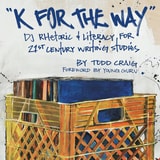
Using material from a larger qualitative research study that illustrates the Hip Hop DJ as a twenty-first-century new media reader, writer, and literary critic, Craig blends interviews from prominent and influential DJs in the Hip Hop community with narrative and interdisciplinary scholarship from writing studies, Hip Hop studies, African American studies, urban education, and ethnomusicology. The voices of DJs sit front and center, presenting a revolutionary conversation about writing and communication in the twenty-first century.
Weaving Craig’s life experiences with important discussions of racial literacies, “K for the Way” is a layered and utterly singular exploration of culture, identity, and literacy in America.
"K for the Way"
DJ Rhetoric and Literacy for 21st Century Writing StudiesTodd Craig
Utah State University Press, 2023
Using material from a larger qualitative research study that illustrates the Hip Hop DJ as a twenty-first-century new media reader, writer, and literary critic, Craig blends interviews from prominent and influential DJs in the Hip Hop community with narrative and interdisciplinary scholarship from writing studies, Hip Hop studies, African American studies, urban education, and ethnomusicology. The voices of DJs sit front and center, presenting a revolutionary conversation about writing and communication in the twenty-first century.
Weaving Craig’s life experiences with important discussions of racial literacies, “K for the Way” is a layered and utterly singular exploration of culture, identity, and literacy in America.
"Maximum Clarity" and Other Writings on Music
Ben Johnston. Edited by Bob Gilmore
University of Illinois Press, 2022
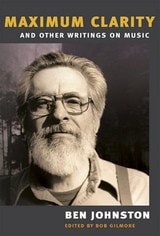
This collection spans forty years and brings together forty-one of Johnston's most important writings, including many rare and several previously unpublished selections. They include position papers, theoretical treatises, program notes, historical reflections, lectures, excerpts from interviews, and letters, and they cover a broad spectrum of concerns--from the technical exegesis of microtonality to the personal and the broadly humanistic. A discography of commercially available recordings of Johnston's music closes out the collection.

"The Whorehouse Bells Were Ringing" and Other Songs Cowboys Sing
Collected and edited by Guy Logsdon
University of Illinois Press, 1995
Winner of the Westerners International Co-Founders Awards of the Western History Association, 1990.

100 Years of Kurt Weill, Volume 30
Tom Sellar, ed.
Duke University Press, 0
100 Years of Kurt Weill makes a notable addition to the commemoration of the anniversary with the English-language publication of two major Weill librettos, both translated and introduced by international opera director Jonathan Eaton. Written in 1925, Royal Palace is a one-act opera with a libretto by surrealist/expressionist poet-playwright Yvan Goll. It was one of the first operas to incorporate film. The other work, Die Bürgschaft (The Pledge), was inspired by a dark social parable by Johann Gottfried von Herder and written in collaboration with Caspar Neher. The piece was banned in 1933 by the Nazi regime because of its controversial content and was not restaged in its original form until Eaton’s 1998 and 1999 productions in Bielefeld, Germany, and at the Spoleto Festival U.S.A.
This special issue specifically addresses the theatrical context of Weill’s music, exploring new perspectives on the artist and his work and on recent developments in Weill scholarship. These articles, combined with the previously unpublished works, make 100 Years of Kurt Weill a considerable and unique contribution to the centenary commemoration of his birth.