Results by title
715 books match the query 'Higher' and 6 start with a non-letter
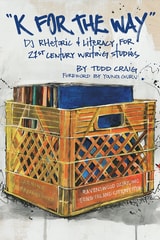
"K for the Way"
DJ Rhetoric and Literacy for 21st Century Writing StudiesTodd Craig
Utah State University Press, 2023
Using material from a larger qualitative research study that illustrates the Hip Hop DJ as a twenty-first-century new media reader, writer, and literary critic, Craig blends interviews from prominent and influential DJs in the Hip Hop community with narrative and interdisciplinary scholarship from writing studies, Hip Hop studies, African American studies, urban education, and ethnomusicology. The voices of DJs sit front and center, presenting a revolutionary conversation about writing and communication in the twenty-first century.
Weaving Craig’s life experiences with important discussions of racial literacies, “K for the Way” is a layered and utterly singular exploration of culture, identity, and literacy in America.
"K for the Way"
DJ Rhetoric and Literacy for 21st Century Writing StudiesTodd Craig
Utah State University Press, 2023
Using material from a larger qualitative research study that illustrates the Hip Hop DJ as a twenty-first-century new media reader, writer, and literary critic, Craig blends interviews from prominent and influential DJs in the Hip Hop community with narrative and interdisciplinary scholarship from writing studies, Hip Hop studies, African American studies, urban education, and ethnomusicology. The voices of DJs sit front and center, presenting a revolutionary conversation about writing and communication in the twenty-first century.
Weaving Craig’s life experiences with important discussions of racial literacies, “K for the Way” is a layered and utterly singular exploration of culture, identity, and literacy in America.
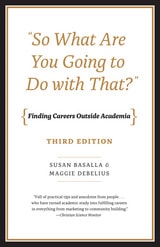
"So What Are You Going to Do with That?"
Finding Careers Outside Academia, Third EditionSusan Basalla and Maggie Debelius
University of Chicago Press, 2014
In this third edition of “So What Are You Going to Do with That?”, thoroughly revised with new advice for students in the sciences, Susan Basalla and Maggie Debelius—PhDs themselves—answer all those questions with a resounding “Yes!” A witty, accessible guide full of concrete advice for anyone contemplating the jump from scholarship to the outside world, “So What Are You Going to Do with That?” covers topics ranging from career counseling to interview etiquette to how to translate skills learned in the academy into terms an employer can understand and appreciate. Packed with examples and stories from real people who have successfully made this daunting—but potentially rewarding—transition, and written with a deep understanding of both the joys and difficulties of the academic life, this fully updated guide will be indispensable for any graduate student or professor who has ever glanced at his or her CV, flipped through the want ads, and wondered, “What if?”
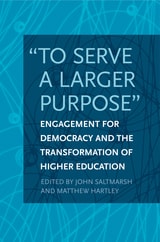
"To Serve a Larger Purpose"
Engagement for Democracy and the Transformation of Higher EducationEdited by John Saltmarsh and Matthew Hartley
Temple University Press, 2012
"To Serve a Larger Purpose" calls for the reclamation of the original democratic purposes of civic engagement and examines the requisite transformation of higher education required to achieve it. The contributors to this timely and relevant volume effectively highlight the current practice of civic engagement and point to the institutional change needed to realize its democratic ideals.
Using multiple perspectives, "To Serve a Larger Purpose" explores the democratic processes and purposes that reorient civic engagement to what the editors call "democratic engagement." The norms of democratic engagement are determined by values such as inclusiveness, collaboration, participation, task sharing, and reciprocity in public problem solving and an equality of respect for the knowledge and experience that everyone contributes to education, knowledge generation, and community building. This book shrewdly rethinks the culture of higher education.
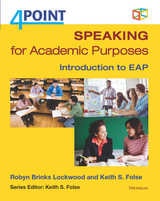
4 Point Speaking for Academic Purposes
Introduction to EAPRobyn Brinks Lockwood and Keith S. Folse
University of Michigan Press, 2017
The 4 Point series is designed for English language learners whose primary goal is to succeed in an academic setting. Academic English learners need skills-based books that focus on reading, listening, and speaking, as well as the two primary language bases of vocabulary and grammar. The ultimate goal is to help your students improve these skills and earn a 4.0 (GPA).
The Introduction to English for Academic Purposes (EAP) level is designed for students in academic programs who need a more general introduction to authentic academic content. The discrete skills volumes are designed for programs and courses that want to more intensively focus on key strategies and authentic academic content in one skill area.
Each 4 Point volume covers academic skills while providing reinforcement and systematic recycling of key vocabulary issues and further exposure to grammar issues. These volumes focus very heavily on vocabulary because language learners know that they are way behind their native-speaker counterparts when it comes to vocabulary. Each book highlights key vocabulary items, including individual words, compound words, phrasal verbs, short phrases, idioms, metaphors, collocations and longer set lexical phrases.
Speaking for Academic Purposes is an introductory textbook containing English for Academic Purposes content. Each unit includes activities to strengthen a range of speaking skills, notably: understanding classroom discourse, using academic language functions, recognizing signal words and phrases, and synthesizing information. These activities are presented within the context of one field of academic study (Architecture, Marketing, Earth Science, U.S. History, Chemistry, and Fine Arts) per unit.
Unique to this speaking text are six videos showing common student interactions. Access to the videos is free.
Each unit includes three academic speaking strategies (including one specific to making presentations) and tasks that involve participating in group discussions, interacting with native speakers, and making a presentation. The goal is to provide students with a variety of strategies/tools to master academic situations in which they need to participate.
57 Ways to Screw Up in Grad School
Perverse Professional Lessons for Graduate StudentsKevin D. Haggerty and Aaron Doyle
University of Chicago Press, 2015
When it comes to a masters or PhD program, most graduate students don’t deliberately set out to fail. Yet, of the nearly 500,000 people who start a graduate program each year, up to half will never complete their degree. Books abound on acing the admissions process, but there is little on what to do once the acceptance letter arrives. Veteran graduate directors Kevin D. Haggerty and Aaron Doyle have set out to demystify the world of advanced education. Taking a wry, frank approach, they explain the common mistakes that can trip up a new graduate student and lay out practical advice about how to avoid the pitfalls. Along the way they relate stories from their decades of mentorship and even share some slip-ups from their own grad experiences.
The litany of foul-ups is organized by theme and covers the grad school experience from beginning to end: selecting the university and program, interacting with advisors and fellow students, balancing personal and scholarly lives, navigating a thesis, and creating a life after academia. Although the tone is engagingly tongue-in-cheek, the lessons are crucial to anyone attending or contemplating grad school. 57 Ways to Screw Up in Grad School allows you to learn from others’ mistakes rather than making them yourself.