Results by title
884 books match the query 'Historical' and 4 start with a non-letter

... And Heaven Shed No Tears
Henry Armin Herzog
University of Wisconsin Press, 2005
Henry Herzog survived the liquidation of the Rzeszow ghetto in Poland and endured terrible hardships in forced labor camps. He documents the increasing severity of Nazi rule in Rzeszow and the complicity of the Jewish council (the Judenrat) and Jewish police in the round-ups for deportation to the Belzec concentration camp. One of these deportations took his parents to their deaths. His brothers were caught, tortured, and killed by the Gestapo. Herzog and his sister escaped to Hungary where—although she found refuge—he was betrayed, arrested, and finally put on a train to the concentration camps. Escaping by jumping off the train and fleeing into the Tatra Mountains, he joined a group of Russian partisans to fight the Nazis.
1995 paperback, Saga Publishers / Folio Private
1995 paperback, Saga Publishers / Folio Private
[more]
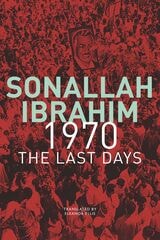
1970
The Last DaysSonallah Ibrahim
Seagull Books, 2024
A riveting novel that is both an indictment and an elegy, a second-person memoir of Nasser’s final months in the voice of his former prisoner.
In 1959, at the age of twenty-two, Egyptian novelist Sonallah Ibrahim was imprisoned by Gamal Abdel Nasser’s regime. Over the following five years in prison in Egypt’s Western Desert, Ibrahim kept diaries that he smuggled out on cigarette papers.
In this novel, Ibrahim takes up Nasser as a fictional character tied tightly to real events, offering a window into his daily life in his final years. Ibrahim follows Nasser during the War of Attrition and the aftermath of the 1967 war with Israel and looks back on the events of the previous decades. He also chronicles Nasser at his most vulnerable, detailing a more private set of Nasser’s setbacks and defeats: the daily routines of a diabetic suffering from heart trouble in the months before his death. Political events as well as social and economic transformations are narrated through newspaper clippings and archival fragments, painting a portrait of the decline of a man who was once larger than life.
[more]
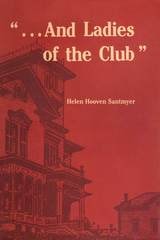
“. . . And the Ladies of the Club”
Helen Hooven Santmyer
The Ohio State University Press, 1980
This New York Times best seller by Helen Hooven Santmyer recounts the lives of a group of women who start a study club in a small town in southwestern Ohio in 1868. Over the years, the club evolves into an influential community service organization in the town. Numerous characters are introduced in the course of the novel but primary are Anne Gordon and Sally Rausch who, as the book begins, are new graduates of the Waynesboro Female Seminary. The novel covers decades of their lives—chronicling the two women’s marriages and those of their children and grandchildren. Santmyer focuses not just on the lives of the women in the club, but also their families and friends and the politics and developments in their small town and the larger world.
In this longest and most ambitious of Santmyer’s books, there is—as with all of her previous work—a poignant sense of a past made present again through an acute sensibility, of human life and experience as somehow cumulative, and of lives and events, largely fugitive and forgotten, as captured and transformed as the stuff of her poetry.
In this longest and most ambitious of Santmyer’s books, there is—as with all of her previous work—a poignant sense of a past made present again through an acute sensibility, of human life and experience as somehow cumulative, and of lives and events, largely fugitive and forgotten, as captured and transformed as the stuff of her poetry.
[more]
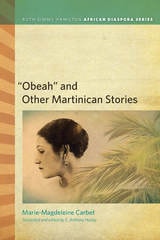
“Obeah” and Other Martinican Stories
Marie-Magdeleine Carbet
Michigan State University Press, 2017
This volume comprises French versions and English translations of seven short stories written by Marie-Magdeleine Carbet, Martinique’s most prolific woman writer. Four of these stories are previously unpublished, culled from documents obtained from Carbet’s niece. While analyses of the literature of the French Caribbean have tended to portray these people typically as suffering from pathologies of colonial oppression, the situations and reflections presented in these stories offer different perspectives on the lives and concerns of ordinary Martinicans and thus provide insight into some of the missing links of the sociocultural scene. This unique, multifaceted text fills an important pedagogical and scholarly need, and allows the reader to access the daily lives of French Caribbeans in a significantly authentic way.
[more]