Results by title
69 books match the query 'Homosexuality and literature' and 2 start with a non-letter
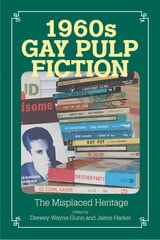
1960s Gay Pulp Fiction
The Misplaced HeritageDrewey Wayne Gunn
University of Massachusetts Press, 2013
As a result of a series of court cases, by the mid-1960s the U.S. post office could no longer interdict books that contained homosexuality. Gay writers were eager to take advantage of this new freedom, but the only houses poised to capitalize on the outpouring of manuscripts were “adult” paperback publishers who marketed their products with salacious covers. Gay critics, unlike their lesbian counterparts, have for the most part declined to take these works seriously, even though they cover an enormous range of genres: adventures, blue-collar and gray-flannel novels, coming-out stories, detective fiction, gothic novels, historical romances, military stories, political novels, prison fiction, romances, satires, sports stories, and spy thrillers—with far more short story collections than is generally realized. Twelve scholars have now banded together to begin a recovery of this largely forgotten explosion of gay writing that occurred in the 1960s.
Descriptions of these pulps have often been inadequate and misinforming, the result of misleading covers, unrepresentative sampling of texts, and a political blindness that refuses to grant worth to pre-Stonewall writing. This volume charts the broader implications of this state of affairs before examining some of the more significant pulp writers from the period. It brings together a diverse range of scholars, methodologies, and reading strategies. The evidence that these essays amass clearly demonstrates the significance of gay pulps for gay literary history, queer cultural studies, and book history.
¿Entiendes?
Queer Readings, Hispanic WritingsEmilie L. Bergmann and Paul Julian Smith, eds.
Duke University Press, 1995
Combining intimate knowledge of Spanish-speaking cultures with contemporary queer theory, these essays address texts that share both a common language and a concern with lesbian, gay, and bisexual identities. Using a variety of approaches, the contributors tease the homoerotic messages out of a wide range of works, from chronicles of colonization in the Caribbean to recent Puerto Rican writing, from the work of Cervantes to that of the most outrageous contemporary Latina performance artists. This volume offers a methodology for examining work by authors and artists whose sexuality is not so much open as "an open secret," respecting, for example, the biographical privacy of writers like Gabriela Mistral while responding to the voices that speak in their writing. Contributing to an archeology of queer discourses, ¿Entiendes? also includes important studies of terminology and encoded homosexuality in Argentine literature and Caribbean journalism of the late nineteenth century.
Whether considering homosexual panic in the stories of Borges, performances by Latino AIDS activists in Los Angeles, queer lives in turn-of-the-century Havana and Buenos Aires, or the mapping of homosexual geographies of 1930s New York in Lorca’s "Ode to Walt Whitman," ¿Entiendes? is certain to stir interest at the crossroads of sexual and national identities while proving to be an invaluable resource.