Results by title
468 books match the query 'Identity' and 3 start with a non-letter

"I'm Not Gonna Die in This Damn Place"
Manliness, Identity, and Survival of the Mexican American Vietnam Prisoners of WarJuan David Coronado
Michigan State University Press, 2018
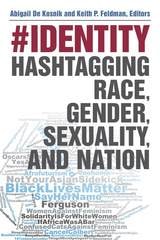
#identity
Hashtagging Race, Gender, Sexuality, and NationAbigail De Kosnik and Keith P. Feldman, editors
University of Michigan Press, 2019
#identity is among the first scholarly books to address the positive and negative effects of Twitter on our contemporary world. Hailing from diverse scholarly fields, all contributors are affiliated with The Color of New Media, a scholarly collective based at the University of California, Berkeley. The Color of New Media explores the intersections of new media studies, critical race theory, gender and women’s studies, and postcolonial studies. The essays in #identity consider topics such as the social justice movements organized through #BlackLivesMatter, #Ferguson, and #SayHerName; the controversies around #WhyIStayed and #CancelColbert; Twitter use in India and Africa; the integration of hashtags such as #nohomo and #onfleek that have become part of everyday online vernacular; and other ways in which Twitter has been used by, for, and against women, people of color, LGBTQ, and Global South communities. Collectively, the essays in this volume offer a critically interdisciplinary view of how and why social media has been at the heart of US and global political discourse for over a decade.
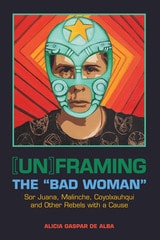
[Un]framing the "Bad Woman"
Sor Juana, Malinche, Coyolxauhqui, and Other Rebels with a CauseBy Alicia Gaspar de Alba
University of Texas Press, 2014
“What the women I write about have in common is that they are all rebels with a cause, and I see myself represented in their mirror,” asserts Alicia Gaspar de Alba. Looking back across a career in which she has written novels, poems, and scholarly works about Sor Juana Inés de la Cruz, la Malinche, Coyolxauhqui, the murdered women of Juárez, the Salem witches, and Chicana lesbian feminists, Gaspar de Alba realized that what links these historically and socially diverse figures is that they all fall into the category of “bad women,” as defined by their place, culture, and time, and all have been punished as well as remembered for rebelling against the “frames” imposed on them by capitalist patriarchal discourses.
In [Un]Framing the “Bad Woman,” Gaspar de Alba revisits and expands several of her published articles and presents three new essays to analyze how specific brown/female bodies have been framed by racial, social, cultural, sexual, national/regional, historical, and religious discourses of identity—as well as how Chicanas can be liberated from these frames. Employing interdisciplinary methodologies of activist scholarship that draw from art, literature, history, politics, popular culture, and feminist theory, she shows how the “bad women” who interest her are transgressive bodies that refuse to cooperate with patriarchal dictates about what constitutes a “good woman” and that queer/alter the male-centric and heteronormative history, politics, and consciousness of Chicano/Mexicano culture. By “unframing” these bad women and rewriting their stories within a revolutionary frame, Gaspar de Alba offers her compañeras and fellow luchadoras empowering models of struggle, resistance, and rebirth.