Results by title
517 books match the query 'In literature' and 5 start with a non-letter
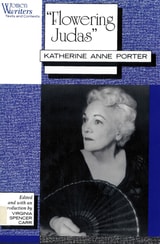
"Flowering Judas"
Katherine Anne PorterCarr, Virginia S
Rutgers University Press, 1993
Katherine Anne Porter often spoke of her story "Flowering Judas" as the tale she liked best of all her stories because it came the nearest to what she meant it to be. It is the story of Laura, an idealistic woman, who travels to Mexico from Arizona at the age of twenty-two to assist the Obreg-n Revolution.
This casebook on "Flowering Judas" addresses Porter's ambivalence surrounding her roles as woman and artist and also attests to the profound influence of Mexico upon her work. Readers of this early tale will not be surprised to learn that although Porter was a practicing feminist in her life and her work, she actually eschewed the feminist label.
Virginia Spencer Carr brings her own sharply focused biographer's eye to the introduction, further illuminating the story and the superb critical essays that it provokes. The casebook includes the authoritative text of the story itself, Porter's own statement regarding the genesis of this highly acclaimed work, an important interview, a collection of significant essays on "Flowering Judas" and the historical, cultural, and personal milieu from which the tale evolved, a bibliography, and a chronology of Porter's life and work.
"Songes of Rechelesnesse"
Langland and the FranciscansLawrence M. Clopper
University of Michigan Press, 1997
In the late Middle Ages, Franciscan friars had a significant impact on all levels of society.
But because of the apparent discrepancy between the poverty the Franciscans claimed and the life they lived, a large body of antifraternal literature arose, including, supposedly, Piers Plowman. Since the sixteenth century, when it was first put into print, Piers Plowman has been understood to be a proto-Protestant work that revealed the failures of the medieval clergy, but especially of the mendicant orders. In "Songes of Rechelesnesse," Clopper establishes the presence of a Franciscan reformist position in Piers Plowman.
Clopper maintains that the poem articulates a reformist agenda, presenting the internal Franciscan debate, in a bid to return the order to its initial foundation. Clopper believes that Langland is deeply imbued with a Franciscan mentality that reaches deep into the structure of the poem. It manifests itself at the level of the alliterative long line in his exemplarist poetics and is the source of his imagery and politics. In short Clopper identifies Franciscanism as holding the poem together.
"Songes of Rechelesnesse" is a historical, political, and religious history of late fourteenth-century England. It will be of interest to literary scholars, historians of the late Middle Ages, and scholars in religious studies.
Lawrence M. Clopper is Director, Medieval Studies Institute, and Professor of English, Indiana University.
"The Disenthralled Hosts of Freedom"
Party Prophecy in the Antebellum Editions of Leaves of GrassDavid Grant
University of Iowa Press, 2021
Anti-slavery party discourse set itself the task of curing an ailing people who had grown compliant, inert, and numb; it fashioned a complete fictional world where the people could be reactivated into assuming their true role in the republic. Both as a cause and a result of this rejuvenation, they would come into their own and spread their energies over the land and over the body politic, thereby rescuing their country at the last minute from what would otherwise be the permanent dominion of slavery. Party discourse had long hinged its success on such magical transformations of the people individually and collectively, and Whitman’s celebrations of his nation’s potential need to be seen in this context: like his party, Whitman calls on the people to reject their own subordination and take command of the future, and redeem themselves as they also redeem the nation.
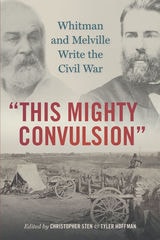
"This Mighty Convulsion"
Whitman and Melville Write the Civil WarChristopher Sten and Tyler Hoffman
University of Iowa Press, 2019
This is the first book exclusively devoted to the Civil War writings of Walt Whitman and Herman Melville, arguably the most important poets of the war. The essays brought together in this volume add significantly to recent critical appreciation of the skill and sophistication of these poets; growing recognition of the complexity of their views of the war; and heightened appreciation for the anxieties they harbored about its aftermath. Both in the ways they come together and seem mutually influenced, and in the ways they disagree, Whitman and Melville grapple with the casualties, complications, and anxieties of the war while highlighting its irresolution. This collection makes clear that rather than simply and straightforwardly memorializing the events of the war, the poetry of Whitman and Melville weighs carefully all sorts of vexing questions and considerations, even as it engages a cultural politics that is never pat.
Contributors: Kyle Barton, Peter Bellis, Adam Bradford, Jonathan A. Cook, Ian Faith, Ed Folsom, Timothy Marr, Cody Marrs, Christopher Ohge, Vanessa Steinroetter, Sarah L. Thwaites, Brian Yothers
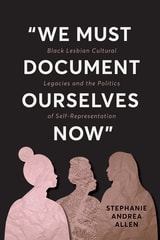
“We Must Document Ourselves Now”
Black Lesbian Cultural Legacies and the Politics of Self-RepresentationStephanie Andrea Allen
The Ohio State University Press, 2026
A long-overdue analysis of how Black lesbians have asserted their lived experience through creative practice, pushing back against heteropatriarchal systems that deny them visibility.
“We Must Document Ourselves Now” examines the essential but oft-ignored importance of Black lesbian literature and film in queer literary and film histories, arguing that Black lesbian cultural texts reflect creators’ lived experiences and resist the heteropatriarchal systems that deny Black lesbians visibility in popular culture. Stephanie Andrea Allen contends that these texts have three goals: to lay bare the experiences of Black lesbians in a raced, gendered, classed, and homophobic society; to challenge the notion that claiming Black lesbian identity is marginal or forbidden; and to take care of Black lesbians by bearing witness to their experiences through creative practice.
Insisting that Black feminist creative practice is an integral form of self and community care, Allen weaves analysis of cultural output spanning key sociocultural moments from 1974 to 2020 with interviews with Black lesbian cultural workers. “We Must Document Ourselves Now” examines the Black Arts / Black Power movement, the “boom” in lesbian and gay publishing, the so-called golden era of Black film, and twenty-first-century visual media to demonstrate how representations of Black lesbians, or lack thereof, were vital to constructing a cultural canon that focused on illuminating Black lesbian experiences in the United States.