Results by title
328 books match the query 'Islam' and 2 start with a non-letter
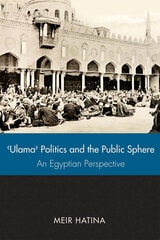
' Ulama', Politics, and the Public Sphere
An Egyptian PerspectiveMeir Hatina
University of Utah Press, 2010
The status of the Sunni Ulama (religious scholars) in modern times has attracted renewed academic interest, in light of their assertiveness regarding moral and sociopolitical issues on the Arab-Muslim agenda. This has led to a reassessment of the narrative of historians and social scientists, who usually depicted the Ulama as marginal players in comparison with the new lay Islamists, and certainly with the Shia Ulama. The Sunni 'Ulama'’s vitality is undoubtedly related to the continuing Islamic resurgence, which since the 1970s has forced the political elites to rely increasingly on the religious establishment in order to neutralize the Islamist challenge, thus allowing the Ulama greater freedom of activity.
Hatina’s study returns to an earlier period and shows that such vitality has its roots in the second half of the nineteenth and the early twentieth centuries. Hatina traces the diverse Ulama reactions to this period of accelerated state building and national cohesion.

7/7
The London Bombings, Islam and the Iraq WarMilan Rai
Pluto Press, 2006
This is the book Tony Blair doesn't want you to read about 7/7.
In February 2003, Tony Blair was warned by British intelligence that the invasion of Iraq would 'heighten' the risk of terrorism in Britain.
In July 2005, al-Qaeda struck in the heart of London. Despite the British Government's increasingly desperate attempts at denial, polls show that an overwhelming majority of people in Britain are convinced that there is a connection between the London bombings and the war on Iraq. A majority of Britons fault Tony Blair himself.
Using secret government documents declassified since the bombings, and leaks from British intelligence, Milan Rai exposes official deceit at the highest levels, and establishes the crucial role of British foreign policy in generating a home-grown version of al-Qaeda. Rai shows how an official report drawn up by the Home Office and Foreign Office in early 2004 identified 'foreign policy' - and the war in Iraq in particular - as a major cause of alienation among young British Muslims.
Examining the backgrounds of the 7/7 bombers, Milan Rai demonstrates that Islam is not to blame. Most importantly, the book shows us how to make sure that this never happens again -- and offers brief obituaries for the 52 people who lost their lives that day.