Results by title
460 books match the query 'Law and legislation' and 2 start with a non-letter
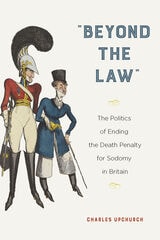
"Beyond the Law"
The Politics of Ending the Death Penalty for Sodomy in BritainCharles Upchurch
Temple University Press, 2021
In nineteenth-century England, sodomy was punishable by death; even an accusation could damage a man’s reputation for life. The last executions for this private, consensual act were in 1835, but the effort to change the law that allowed for those executions was intense and precarious, and not successful until 1861. In this groundbreaking book, “Beyond the Law,” noted historian Charles Upchurch pieces together fragments from history and uses a queer history methodology to recount the untold story of the political process through which the law allowing for the death penalty for sodomy was almost ended in 1841.
Upchurch recounts the legal and political efforts of reformers like Jeremy Bentham and Lord John Russell—the latter of whom argued that the death penalty for sodomy was “beyond the law and above the law.” He also reveals that a same-sex relationship linked the families of the two men responsible for co-sponsoring the key legislation. By recovering the various ethical, religious, and humanitarian arguments against punishing sodomy, “Beyond the Law” overturns longstanding assumptions of nineteenth-century British history. Upchurch demonstrates that social change came from an amalgam of reformist momentum, family affection, elitist politics, class privilege, enlightenment philosophy, and personal desires.
"Mr. Taxpayer versus Mr. Tax Spender"
Taxpayers' Associations, Pocketbook Politics, and the Law during the Great DepressionLinda Upham-Bornstein
Temple University Press, 2023
“Mr. Taxpayer versus Mr. Tax Spender” presents a comprehensive overview of these grassroots taxpayers’ leagues beginning in the 1860s and shows how they evolved during their heyday in the 1930s. Linda Upham-Bornstein chronicles the ways these taxpayers associations organized as well as the tools they used—constructive economy, political efforts, tax strikes, and tax revolt through litigation—to achieve their objectives.
Taxpayer activity was a direct consequence of—and a response to—the economic crisis of the Great Depression and the expansion of the size and scope of government. “Mr. Taxpayer versus Mr. Tax Spender” connects collective tax resistance in the 1930s to the populist tradition in American politics and to other broad impulses in American political and legal history.