Results by title
71 books match the query 'Mexicans' and 2 start with a non-letter
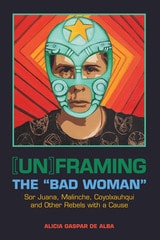
[Un]framing the "Bad Woman"
Sor Juana, Malinche, Coyolxauhqui, and Other Rebels with a CauseBy Alicia Gaspar de Alba
University of Texas Press, 2014
“What the women I write about have in common is that they are all rebels with a cause, and I see myself represented in their mirror,” asserts Alicia Gaspar de Alba. Looking back across a career in which she has written novels, poems, and scholarly works about Sor Juana Inés de la Cruz, la Malinche, Coyolxauhqui, the murdered women of Juárez, the Salem witches, and Chicana lesbian feminists, Gaspar de Alba realized that what links these historically and socially diverse figures is that they all fall into the category of “bad women,” as defined by their place, culture, and time, and all have been punished as well as remembered for rebelling against the “frames” imposed on them by capitalist patriarchal discourses.
In [Un]Framing the “Bad Woman,” Gaspar de Alba revisits and expands several of her published articles and presents three new essays to analyze how specific brown/female bodies have been framed by racial, social, cultural, sexual, national/regional, historical, and religious discourses of identity—as well as how Chicanas can be liberated from these frames. Employing interdisciplinary methodologies of activist scholarship that draw from art, literature, history, politics, popular culture, and feminist theory, she shows how the “bad women” who interest her are transgressive bodies that refuse to cooperate with patriarchal dictates about what constitutes a “good woman” and that queer/alter the male-centric and heteronormative history, politics, and consciousness of Chicano/Mexicano culture. By “unframing” these bad women and rewriting their stories within a revolutionary frame, Gaspar de Alba offers her compañeras and fellow luchadoras empowering models of struggle, resistance, and rebirth.
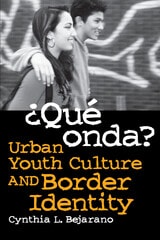
¿Qué Onda?
Urban Youth Culture and Border IdentityCynthia L. Bejarano
University of Arizona Press, 2005
For Latina/o adolescents who already find life challenging, the borderland is a place that presents continual affirmations of and contradictions about identity—questions of who is more Mexican than American or vice versa. This book analyzes the construction of Mexicana/o and Chicana/o identities through a four-year ethnographic study in a representative American high school. It reveals how identity politics impacts young people’s forms of communication and the cultural spaces they occupy in the school setting. By showing how identities are created and directly influenced by the complexities of geopolitics and sociocultural influences, it stresses the largely unexplored divisions among youths whose identities are located along a wide continuum of “Mexicanness.”
Through in-depth interviews and focus groups with both Mexicana/o and Chicana/o students, Cynthia Bejarano explores such topics as the creation of distinct styles that reinforce differences between the two groups; the use of language to further distinguish themselves from one another; and social stratification perpetuated by internal colonialism and the “Othering” process. These and other issues are shown to complicate how Latinas/os ethnically identify as Mexicanas/os or Chicanas/os and help explain how they get to this point.
In contrast to research that views identity as a reflection of immigration or educational experiences, this study embraces border theory to frame the complex and conflicted relations of adolescents as a result of their identity-making processes. This intimate glimpse into their lives provides valuable information about the diversity among youths and their constant efforts to create, define, and shape their identities according to cultural and social structures.